Sometimes, an ordinary evening can produce a moment that feels anything but ordinary.
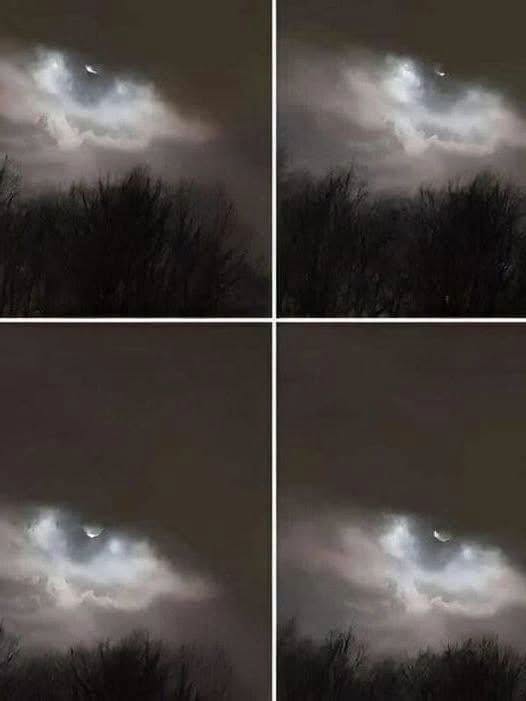
During a quiet walk near the sea, Alfredo Lo Grossa noticed an unusual shape appearing along the distant horizon. The evening light, clouds, and open water had combined in a way that created a striking visual effect. What caught his attention most was the fact that the glowing formation seemed to resemble a human figure.
Lo Grossa quickly took a photograph before the scene changed.
What began as a simple photograph of an evening sky soon attracted considerable attention online. People who viewed the image offered very different interpretations. Some saw a peaceful human-like silhouette, while others believed the unusual appearance could be explained by clouds, reflections, atmospheric conditions, or the angle of the fading sunlight.
The photograph became interesting not because it provided a definite answer, but because it encouraged people to look at a familiar part of nature in a different way.
A Surprising Moment During an Evening Walk
According to the story surrounding the photograph, Lo Grossa was walking more than twenty kilometers from his home when he noticed the unusual formation.
There was nothing particularly unusual about the walk itself. The surroundings were calm, the sea stretched toward the horizon, and the remaining daylight created soft colors across the sky.
Then, for a brief period, the light appeared to form a shape that stood out from the surrounding landscape.
From a distance, the silhouette could be interpreted as resembling a person. The effect was subtle enough that different viewers could see different things depending on how they looked at the photograph.
Lo Grossa captured the scene before the light changed and the shape disappeared.
That simple decision turned an ordinary walk into a memorable photographic moment.
Why the Image Attracted So Much Attention
When the photograph was shared online, viewers immediately began discussing what they believed they were seeing.
Some people described the shape as peaceful and almost human. Others interpreted it symbolically, seeing the image as a reminder to slow down and appreciate moments of beauty in everyday life.
There were also viewers who approached the photograph from a more scientific perspective.
They suggested that the unusual shape could have resulted from a combination of clouds, sunlight, atmospheric conditions, and perspective. Because the photograph was taken near the horizon during the evening, changing light could have played an important role in producing the glowing appearance.
Both interpretations demonstrate why unusual photographs can become so engaging.
One person may see an extraordinary image, while another sees a perfectly natural combination of light and clouds.
Neither reaction changes the fact that the moment was visually striking.
The Human Tendency to See Familiar Shapes
There is a well-known psychological phenomenon that can help explain why people sometimes recognize faces, animals, or human figures in random patterns.
It is called pareidolia.
Pareidolia occurs when the brain interprets an unclear or random visual pattern as something familiar. This is why people sometimes notice faces in clouds, figures in rock formations, or familiar shapes in shadows.
The brain is constantly processing visual information and searching for patterns. Recognizing familiar forms quickly can be useful in everyday life, particularly when identifying people and objects.
As a result, when viewers see an unusual combination of light and clouds, their brains may naturally organize those shapes into something recognizable.
This does not mean the experience is imaginary. The visual pattern is real; the interpretation of that pattern is what can differ from person to person.
Could the Shape Have a Natural Explanation?
There is no reliable evidence from the photograph alone to conclude that the luminous figure represents anything supernatural.
A natural explanation is entirely possible.
Cloud formations can take on remarkable shapes, especially when sunlight reaches them from a low angle. During sunrise and sunset, sunlight travels through more of the atmosphere, producing softer and warmer illumination.
If clouds are positioned at the right height and angle, their edges can become brightly illuminated while other areas remain darker. From a particular viewpoint, this can create silhouettes that resemble familiar objects or figures.
Reflections and atmospheric haze may also influence how distant objects appear.
Photography adds another layer to the effect. Camera exposure, contrast, lens characteristics, and the position of the light source can all affect the final appearance of an image.
Without additional photographs, measurements, or information about the precise atmospheric conditions at the time, it would be difficult to determine exactly how the formation appeared.
Why People Find These Moments Meaningful
Even when there is a straightforward scientific explanation for an unusual scene, that does not necessarily make the experience less meaningful.
People have always attached personal meaning to natural events.
A colorful sunset can remind someone of a special memory. A particular cloud formation can bring back childhood experiences. A clear night sky can inspire thoughts about the size and beauty of the world around us.
In this sense, the value of Lo Grossa’s photograph does not depend on whether the shape has a mysterious origin.
Its appeal comes from the reaction it creates.
For some viewers, the image may simply be a beautiful example of unusual natural lighting. For others, it may become a quiet reminder to pause, breathe, and pay closer attention to the world around them.
The Beauty of an Unplanned Photograph
Many memorable photographs are not carefully planned.
A photographer can spend hours preparing for a particular shot, but sometimes the most interesting image appears unexpectedly.
That seems to be part of what makes this photograph appealing.
Lo Grossa was not necessarily searching for anything unusual. He was simply walking and observing his surroundings. When the light produced the distinctive shape, he recognized that the moment was worth capturing.
The window of opportunity may have been brief.
Clouds move, sunlight changes, and reflections shift constantly. A scene that looks remarkable for a few seconds can look completely different moments later.
Photography allows these temporary moments to be preserved and shared.
The Role of the Sea and Evening Light
The setting also contributes to the atmosphere of the photograph.
Open water provides a wide, unobstructed view of the horizon. During the evening, the changing position of the sun can create dramatic differences between illuminated and shaded areas.
Clouds near the horizon can become especially noticeable when their edges catch the remaining sunlight.
The combination of water, sky, distance, and fading daylight can therefore create scenes that look almost unreal, even when every part of the image has a natural explanation.
This is one reason coastal landscapes are so popular with photographers.
The horizon provides a simple composition, while changing light continuously transforms the scene.
Different Viewers, Different Interpretations
One of the most interesting aspects of the photograph is how differently people perceive it.
Some viewers immediately notice a human-like outline.
Others see clouds.
Another person might focus on the light itself rather than the shape.
This difference is completely normal.
Our visual interpretation is influenced by personal experiences, expectations, attention, and context. If someone is told that a photograph contains a human figure, they may be more likely to notice a figure themselves.
The same principle can be seen in everyday life.
One person may look at a cloud and see an animal, while another sees a mountain or simply a cloud.
There is no requirement for everyone to see the same thing.
A Reminder to Look Up
Modern life often keeps people’s attention focused on phones, computers, schedules, and daily responsibilities.
Unexpected moments in nature can provide an opportunity to step away from that routine.
Looking at the sky for a few minutes costs nothing. It can reveal changing colors, moving clouds, distant stars, birds, aircraft, or simply the quiet transition between day and night.
The photograph captured by Alfredo Lo Grossa is a reminder of how much visual detail can be missed when people move through their surroundings without stopping to observe them.
Sometimes, the most interesting moments are already there.
They simply require attention.
What Science Says About Unusual Shapes
Pareidolia is a normal feature of human perception. It is not limited to photographs or clouds.
People can experience it when looking at shadows, tree branches, buildings, rock formations, or even everyday objects.
The brain is highly effective at identifying patterns. Faces, in particular, receive a great deal of attention because humans are naturally sensitive to facial features.
This is why two dark areas and a curved line can sometimes look like a face even when they are simply parts of an unrelated object.
The same principle can apply to larger formations in the sky.
A combination of bright and dark areas may accidentally create the visual characteristics associated with a person, animal, or other familiar object.
Understanding pareidolia can make unusual photographs even more fascinating because it reveals something about how human vision works.
Does the Photograph Prove Something Supernatural?
The photograph itself does not provide sufficient evidence to make such a conclusion.
A striking appearance is not the same as proof of an extraordinary event.
Without independent evidence, it is more reasonable to consider natural possibilities such as cloud formations, sunlight, reflections, perspective, and atmospheric conditions.
At the same time, viewers are free to appreciate the photograph on a personal level.
A person can enjoy the mystery of an unusual image while still recognizing that there may be an ordinary explanation.
Curiosity and skepticism can exist together.
Why We Enjoy Mysterious Images
People are naturally attracted to things that make them stop and think.
An unusual photograph creates a small puzzle. The viewer looks at it, forms an initial impression, and then tries to understand what produced the effect.
That process can be entertaining.
It also explains why unusual photographs often generate conversations online. Each person brings a different perspective, and the discussion becomes part of the experience.
In the case of Lo Grossa’s photograph, the central question is not necessarily whether everyone agrees about what the shape represents.
The more interesting question may be why the same image can produce such different interpretations.
A Quiet Moment Worth Remembering
The story of Alfredo Lo Grossa’s photograph ultimately highlights something simple.
Nature does not always need to produce something extraordinary to capture our attention.
A sunset, a cloud, a reflection, or a changing horizon can be enough.
The unusual luminous shape may have been created by completely natural conditions. It may have looked different from another angle or disappeared moments later. Yet the fact that it was photographed means that a temporary visual effect became something others could experience and interpret.
That is one of the pleasures of photography.
A camera can preserve a moment that would otherwise disappear.
What Do You See?
When looking at an unusual image like this, there is no need to immediately choose between mystery and science.
It can be interesting to consider both.
The scientific explanation may involve clouds, light, perspective, and the way the brain recognizes patterns. The personal interpretation may involve feelings, memories, or simply appreciation for the beauty of the scene.
Both can make the photograph worth discussing.
The next time you are outside during sunset or early evening, take a moment to look toward the horizon.
Watch how quickly the colors change.
Notice how clouds transform as the sunlight fades.
And pay attention to the shapes that appear for only a few moments.
You may not discover anything mysterious, but you may notice something beautiful that would otherwise have gone unnoticed.
Sometimes, an ordinary evening is enough to remind us to slow down and simply look.
Final Thoughts
Alfredo Lo Grossa’s photograph is an intriguing example of how light, landscape, and human perception can come together to create an unforgettable image.
Whether viewers see a human-like figure, a cloud formation, an effect of sunlight, or simply an interesting pattern is largely a matter of interpretation.
There is no strong evidence that the image represents anything supernatural. Natural explanations involving atmospheric conditions and pareidolia remain plausible.
But perhaps the most valuable part of the story is simpler than that.
The photograph encourages people to pause and appreciate a brief moment in nature.
In a world filled with constant notifications and distractions, sometimes looking up at the sky for a few quiet minutes can be enough to make an ordinary evening feel special.