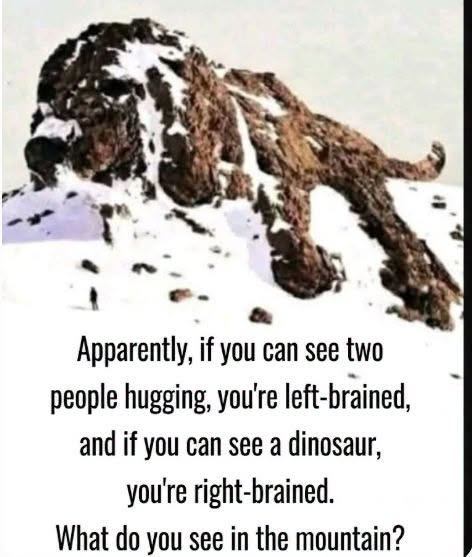
At first glance, this snowy landscape may look like an ordinary winter scene. Some people see what appears to be a mountain range, while others may notice shapes that resemble two people embracing or even a prehistoric creature.
But there is another image hiding in plain sight.
Look closely, and you may discover the outline of a giant sleeping dog stretched across the snow.
The dog’s face appears toward the left side of the picture, while its enormous body extends across the snowy landscape. Because the animal blends so naturally into its surroundings, your brain may initially interpret the image as something completely different.
That is what makes this visual brain teaser so interesting.
What Do You See First?
Visual puzzles like this are designed to encourage your eyes and brain to search for familiar shapes.
When you first look at the image, you may immediately try to identify a particular object. If someone tells you that the picture contains either a dinosaur or a pair of people, for example, your attention may automatically begin looking for clues that match those descriptions.
This can make it surprisingly difficult to notice another shape that is already visible.
In this case, the giant dog is camouflaged by the snowy environment. Its body does not have a strong, obvious outline, so parts of the animal can easily be mistaken for hills, shadows, or distant terrain.
Where Is the Giant Dog?
The easiest way to recognize the hidden image is to start with the dog’s face.
Look toward the left side of the snowy landscape and pay attention to the darker shapes. Once you notice what appears to be the dog’s nose and eye, the rest of the image becomes much easier to understand.
The ears help define the head, while the paws, body, and tail gradually connect the shape together.
What initially looked like a collection of unrelated shapes begins to resemble one enormous animal peacefully resting in the snow.
This is a common feature of visual illusions: once your brain recognizes the intended shape, it can become difficult to see the image the way you saw it before.
Why Is the Image So Difficult to Read?
Our brains are constantly trying to make sense of visual information.
When we look at a complicated picture, we don’t consciously analyze every individual detail. Instead, the brain quickly organizes shapes, shadows, colors, and patterns into something familiar.
That usually makes everyday life easier, but it can also make optical illusions possible.
The snowy background in this puzzle is particularly effective because the dog’s body blends into the surrounding landscape. Instead of seeing one clearly defined animal, your eyes may separate the picture into smaller sections.
One part may look like a hill.
Another may resemble a patch of snow.
A darker area may appear to be a shadow.
Only when these individual elements are mentally connected does the larger picture become obvious.
The Power of Expectations
Another reason people can miss the dog is that expectations influence what we notice.
Imagine someone tells you to find a dinosaur in the image. Your brain will naturally begin searching for a shape that resembles a dinosaur.
If you’re told to look for two people hugging, you may instead search for human-like outlines.
Neither interpretation necessarily changes the picture itself. The image remains exactly the same. What changes is the way your attention is directed.
This is one reason visual puzzles can produce very different reactions from different people.
One person may spot the dog immediately, while another may stare at the same image for several minutes without noticing it.
Once You See It, You Can’t Unsee It
The most entertaining part of this puzzle is what happens after the hidden dog is revealed.
Before recognizing it, the image may seem confusing or even meaningless. After recognizing the face, however, the rest of the animal starts to make sense.
The nose becomes easier to identify.
The ears become more noticeable.
The body appears to stretch across the snowy landscape.
The paws and tail become easier to connect with the rest of the shape.
Suddenly, the same picture looks completely different.
Of course, nothing in the image has actually moved or changed. Your interpretation has changed.
A Simple Test for Your Friends
Want to see how other people react?
Show them the image without explaining what is hidden inside it. Ask them what they see first.
Give them a few seconds to study the picture, then ask whether they can find the giant sleeping dog.
You may get very different answers.
Some people will recognize the animal almost immediately. Others may focus on the misleading shapes and need a hint before the dog’s outline becomes clear.
For an even more interesting challenge, ask someone to describe exactly what they noticed before you reveal the answer.
Their first interpretation can be just as interesting as the puzzle itself.
Why Visual Illusions Are So Entertaining
Optical illusions remind us that seeing something and understanding what we see are not always the same thing.
Our eyes collect visual information, but our brains interpret that information using patterns, previous experiences, expectations, and context.
That’s why an image can appear to show one thing at first and something completely different a moment later.
The giant dog hidden in this snowy landscape is a good example. The picture doesn’t need to change for your perception to change.
All it takes is a different way of connecting the shapes.
Did You Spot the Dog?
So, what did you see when you first looked at the snowy landscape?
Did you notice the giant sleeping dog right away, or did you initially see something else?
If the dog was difficult to find, don’t worry. That’s part of the challenge. Visual puzzles are often designed specifically to make the obvious seem hidden.
Once you recognize the dog’s face and understand how its body blends into the snow, the illusion becomes much easier to see.
And that is exactly what makes this kind of brain teaser so satisfying: the answer was there the entire time—you simply had to look at the picture differently.