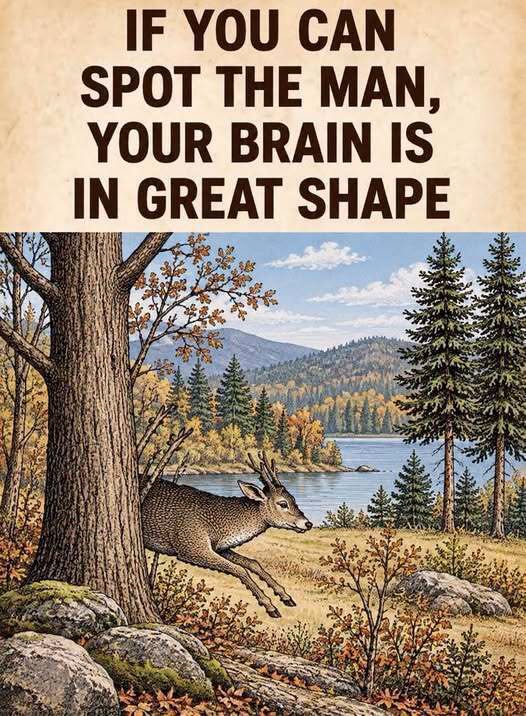
At first glance, this winter scene appears to be a peaceful picture of a snowy forest. Tall trees surround the landscape, patches of snow cover the ground, and a deer stands quietly among the trees.
Everything seems easy to identify.
But there is more to the picture than what immediately catches your attention.
Somewhere within the arrangement of trees, branches, shadows, and snowy areas is a hidden figure. It does not stand out in the way a normal object would. Instead, it blends into the landscape so naturally that many viewers can look directly at it without recognizing what they are seeing.
That is what makes this type of hidden-image puzzle so fascinating.
The challenge is not necessarily that the figure is extremely small or completely concealed. The real challenge is that your brain has already decided what the picture represents.
Once your mind recognizes a winter forest and a deer, it tends to organize the remaining details around that interpretation.
And that can make the hidden image surprisingly difficult to notice.
Why Hidden Images Can Be So Difficult to Spot
When people look at a picture, the brain does not analyze every individual shape separately.
Instead, it quickly tries to make sense of the overall scene. Familiar objects are especially easy to recognize because the brain has learned their typical shapes and patterns.
A tree looks like a tree.
Snow looks like snow.
A deer has a recognizable body, head, and legs.
Once these elements are identified, your attention naturally moves toward the most obvious parts of the image rather than continuously questioning what else they might represent.
This is exactly what makes hidden-image puzzles work.
The creator can use ordinary objects to form another image without making the individual components look unusual. The viewer sees each element for what it appears to be, rather than considering how several elements might work together.
In this winter scene, the surrounding landscape provides plenty of visual information. There are different shades, lines, branches, spaces, and natural shapes competing for your attention.
The hidden figure takes advantage of all of them.
The Deer May Be the Biggest Distraction
One of the strongest distractions in the scene is the deer.
Because the deer is a familiar and recognizable subject, your eyes are naturally drawn toward it. Its body has a clear shape, and its position within the snowy landscape gives the picture an obvious focal point.
Once you identify the deer, your brain may assume that you have already understood the main idea of the image.
That assumption makes the hidden figure easier to overlook.
You may examine the deer itself, the snow around it, or the trees behind it without realizing that the surrounding shapes can also be interpreted in another way.
This is a common feature of visual puzzles. The obvious subject can actually make the less obvious subject harder to find.
The more confident you become about what you are looking at, the less likely you may be to question that first interpretation.
Try Looking at Shapes Instead of Objects
If you are still trying to find the hidden figure, there is a simple change you can make to your approach.
Instead of asking, “What objects are in this picture?” try asking, “What shapes do I see?”
This small change can make a surprising difference.
Look at the dark and light areas of the image. Examine the spaces between the trees. Pay attention to branches, trunks, shadows, and irregular patches of snow.
A section that looks like nothing more than part of a tree may contribute to the outline of the hidden figure.
A shadow could resemble part of an eye or another feature.
A branch might create a line that only makes sense when viewed together with another nearby shape.
The important thing is that the hidden figure is not necessarily represented by one single object.
It can emerge from the relationship between several objects.
The Importance of Perspective
Another reason these puzzles are challenging is perspective.
When you first look at the scene, you see it from the perspective that the image encourages you to use. The deer occupies one recognizable role, the trees create the background, and the snow establishes the setting.
But hidden-image puzzles often require you to mentally step away from that first perspective.
Imagine temporarily ignoring the meaning of the objects.
Instead of seeing a tree trunk, see a vertical dark shape.
Instead of seeing a branch, see a curved line.
Instead of seeing snow, see a light-colored area surrounding darker shapes.
When enough of these shapes are considered together, a completely different interpretation can begin to appear.
This is why a hidden image can sometimes seem impossible to find for several minutes and then suddenly become obvious.
Your Brain Can Change Its Interpretation
One of the most interesting things about optical illusions is how quickly perception can change.
At one moment, you may see nothing unusual in the picture.
Then you notice one small detail.
That detail changes the way you interpret the surrounding shapes, and suddenly the hidden figure becomes much easier to recognize.
The image itself has not changed.
The trees have not moved.
The snow has not disappeared.
The deer remains in exactly the same position.
What changes is the way your brain connects the information.
Before noticing the hidden figure, individual shapes may seem unrelated. After noticing it, those same shapes can suddenly appear to fit together.
This is sometimes the most satisfying part of solving a visual puzzle.
Look Beyond the Most Obvious Subject
When searching for the hidden figure, try not to spend too much time staring directly at the deer.
Instead, gradually move your attention toward the surrounding landscape.
Examine the trees on different sides of the image. Look at the darker areas and compare them with the lighter patches. Pay attention to unusual combinations of lines and curves.
You can also slightly change the distance from which you view the picture.
Sometimes a hidden shape is easier to recognize when you look at the image from farther away. At a closer distance, individual details can become distracting, while stepping back allows the larger composition to become more apparent.
Another useful approach is to relax your focus rather than concentrating intensely on one tiny area.
The hidden figure may become easier to recognize when you allow your eyes to take in the entire scene.
Why Familiar Patterns Matter
The human brain is very good at recognizing patterns.
That ability is useful in everyday life because it allows us to identify objects quickly without consciously analyzing every detail.
For example, you do not normally need to study every line of a tree before recognizing it as a tree. A few familiar characteristics are enough.
Hidden-image puzzles use this same ability in an unexpected way.
The viewer recognizes the familiar objects correctly, but that correct recognition can prevent a second interpretation from appearing.
The puzzle essentially asks your brain to do something it does not normally need to do: reconsider information that has already been classified.
That is why the solution can feel so obvious after you see it.
The Hidden Figure Is Built Into the Composition
The cleverness of the scene comes from the way the hidden figure blends with its surroundings.
It does not need to be drawn in a completely separate color or placed in an empty part of the picture.
Instead, different portions of the landscape can contribute to its appearance.
Tree trunks may create boundaries.
Branches may provide lines.
Shadows may add darker details.
Snow can separate one shape from another.
When these elements are viewed together, they can suggest a recognizable form.
Viewed individually, however, they simply look like natural parts of a winter forest.
That difference between the individual pieces and the complete composition is what makes the puzzle work.
Have You Found It Yet?
If you are looking at the scene and still cannot identify the hidden figure, do not assume that you have missed something obvious.
These puzzles are designed to take advantage of the way people naturally process visual information.
Try giving yourself a short break and then looking at the image again.
This time, begin with the entire composition rather than the deer.
Look for large outlines rather than tiny details.
Compare the darker areas with the lighter ones.
Follow the lines created by the trees and branches.
Then ask yourself whether several apparently unrelated shapes could form something recognizable when viewed together.
You may find that the answer becomes clearer after you stop trying to force yourself to find a traditional face or object.
The Moment the Illusion Finally Makes Sense
There is a particular moment that makes hidden-image puzzles so enjoyable.
At first, the picture appears completely ordinary.
You search.
You move your attention from one section to another.
You may even convince yourself that there is nothing hidden at all.
Then, suddenly, a shape begins to make sense.
Once you see it, the rest of the image seems to reorganize itself.
The same tree branches that looked random a moment earlier now appear to have a purpose. A shadow that seemed insignificant suddenly looks like an important part of the hidden outline.
Nothing in the picture has changed.
Only your interpretation has changed.
That is the central idea behind many optical illusions and hidden-image puzzles.
Why You May Not Be Able to Unsee It
One of the most interesting effects of solving a hidden-image puzzle is that the discovered figure can become difficult to ignore afterward.
Before finding it, your brain treats the surrounding details as separate pieces of scenery.
After finding it, those pieces become connected.
This creates a kind of visual switch between two interpretations of the same image.
You can still see the winter forest and the deer, but now you are also aware of the hidden figure within the composition.
That is what makes a successful illusion memorable.
It does not simply hide something from you. It encourages you to see the same information in two different ways.
A Simple Test for Your Eyes
Take another look at the image and try this approach:
First, identify the obvious objects without spending too much time on them.
Next, ignore their meanings and focus only on their outlines, colors, shadows, and positions.
Then examine the spaces between the objects.
Finally, step back and look at the entire composition as though you were seeing it for the first time.
The goal is not to stare harder.
It is to look differently.
Sometimes changing your approach is enough to reveal a shape that was visible from the beginning.
The Real Trick Behind the Puzzle
The hidden figure is not necessarily concealed through complicated editing or an impossible visual trick.
Its effectiveness comes from something much simpler: the landscape gives your brain a convincing explanation for what you are seeing.
You see a tree and accept it as a tree.
You see a deer and accept it as a deer.
You see snow and understand it as part of the winter setting.
Because all of those interpretations make sense, there is little reason for your brain to search for another one.
The puzzle succeeds by using familiar objects to create an unfamiliar pattern.
That is why the solution can feel surprising even though the relevant shapes were visible all along.
A Different Way to Look at Ordinary Pictures
Hidden-image puzzles can also be a reminder that photographs and illustrations contain more information than we notice during a quick glance.
We often focus on the obvious subject of an image and overlook the relationships between smaller details.
In a busy landscape, this effect can be even stronger.
There may be dozens of shapes contributing to the overall composition, but only a few immediately attract attention.
Once you start looking for secondary patterns, you may notice details that would normally be ignored.
That does not mean every unusual shape contains a hidden message. It simply shows how strongly context influences visual interpretation.
Did You Spot the Hidden Figure?
So, can you find the figure blending into this winter scene?
If you noticed it quickly, you probably recognized the unusual arrangement of shapes before the deer completely captured your attention.
If you needed more time, that is part of what makes the puzzle interesting.
The hidden figure is designed to blend naturally with the forest, using familiar elements to create a second visual interpretation.
The next time you look at the image, try focusing less on what each individual object represents and more on how the shapes work together.
You may discover that the scene contains much more than what first meets the eye.
And once the hidden figure finally becomes visible, you may wonder how you managed to miss it in the first place.