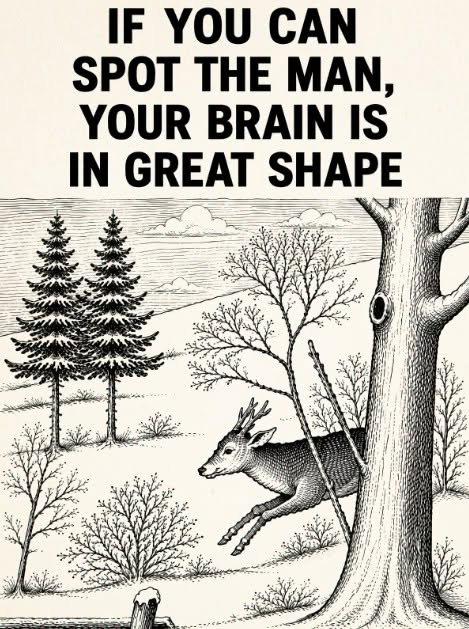
At first glance, this winter scene looks like a peaceful picture of a snowy forest. Tall trees rise through the background, branches stretch in different directions, and a deer stands out against the pale landscape.
It seems like there is nothing particularly difficult to understand.
But there is another image hidden within the scene.
Somewhere among the tree trunks, branches, shadows, and snow is a human face that can be surprisingly difficult to notice at first.
The challenge is simple: Can you find it before reading the rest of the article?
Take a moment to look carefully at the image above.
Don’t concentrate only on the deer. Instead, let your eyes move slowly across the entire picture.
The hidden face does not appear like a traditional portrait. There is no obvious outline separating it from the forest. Instead, different parts of the landscape work together to create the impression of another image.
That is what makes this type of visual puzzle so interesting.
Take Another Look at the Winter Scene
Before continuing, give the picture another careful look.
Start with the deer, since it is probably the first thing that caught your attention. Its recognizable shape makes it easy for your eyes to identify.
Now move your attention away from the animal.
Look between the tree trunks.
Examine the branches.
Pay attention to the areas where darker shadows meet lighter patches of snow.
Some of the shapes that initially appear to be ordinary parts of the forest may look different when viewed together.
The trick is not necessarily to search for a perfectly drawn face. Instead, look for an arrangement of natural shapes that can be interpreted as facial features.
You might notice what appears to be the outline of a forehead, the suggestion of eyes, or the shape of a nose and mouth.
Once your brain recognizes the pattern, the hidden image can suddenly become much easier to see.
Why Is the Hidden Face So Difficult to Notice?
The main reason is that your attention is naturally drawn toward the most recognizable object in the photograph.
In this case, that object is the deer.
The animal has a relatively clear shape and stands out from the surrounding environment. Your brain can quickly identify it without much effort.
The face, on the other hand, is blended into the scenery.
It isn’t presented as a separate object.
Instead, several visual elements have to be interpreted together before the second image becomes apparent.
This is a common feature of hidden-image puzzles. The image isn’t necessarily invisible. It is simply being interpreted differently at first.
Your eyes see trees, snow, branches, and shadows.
Your brain organizes those individual elements into a familiar scene.
Only after you change the way you look at the picture does another possible pattern begin to emerge.
Look Beyond the Obvious Shapes
If you are still having trouble finding the face, try changing your approach.
Instead of looking directly at the objects in the picture, look at the spaces between them.
Examine the gaps between tree trunks.
Look at the shapes created by overlapping branches.
Notice how the darker areas contrast with the lighter snow-covered sections.
Sometimes the hidden image is created by the relationship between several objects rather than by one particular object.
That means staring at a single tree may not help.
Try looking at several trees at once.
Step back from the image slightly if you are viewing it on a large screen. You can also move closer and then farther away to see whether the overall pattern becomes easier to recognize.
The goal is to stop seeing the forest as individual trees and start looking at the larger arrangement of shapes.
The Deer May Be Distracting You
There is a reason many people notice the deer almost immediately.
It has a familiar form.
You can recognize its body, head, legs, and general outline within seconds. Once your brain identifies the animal, your attention naturally stays there.
This is exactly what makes the puzzle more challenging.
The hidden face doesn’t compete with the deer in the same obvious way.
Instead, it relies on your ability to notice an alternative pattern in the background.
Try covering the deer with your hand or temporarily looking away from it.
Then scan the rest of the image from left to right.
You may begin noticing shapes that you completely overlooked during your first glance.
When You Finally See It
One of the most enjoyable parts of a hidden-image puzzle is the moment when the concealed shape suddenly becomes recognizable.
Before that moment, the picture looks like an ordinary snowy forest.
Afterward, the same collection of trees and shadows can appear completely different.
This happens because your brain has found a new way to organize the visual information.
What previously looked like random branches may begin to resemble facial features.
A shadow may suddenly appear to form part of an eye.
A group of branches may seem to create the outline of a face.
The image itself hasn’t changed.
Your interpretation of it has.
Why Hidden-Image Puzzles Are So Engaging
Pictures like this are more than simple visual games.
They encourage people to slow down and pay attention to details that might otherwise be ignored.
Instead of quickly scrolling past an image, you have a reason to study it.
Hidden-picture challenges can also be interesting because different people may notice different details first.
One person might immediately see the deer.
Another might notice the hidden face.
Someone else may spend several minutes looking at the image before recognizing the second pattern.
There is no need to rush.
Sometimes the best way to solve these puzzles is simply to look at the image from a different perspective.
A Simple Strategy for Finding Hidden Figures
If you enjoy visual puzzles, there are a few approaches that can help.
First, identify the most obvious object in the picture. Once you know what your eyes are naturally focusing on, deliberately move your attention somewhere else.
Next, examine the background rather than the foreground.
Look for unusual symmetry or shapes that seem slightly different from their surroundings.
Pay close attention to areas where light and shadow meet.
Finally, try viewing the entire image rather than concentrating on one small section.
Hidden figures often become easier to recognize when you stop searching for a specific object and instead look for a larger pattern.
Did You Spot the Face?
Now take one final look at the winter scene.
Can you see the hidden face among the trees?
If you spotted it quickly, you may have a good eye for visual details. If it took several attempts, don’t worry. The puzzle is designed to take advantage of the way our eyes naturally focus on familiar and clearly defined objects.
The deer provides an obvious starting point, while the surrounding forest contains the more subtle visual surprise.
Once you recognize the hidden shape, you may find yourself wondering how you missed it during the first few seconds.
That’s the fun of these puzzles.
The picture remains exactly the same, but your perception of it changes.
And sometimes, after discovering the hidden face, you’ll never look at the winter forest in quite the same way again.