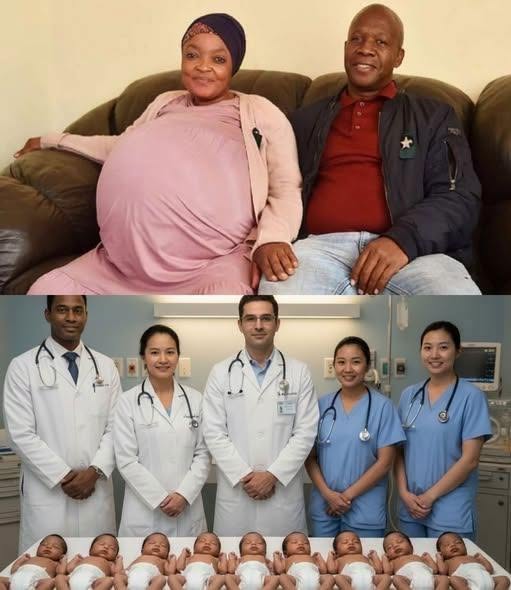
A reported birth involving ten babies has attracted widespread attention and raised fascinating questions about pregnancy, prenatal care, and the enormous coordination required when several newborns arrive at once.
Multiple pregnancies are already considered medically complex. When the number of babies becomes exceptionally high, the challenges can increase dramatically for both the mother and the medical team.
According to the account provided, the pregnancy was closely monitored and eventually resulted in the reported delivery of ten babies. The story also describes an unexpected discovery during the delivery that reportedly surprised the medical team.
Because the details of such an extraordinary case require reliable documentation, the exact circumstances should be treated carefully. Without access to original hospital records or independent statements from the treating physicians, some of the specific claims cannot be independently established from the account alone.
Still, the story provides an opportunity to look at what makes high-order multiple pregnancies so challenging and why careful preparation is essential.
A Pregnancy Unlike Most Others
A pregnancy involving multiple babies places additional demands on the mother’s body.
With more than one fetus developing at the same time, healthcare professionals generally monitor the pregnancy closely. Appointments may involve assessments of fetal growth, maternal health, blood pressure, placental function, and other potential complications.
As the number of fetuses increases, medical management can become increasingly complicated.
For the family described in the story, every stage of the pregnancy would have carried significant importance. The excitement of expecting children would exist alongside concerns about premature delivery, fetal growth, maternal health, and the possibility that the babies might need specialized care after birth.
This is one reason multiple pregnancies are often followed more closely than uncomplicated singleton pregnancies.
The goal is to identify potential problems as early as possible and prepare an appropriate plan for delivery and newborn care.
Preparing for an Exceptionally Complex Delivery
The delivery of multiple babies requires more than simply having an obstetrician present.
Depending on the circumstances, a medical team may include obstetricians, anesthesiologists, nurses, neonatologists, respiratory specialists, and other healthcare professionals.
The reason is straightforward: each newborn becomes an individual patient immediately after birth.
A newborn may need an assessment of breathing, heart rate, temperature, blood glucose, and other vital signs. Some babies may require additional support, particularly when they are born prematurely or have a low birth weight.
In an extremely large multiple pregnancy, several infants could potentially need attention at almost the same time.
That creates a major logistical challenge.
The delivery area must have enough personnel, equipment, monitoring systems, and neonatal resources available to respond quickly. Staff members also need to communicate clearly so that every infant receives appropriate care while the mother’s condition continues to be monitored.
According to the supplied account, a large healthcare team was prepared for the reported delivery.
The central priorities were the same as in any complicated birth: protect the mother, assess every newborn, and respond quickly when medical support is needed.
The Delivery Begins
When the delivery reportedly began, the medical team worked through the process one newborn at a time.
The account describes the babies arriving sequentially, with healthcare professionals assessing each infant and providing immediate care where necessary.
For the family, the experience would have been extraordinary.
Instead of waiting for one newborn to arrive, they were watching multiple children enter the world within the same medical event.
Each arrival would naturally bring a mixture of emotions, including excitement, relief, concern, and anticipation.
As the deliveries continued, the reported number of newborns increased.
Then came an unexpected development.
The Reported Arrival of a Tenth Baby
According to the supplied story, nine babies had been delivered before another newborn reportedly arrived.
The account says the tenth baby’s arrival surprised members of the medical team and added another layer of complexity to an already extraordinary delivery.
The story attributes the unexpected discovery to an unusual medical circumstance and raises questions about how an additional fetus could have gone undetected during earlier prenatal assessments.
However, this is an important point where careful reporting matters.
Modern prenatal imaging can provide doctors with valuable information about fetal development, but imaging is not perfect. Visibility can be affected by fetal position, gestational age, the number of fetuses, and other technical or anatomical factors.
At the same time, the precise explanation for an unexpected finding cannot be established from a social media post or an unverified account alone.
The original hospital records, prenatal imaging, and statements from the treating medical team would be needed to confirm exactly what happened.
Why High-Order Multiple Pregnancies Are So Challenging
Multiple pregnancies can involve a variety of medical concerns.
Healthcare professionals may monitor for premature birth, high blood pressure, gestational diabetes, anemia, differences in fetal growth, placental complications, and other pregnancy-related issues.
The babies can also face challenges associated with being born early or with a low birth weight.
When babies arrive prematurely, they may require additional support with breathing, temperature regulation, feeding, or other aspects of newborn care.
This is why pregnancies involving several fetuses generally require close medical supervision.
The exact level of monitoring and treatment depends on the individual pregnancy, the mother’s condition, the babies’ development, and other clinical factors.
The Responsibility of the Medical Team
Caring for one newborn immediately after birth requires attention to many details.
Caring for several newborns simultaneously requires even more coordination.
Every baby needs an individual assessment. One infant might need respiratory support, while another may require assistance maintaining body temperature. Another could need monitoring of blood glucose or other vital signs.
At the same time, the mother continues to require medical attention.
This means communication between members of the healthcare team becomes especially important.
Staff need to know which baby is receiving treatment, what that baby’s condition is, and what should happen next. Clear organization helps prevent confusion when multiple patients require care at the same time.
In an unusually complicated delivery, preparation begins well before the first baby is born.
What Happens Immediately After Birth?
The delivery itself is only the beginning.
Newborns need warmth, feeding, monitoring, hygiene, and appropriate medical observation.
If some babies are premature or have other medical concerns, they may require specialized neonatal care.
In a situation involving a very large number of newborns, these responsibilities multiply quickly.
Medical teams may need to monitor breathing, temperature, blood glucose, feeding tolerance, and signs of infection.
The mother also needs postpartum care.
Healthcare professionals may monitor bleeding, blood pressure, pain, recovery from delivery, and other aspects of maternal health.
Emotional support can also be important after an unusually demanding pregnancy and delivery.
Life After the Hospital
For a family caring for several newborns at once, leaving the hospital would mark the beginning of another demanding stage.
Each baby has individual needs.
There may be feeding schedules, medical appointments, sleep routines, clothing, diapers, vaccinations, and developmental monitoring.
If any child requires additional medical follow-up, the family may need to coordinate appointments with multiple healthcare professionals.
Even basic household tasks can become more complicated when several infants require care simultaneously.
Feeding one baby can already take considerable time. Feeding several babies on overlapping schedules requires careful organization.
Sleep can become another major challenge.
Parents may need to establish routines that allow them to respond to different babies while also finding opportunities to rest.
Support Beyond Medical Care
A family facing an unusually large multiple birth may need support that goes beyond healthcare.
Depending on their circumstances, they could benefit from assistance with transportation, infant supplies, childcare, meals, household responsibilities, and other practical needs.
Extended family members can sometimes provide valuable help.
Community organizations and charitable groups may also play a role in supporting families with unusually demanding circumstances.
The needs can change as the children grow.
What begins as a focus on feeding and medical appointments eventually becomes a question of education, transportation, childcare, and individual attention.
The Importance of Prenatal Care
One of the broader lessons from the story is the importance of regular prenatal care.
Prenatal appointments allow healthcare professionals to monitor the mother’s health and the development of the babies.
Ultrasound examinations and other assessments can provide important information about fetal growth, anatomy, position, and potential complications.
However, medical testing cannot guarantee that every possible issue will be identified before birth.
Pregnancy is a changing process, and some circumstances can remain difficult to predict.
This becomes particularly important in pregnancies considered high risk.
Close medical supervision gives healthcare professionals an opportunity to identify concerns, monitor changes, and prepare for different possibilities surrounding delivery.
Why Extraordinary Medical Stories Need Verification
Stories about extremely rare births can spread rapidly online.
A dramatic headline can attract attention before readers have an opportunity to examine the underlying evidence.
That is why unusual medical claims should be approached carefully.
The number of babies involved is a factual medical claim. Their health status is another factual claim. The circumstances of the pregnancy and the explanation for any unexpected finding are also medical claims.
Each requires reliable evidence.
A photograph or social media post by itself cannot establish every detail of a reported medical event.
In the case described here, the supplied account itself acknowledges that the precise medical explanation for the reported tenth baby cannot be established without original documentation or independent confirmation from the hospital and treating physicians.
That distinction is important.
An extraordinary story can be interesting without every detail being presented as established fact.
What Caring for Many Newborns Could Involve
The practical demands of caring for a large group of newborns would be substantial.
Medical follow-up could involve regular assessments of growth and development. Feeding plans might need to be adjusted depending on the individual needs of each child.
Some infants could feed normally, while others might temporarily need additional assistance.
Parents may also need to keep track of medications, appointments, vaccinations, feeding times, sleep patterns, and developmental milestones.
Organization becomes extremely important.
As the children grow, their needs will naturally begin to differ.
One child may sleep differently from another. One may develop a particular interest or talent earlier than a sibling. Medical needs may also vary from child to child.
Although the children share the same extraordinary beginning, each will eventually develop as an individual.
The Human Side of the Story
Beyond the medical numbers is a family facing an enormous change.
A pregnancy involving multiple babies would likely bring a wide range of emotions.
There could be excitement about meeting the children, concern about the pregnancy, relief when the delivery is completed, and uncertainty about what comes next.
For the healthcare team, the situation would involve a different kind of responsibility.
Every newborn represents an individual patient.
Every child requires attention to their own condition and needs.
The medical team’s role does not end when the final baby is delivered. Monitoring and follow-up may continue well beyond the delivery room.
A Remarkable Family Journey
If the reported circumstances are confirmed, the birth would represent an exceptionally unusual event.
But the delivery itself would only be the beginning of the family’s story.
The months and years that follow would bring ordinary family experiences alongside extraordinary logistical challenges.
There would be feeding routines, sleepless nights, medical appointments, developmental milestones, and eventually school and other childhood experiences.
Each child would develop a separate personality, interests, abilities, and ambitions.
For the parents, supporting ten children would require organization, patience, resources, and a strong support network.
The family would also need to find ways to give each child individual attention while managing the needs of the household as a whole.
What the Story Teaches About Modern Medicine
The reported case also highlights how much preparation can go into managing complicated pregnancies.
Modern medicine provides healthcare professionals with sophisticated tools for monitoring pregnancy and preparing for potential complications.
Ultrasound and other forms of prenatal imaging can provide valuable information about fetal development.
Specialized neonatal teams can prepare equipment and personnel before a high-risk delivery.
Hospitals can coordinate different medical specialties so that the mother and newborns receive appropriate attention.
But medicine also has limitations.
Not every pregnancy follows an expected pattern, and unusual circumstances can create challenges even when healthcare professionals have prepared carefully.
That is why flexibility and teamwork are so important in complex medical situations.
The Story Beyond the Headlines
A rare birth naturally attracts public attention.
People are curious about how such a pregnancy could happen, how the delivery was managed, and what happens to the babies afterward.
Social media can make such stories spread around the world within a short period of time.
But behind every headline is a real family and a real medical situation.
The most important details are not simply the number of babies.
They include the health of the mother, the condition of each newborn, the medical care provided, and the support available to the family afterward.
Those details require careful documentation rather than assumptions based on an eye-catching headline.
A Beginning Filled With Challenges and Possibilities
The reported birth of ten babies is extraordinary because of its scale, but the larger story is about what happens after an unusual pregnancy ends.
A mother has gone through an exceptionally demanding experience.
A medical team has faced a complicated delivery requiring extensive coordination.
Parents have begun life with a dramatically larger family.
And multiple newborns have started their own individual journeys.
If the precise details of the reported case are eventually confirmed by reliable medical and hospital sources, they may provide valuable information about the challenges involved in high-order multiple pregnancies and the coordination required to care for many newborns at once.
For now, the most responsible approach is to distinguish the reported account from independently verified medical facts.
What remains clear from the broader medical picture is that pregnancies involving many fetuses can require intensive monitoring, careful delivery planning, specialized newborn care, and substantial support after birth.
The reported story may have captured public attention because of its extraordinary number, but the human reality extends far beyond that headline.
For the family, the delivery was not the conclusion.
It was the beginning of a remarkable new chapter.