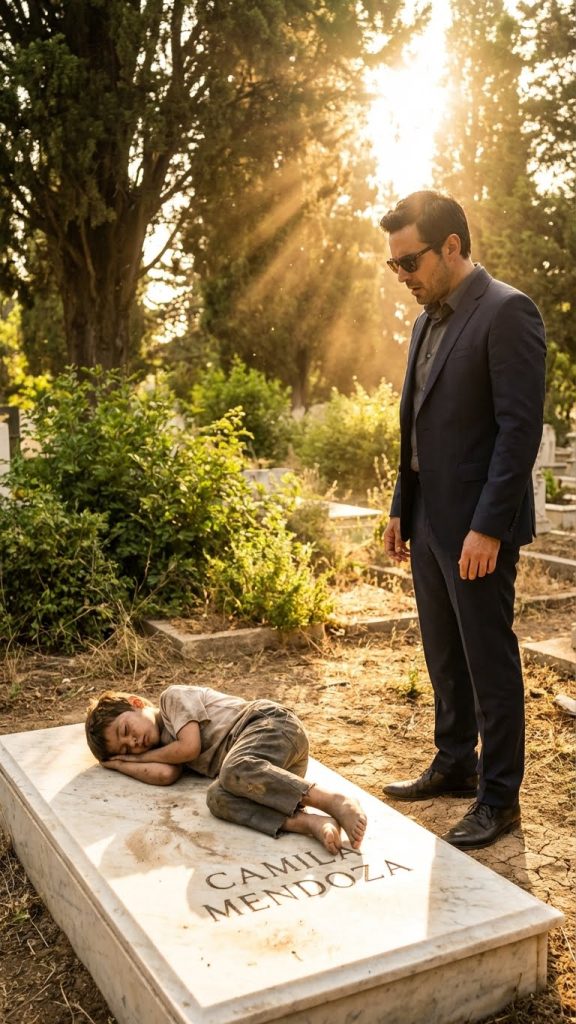
Gabriel Santoro followed the same routine every year.
He walked through the iron gates of San Rafael Pantheon, crossed the quiet paths, stopped at a white headstone, lit a candle, and left without speaking. It was the only way he knew how to honor Camila, his wife, who had passed away five years earlier.
That morning, however, something felt different.
The cemetery was unusually still, the air sharp and heavy. Gabriel barely made it halfway to the grave before he noticed something unexpected resting on the marble.
A child.
A small boy lay curled up on the headstone, wrapped in a worn blanket, his bare feet exposed to the cold. Clutched tightly against his chest was a faded photograph.
When Gabriel stepped closer, his heart skipped.
The photo showed Camila—alive, smiling—holding the same boy in her arms.
The gravel crunched beneath Gabriel’s shoes. The boy stirred and opened his eyes, exhaustion etched across his face. He hugged the photo tighter and whispered softly, “Sorry, Mom…”
Gabriel froze.
“What did you say?” he asked carefully.
The boy swallowed. “I’m sorry, Mom. I didn’t mean to fall asleep here.”
His name was Matías.
The realization struck Gabriel all at once: this child knew his wife in a way Gabriel never had.
Matías explained that Camila used to visit him at an orphanage. She read to him, spent time with him, and gave him the photograph. Gabriel listened in disbelief. In all their years together, Camila had never mentioned an orphanage—or a child.
Seeing the boy shiver, Gabriel wrapped him in his coat and brought him somewhere warm. The silence between them was heavy, filled with questions neither knew how to ask yet.
The next morning, they visited the orphanage.
The staff recognized Matías immediately—and Gabriel as well.
“Your wife came here often,” the director explained gently. “She was in the process of adopting Matías.”
The words felt unreal. Gabriel realized then that Camila had been carrying a dream he never noticed, perhaps because he had been emotionally distant without realizing it.
Gabriel took Matías home, unsure of what the future would look like. The boy moved carefully through the house, afraid to take up space, unsure if he truly belonged.
That night, Gabriel read through Camila’s letters. One sentence stayed with him:
“I tried to tell you, but you were always far away—even when you were home.”
The following days were difficult. When Gabriel reacted out of fear and uncertainty, Matías quietly prepared to leave, believing he was unwanted.
But Gabriel couldn’t let that happen.
He stopped the boy at the door and admitted the truth—that he was scared, unprepared, and grieving—but unwilling to abandon a child Camila had loved.
For the first time, Matías allowed himself to cry.
Later, Gabriel discovered a video Camila had recorded before her death. In it, she asked him to care for Matías, believing that both of them needed each other.
That same week, Gabriel made his decision.
He chose to adopt Matías.
The paperwork took time, but the bond had already formed—in quiet moments, shared meals, and the simple reassurance of staying.
One afternoon, Matías showed Gabriel a drawing: three figures standing together.
“That’s her,” he said, pointing to Camila. “That’s me.” He paused, then pointed at the third figure.
“And that’s you.”
It wasn’t a grand beginning.
Just a door that stayed open—and a child who finally believed he was allowed to remain.