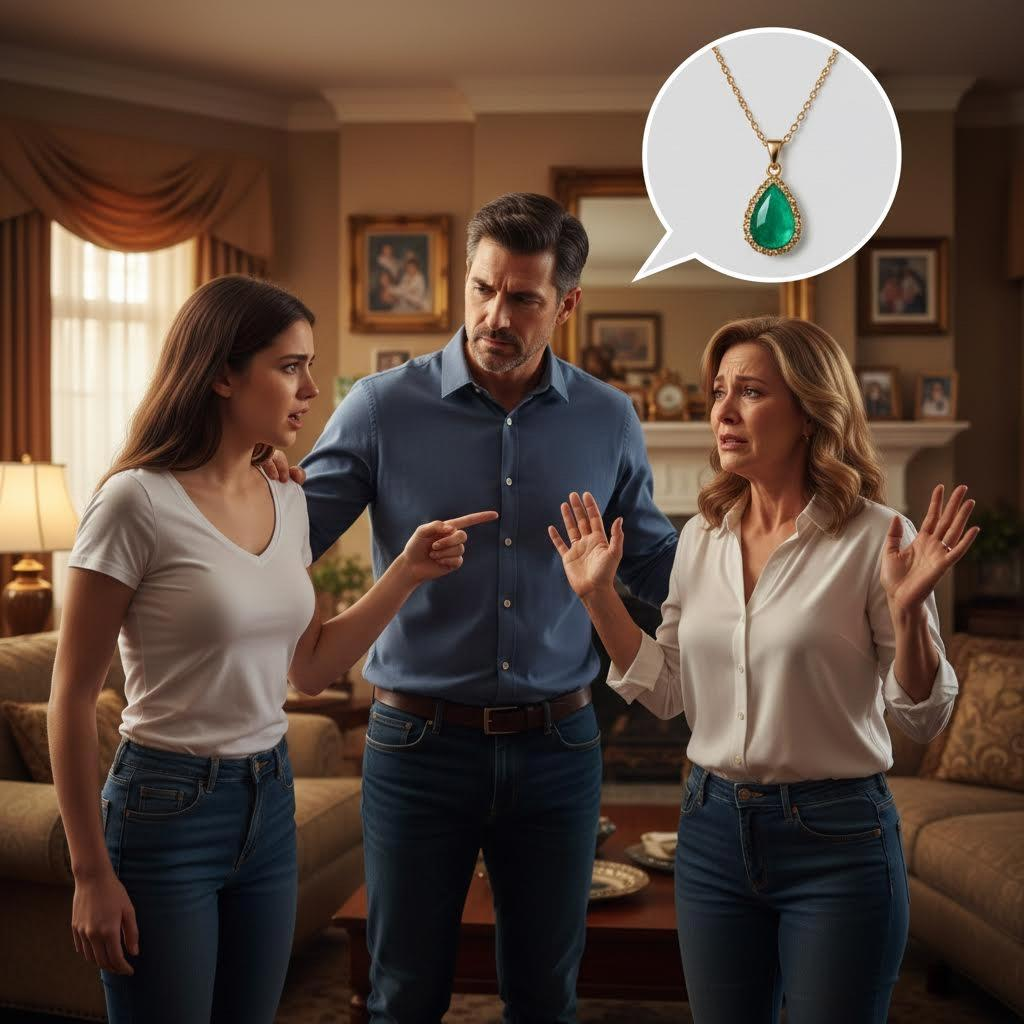
When my mother died, the world didn’t shatter all at once. Instead, it faded slowly, like the lights dimming in a room I wasn’t ready to leave. Sounds felt distant. Days blurred together. And grief became something I carried everywhere, even when I tried to pretend I was fine.
The one thing that still made me feel connected to her was an heirloom necklace she had left behind. It was a delicate gold pendant, small but detailed, passed down through generations of women in our family. My mother used to tell me stories about it—who wore it, where it traveled, and why it mattered. After she was gone, that necklace felt like more than jewelry. It felt like her voice, her presence, her love.
I wore it every day. I touched it when I felt overwhelmed. It grounded me when everything else felt uncertain.
After the funeral, I moved in with my father and my stepmother, Laura. She had married my dad a few years earlier, and while we were polite, we weren’t close. Still, she made an effort. She cleaned my room before I arrived, left fresh towels on the bed, and cooked meals she thought I might like. She spoke softly, never pushed, and gave me space when I needed it.
But grief has a way of twisting perception. Kindness felt suspicious. Silence felt loaded. And every gesture was easy to misread.
One morning, as I was getting ready, I reached for the necklace—and my fingers found nothing.
I froze.
I searched my dresser, my jewelry box, the bathroom sink. I checked my bed, my pockets, even the laundry basket. My heart started racing. I tore through my room, pulling open drawers, shaking out blankets, retracing every step from the night before.
The necklace was gone.
Fear quickly turned into panic, and panic hardened into anger. In my mind, there was only one explanation. I stormed downstairs and found Laura in the kitchen, calmly rinsing dishes.
I didn’t ease into the conversation. I didn’t ask questions. I accused her.
I told her she had taken the one thing my mother left me. I told her she had crossed a line she could never undo.
The change on her face was immediate. Color drained from it. Her eyes filled with tears, and her hands trembled as she set the dish down. She said—quietly, almost pleading—that she would never do something like that. That she understood how much it meant to me.
My father stepped in, confused and upset, trying to figure out what had happened. Voices rose. Emotions spilled over. Laura kept insisting she didn’t know where the necklace was, but by then, I had already decided what I believed.
I walked away, certain I had been betrayed.
That night, I barely slept. Grief and anger tangled together, feeding each other. I replayed the moment over and over, convincing myself I had seen guilt in her expression instead of shock.
The next morning, a knock echoed through the house.
When I opened the door, two police officers stood on the porch. They were calm, respectful, and not at all what I had expected. My heart sank and raced at the same time.
Then I noticed Laura nearby.
She looked exhausted. Her eyes were red and swollen, and she held a small, clear evidence bag in her hands. Inside it, unmistakably, was my necklace.
The officers explained that Laura had contacted them after realizing how serious the situation was. She had spent hours driving to pawn shops, retracing steps, asking questions, and filing a detailed report. She told them she was afraid that no one would believe her unless she could prove she had done everything possible to help.
“She didn’t give up,” one officer said gently. “She just wanted to bring it back to you.”
Laura stepped forward and held the bag out to me. Her voice shook as she spoke. She said she knew the necklace was one of the last connections I had to my mother—and that she couldn’t rest knowing it was missing.
In that moment, everything I thought I knew collapsed.
The shame came fast and heavy. My chest tightened, and my throat burned as I realized how wrong I had been. All the anger I had carried suddenly had nowhere to go. I clutched the necklace, overwhelmed by relief, guilt, and a deep sadness I hadn’t allowed myself to feel before.
Laura didn’t say “I told you so.” She didn’t look angry. She just stood there, careful and quiet, and wrapped her arms around me as I broke down.
She hadn’t taken anything from me.
She had spent an entire night trying to return the last piece of my mother I had left—and I had almost missed what that meant.