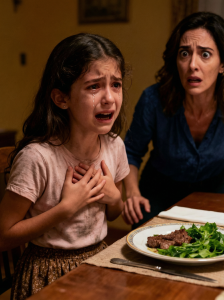
When my husband’s five-year-old daughter, Lucía, came to live with us, I hoped she would adjust quickly to our new family life. She was quiet, observant, and always polite. But from the very first evening, something worried me: she barely touched her food.
I prepared simple, comforting meals—omelets, baked rice, lentils, warm soups—dishes children usually enjoy. Yet every night, she would gently push her plate away and whisper:
“I’m sorry, Mom… I’m not hungry.”
She called me Mom from the beginning, and although the word warmed my heart, there was a heaviness behind it that I couldn’t quite explain.
My husband, Javier, always brushed off my concerns.
“She needs time,” he insisted. “It used to be worse before.”
There was something evasive in his tone, but I convinced myself she simply needed space to feel comfortable.
A Night That Changed Everything
A week later, Javier traveled for work. That first night alone, while I was tidying up the kitchen, I heard soft little footsteps behind me. When I turned, Lucía stood there holding her stuffed toy, her face pale and serious.
“Sweetheart, can’t you sleep?” I asked gently.
She shook her head. Then, after a long pause, she whispered:
“Mom… I need to tell you something.”
Her trembling voice made my heart drop. I lifted her into my arms and we sat on the sofa. She looked around nervously before speaking again—this time saying something so alarming that I immediately reached for the phone.
My hands shook as I called for help.
“I’m… I’m a stepmother,” I managed to say. “And my stepdaughter just told me something very serious.”
Within minutes, a patrol car arrived.
The First Breakthrough
The officers spoke softly, aware that Lucía needed patience and reassurance. With encouragement, she repeated what she had told me: that she had been taught not to eat whenever she “misbehaved,” and that “good girls don’t ask for food.”
Her words were heartbreaking—quiet, fearful, and far too mature for her age.
The officers recommended taking her to the hospital for a full check-up, and I agreed immediately.
At the pediatric emergency room, doctors confirmed she wasn’t in immediate danger but showed signs of learned food avoidance.
“This didn’t happen overnight,” the doctor said. “This is a pattern.”
That sentence alone felt like a punch to the stomach.
More Truth Comes to Light
The next morning, a child psychologist met with Lucía privately. When the session ended, she pulled me aside.
“Lucía shared something important,” she said carefully. “She mentioned that these behaviors began long before she came to your home.”
She added that Lucía described how food had been used as a form of discipline in her previous environment. Then came another detail—one that shook me deeply.
“She also said someone close to her knew about it,” the psychologist continued, choosing her words thoughtfully. “Not necessarily participating, but aware.”
I felt the room spin. The puzzle pieces that once seemed harmless now formed a painful picture.
Moving Toward Healing
The authorities opened an investigation, and I focused entirely on supporting Lucía. She stayed close to me, often asking softly:
“Can I eat this?”
Every time, I reassured her:
“Yes, sweetheart. You can always eat in this home.”
Day by day, she improved.
Week by week, she grew stronger.
Meal by meal, she relearned trust.
Over time, professionals continued to support her, and protective measures were put in place to ensure her safety.
One peaceful afternoon, while we were drawing together in the living room, she looked up at me and said:
“Mom… thank you for listening to me.”
It was the moment I realized just how powerful one conversation—and one phone call—can be.