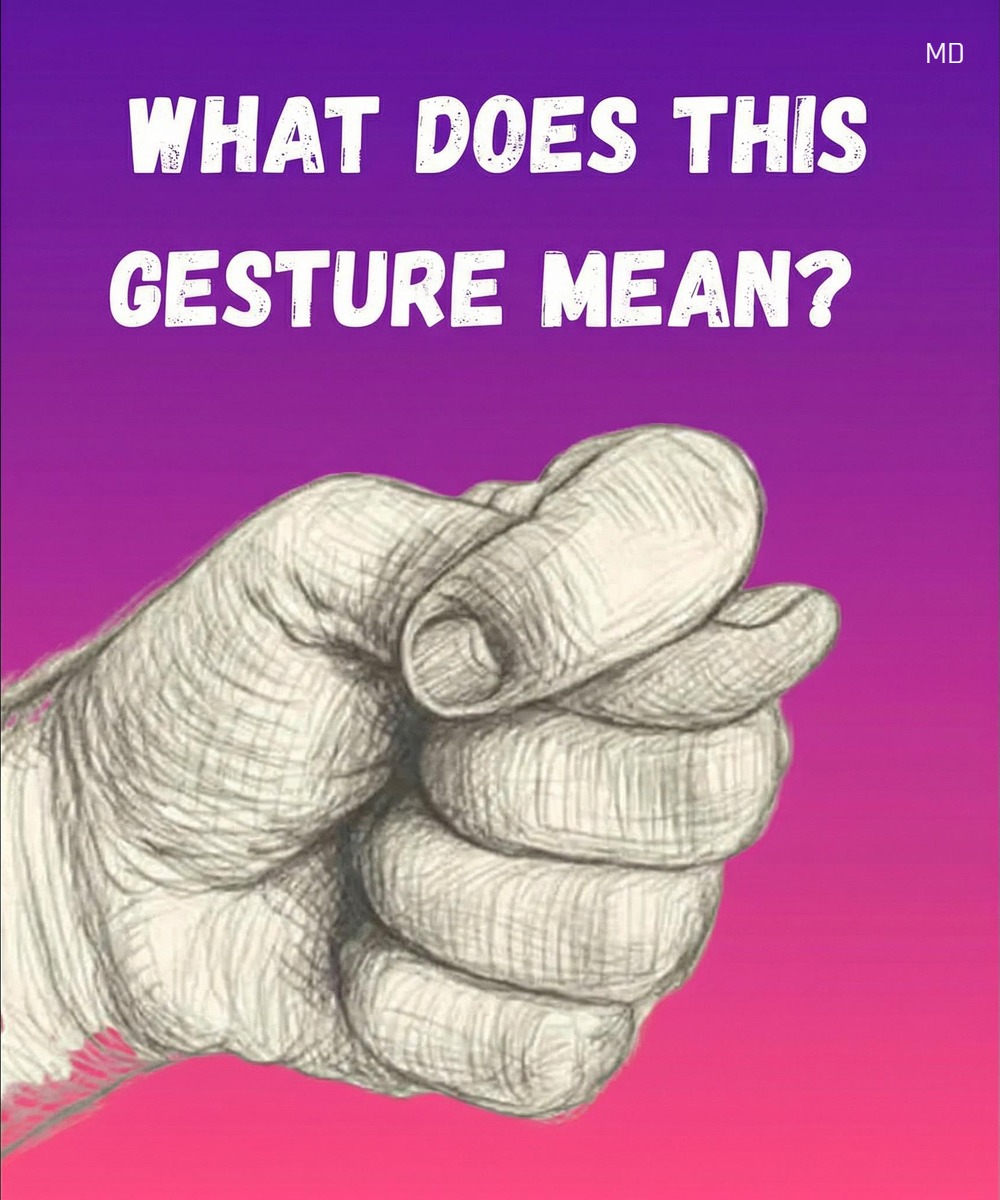
At first glance, it looks like nothing more than a closed fist. But when the thumb is tucked between the fingers, it forms what many cultures recognize as the “fig” gesture — a simple motion that has carried powerful meanings across centuries.
Ancient Origins
The fig gesture dates back to the time of the Roman Empire, where it was known as manus fica (literally “fig hand”). In that era, the gesture had layered meanings. It could be used as an insult, but it was also believed to serve as protection against the “evil eye,” a widespread superstition in Mediterranean cultures.
Small charms shaped like the fig hand were sometimes worn as amulets. People believed the symbol could shield them from envy, bad luck, or harmful intentions. Its protective reputation allowed it to endure long after the fall of ancient Rome.
A Quiet Sign of Refusal
Beyond its ancient roots, the gesture evolved into a subtle way to express refusal or disagreement. In communities where open confrontation was discouraged, nonverbal signs played an important role. The fig gesture became a discreet way of saying “no” without escalating a situation.
Because it required only a small movement, it allowed individuals to communicate boundaries calmly and clearly. In some regions, it also carried a tone of playful defiance rather than outright hostility.
Cultural Variations
Across parts of Eastern Europe, Latin America, and other regions, the fig gesture has appeared in different forms. In countries such as Brazil and Portugal, versions of the gesture have been used both as protective charms and as expressive social signals.
Over time, its meaning softened in many places. Children adopted it in games and jokes, turning what was once a serious symbol into something more lighthearted. In this way, the gesture shifted from spiritual protection or sharp refusal to playful teasing.
A Symbol That Endures
Today, the fig gesture is rarely used in everyday conversation, especially in a world shaped by digital communication and direct expression. Yet it remains a fascinating reminder of how people once relied heavily on body language to communicate feelings, resistance, and even spiritual beliefs.
Its story shows that communication does not always require words. Sometimes, a small motion of the hand can carry generations of meaning — from protection and protest to humor and resilience.