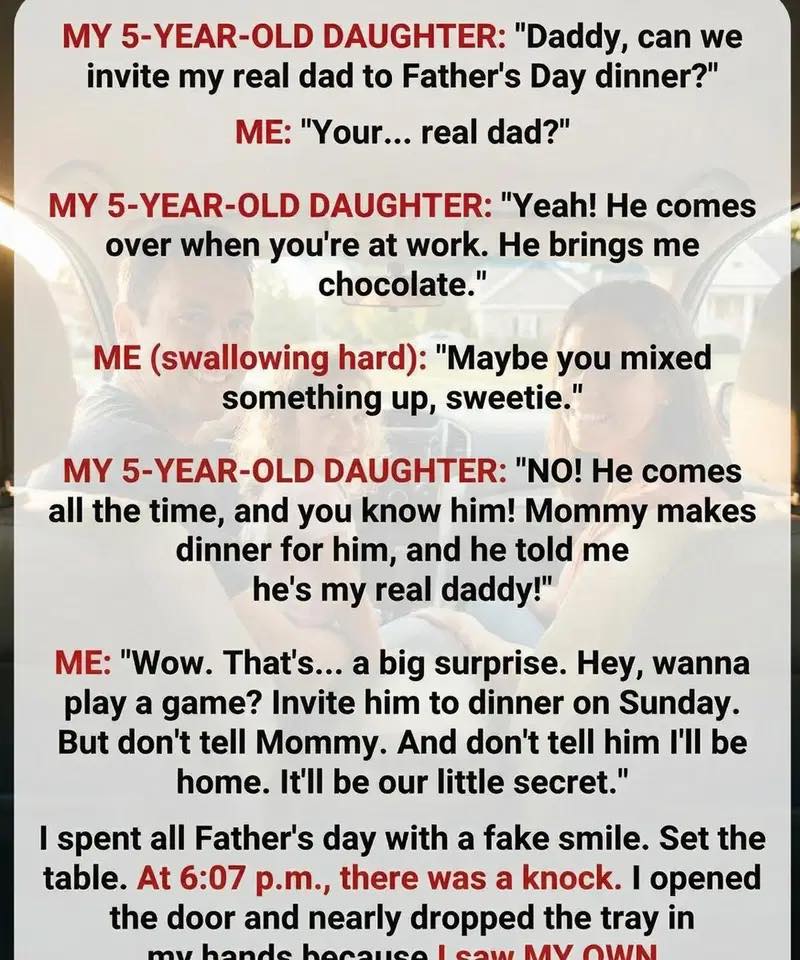
Father’s Day was supposed to be simple—pancakes for breakfast, handmade cards, and a day filled with the kind of gentle chaos only a five-year-old can create. I expected a familiar, heartwarming routine… nothing more.
But life has its own timing, and sometimes the most profound moments arrive quietly. For me, it happened in the back seat of the car, delivered by my daughter Lily—purple crayon in hand, imagination in full bloom, and a question I never saw coming.
Lily has always viewed the world through her own colorful lens. In her mind, the moon follows our car “because it likes our music,” puddles reflect “the sky’s secret smile,” and the neighbor’s dog definitely “understands English but pretends not to.”
So when she asked me something unexpected—something that didn’t match our usual lighthearted conversations—I knew she wasn’t trying to surprise or confuse me. She was simply sharing what she believed to be true.
I responded carefully, keeping my tone gentle and curious. What she said came out in little pieces only a child could assemble—moments she noticed while I was at work, comments she didn’t fully understand, and observations she believed were part of a fun story. She had no idea her question carried real weight.
To keep her comfortable, I turned the conversation into a playful “Father’s Day secret mission,” giving her a safe way to express herself while allowing me to understand what she meant. She was delighted. I, on the other hand, felt a quiet swirl of worry forming beneath the surface.
When Father’s Day arrived, my wife left early for a photography session she had scheduled weeks ahead. Lily insisted we stay home to cook dinner together. She decorated the table with sunflowers she had picked from the backyard—placing them in a vase that wobbled but somehow stayed upright.
She hummed as she worked, completely unaware that her innocent words had changed the direction of our week.
As evening settled, there was a knock at the door—right when Lily had predicted it during our “game.” What followed was a calm but honest conversation that brought clarity to some confusing details. There were no arguments, just a thoughtful discussion to clear the air and make sure everyone was on the same page.
But the most important moments came afterward.
In the days that followed, my focus was on Lily—her sense of security, her happiness, and her understanding of what family truly means. She didn’t need complicated explanations. What she needed was reassurance, consistency, and love she could feel—not analyze.
We talked in simple truths. I told her that families are built on care, trust, and showing up every day. Being a parent isn’t about perfection—it’s about tying shoelaces, wiping tears, making silly pancake faces, and being the one who stays when things feel uncertain.
One night, as she curled against me during bedtime, she traced tiny circles on my arm and whispered, “Are you still my daddy?”
The question stopped me cold.
I hugged her and answered with the only thing that mattered:
“I always have been—and I always will be.”
She let out a small breath—the kind a child releases when the world suddenly feels safe again.
Over the next few weeks, our home found its rhythm once more. There were still grown-up conversations to navigate, but none of that touched Lily’s peaceful little world. She returned to her usual activities—drawing suns with sunglasses, giving names to every bug in the yard, and singing loudly every morning.
And I went back to being the steady presence she could always count on.
Not every family moment is picture-perfect. Sometimes the unexpected questions are the ones that reveal the most—about commitment, resilience, and the love that holds a parent and child together.
Years from now, Lily might not remember the questions she asked or the conversations that followed. She will remember the sunflowers on the table, the pancake breakfasts, and the safety of being held close by someone who never stopped showing up.
Because at the end of the day, fatherhood isn’t defined by paperwork or perfect plans.
It’s defined by presence.
Every morning.
Every night.
Every time she reaches for me.
And nothing—not confusion, not change, not uncertainty—can undo that truth.