The day our daughter was born was supposed to be the happiest moment of our lives. After years of planning, hoping, and waiting, we finally stood on the edge of becoming parents. We imagined that moment countless times—what she might look like, whose eyes she would have, how it would feel to hold her for the first time.
Nothing prepared us for what actually happened.
My wife and I are both white. Our families had blended traditions, shared histories, and familiar expectations. Like many couples, we assumed our child would resemble us in predictable ways. That assumption, innocent as it seemed, would be tested in the most unexpected moment.
When our daughter was delivered, the room went quiet.
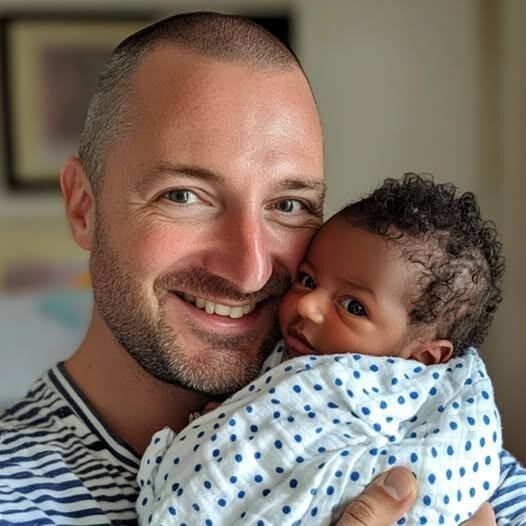
She had dark skin and tightly curled black hair. The shift in the atmosphere was immediate. Nurses exchanged brief glances. Family members waiting nearby fell silent. What should have been filled with celebration suddenly carried confusion, hesitation, and unspoken questions.
I was still holding my wife’s hand, trying to steady her after hours of labor. When the nurse moved to place our baby in her arms, my wife froze.
“That’s not my baby,” she cried.
The words echoed through the room, sharp and filled with panic. Her reaction wasn’t anger—it was fear, shock, and exhaustion colliding all at once. I looked at the baby, then back at my wife, trying to understand what she was seeing that made her say those words.
The umbilical cord was still attached. There was no possibility of a mix-up. This child had been born only seconds earlier.
Tears streamed down my wife’s face as she struggled to catch her breath.
“I swear to you,” she said, gripping my hand tightly. “I have never been with anyone else. Please believe me.”
Her voice wasn’t defensive—it was pleading. Outside the delivery room, voices began to rise. Family members whispered, then spoke openly. Doubts surfaced quickly, shaped by misunderstanding and shock rather than facts.
I felt torn in two directions. I loved my wife deeply. I trusted her. But I was also overwhelmed by what I couldn’t immediately explain.
I stepped into the hallway, trying to clear my head. My mother approached me, her expression serious and concerned.
“You need to think carefully,” she said. “This isn’t something you can ignore.”
Her words echoed what others were already thinking. They planted seeds of uncertainty that I hated but couldn’t fully dismiss. Yet when I looked back into the room and saw our daughter, something stopped me.
She had my eyes. The same soft curve to her smile. The same dimples that had appeared in my family for generations.
I realized then that I didn’t need assumptions—I needed answers.
Not to accuse my wife, but to protect the truth for all of us.
The hospital arranged genetic testing. A simple process, they explained. Routine. Common. For me, it felt anything but simple. It felt like a test of trust, even though it was really a search for clarity.
The days that followed were heavy. My wife barely spoke. She focused entirely on caring for our daughter, holding her close, whispering to her, loving her without hesitation. Watching that bond grow made the accusations feel increasingly hollow.
She never once pulled away. Never showed doubt. Never stopped being a mother.
When the results finally came back, the doctor asked to speak with me privately. His tone was calm and professional.
“She is your biological daughter,” he said.
I felt a wave of relief rush through me so strong it nearly knocked the air from my lungs. The doctor went on to explain how genetics work—how traits can remain hidden for generations and surface unexpectedly when recessive genes align. It was rare, but entirely possible.
Science had an answer where fear had failed us.
What followed relief, however, was guilt. I had allowed doubt to creep into a moment that required unwavering support. I had questioned the person who trusted me most at her most vulnerable.
I returned to the hospital room and handed my wife the results. She read them slowly, her hands trembling slightly. Then she looked up at me, her eyes searching my face.
“I’m sorry,” I said quietly. “I should have trusted you without needing proof.”
Tears filled her eyes, but this time they carried relief instead of pain. She squeezed my hand.
“We’re okay,” she said. “That’s all that matters now.”
As she rested, exhausted from labor and emotional strain, I held our daughter against my chest. She was warm, calm, and perfectly real. Her breathing was steady, her presence grounding.
In that quiet moment, everything became clear.
Fear can take root quickly when understanding is missing. Assumptions can damage trust before truth has a chance to speak. But love, when given room, can survive even the most unexpected tests.
Our family didn’t begin with certainty. It began with honesty, humility, and truth.
And that truth held us together.