I once believed the end of a marriage would be loud—filled with arguments, difficult conversations, or at least clear explanations.
Instead, it ended quietly.
One day my husband was part of my daily life. The next, he was gone. There were no long discussions or attempts to fix what we had built together. Just an absence that forced me to move forward without answers.
Suddenly, I was raising two children on my own, responsible for every decision and every outcome. Those early years were demanding. Each dollar mattered. Every hour of rest felt precious. I learned quickly that there was no room for hesitation—my children depended on me.
I worked, parented, listened, and stayed steady even when exhaustion felt overwhelming. Over time, I stopped waiting for him to come back or hoping for apologies that never arrived. Healing didn’t happen because I forgot the past. It happened because I adapted to a new reality.
Slowly, life found its rhythm again. My children grew stronger, and so did I. The pain softened into something manageable—something I understood rather than something that controlled me. I believed that chapter of my life was fully behind me.
Then, one afternoon, the doorbell rang.
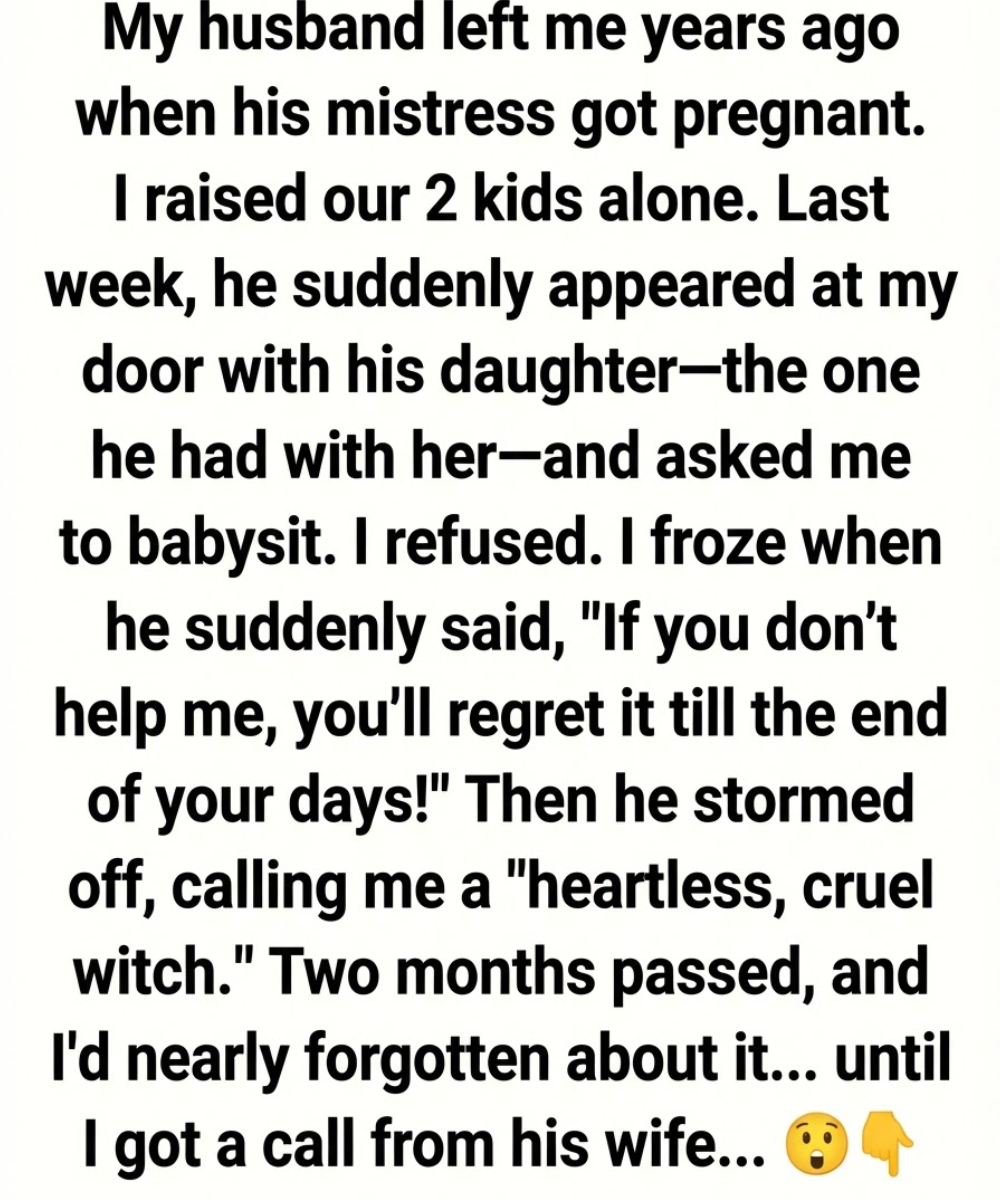
When I opened the door, I saw my former husband standing there. Beside him was a young girl, holding his hand. She was his daughter from the life he had built after leaving ours.
He spoke casually, explaining that he needed help for a short time. Would I be willing to watch her? Just temporarily. As if the years of silence and rebuilding had never happened.
I didn’t feel angry. I felt surprised.
I looked at the child—completely innocent—and then back at him. Memories surfaced: long nights of worry, milestones he missed, and the strength I had developed on my own. In that moment, I realized something important—I wasn’t responsible for fixing the consequences of his choices.
So I said no.
Not harshly. Not unkindly. Just honestly. I explained that my life was full, that I couldn’t take on that responsibility, and that boundaries mattered.
His reaction was immediate. His tone changed, and he accused me of lacking compassion before leaving abruptly. The door closed, and the house fell quiet again—this time heavier than before.
For a while, I questioned myself. Had I done the right thing? Could I have handled it differently? But as time passed, the doubt faded. I understood that protecting my peace didn’t make me uncaring. It made me truthful.
Two months later, my phone rang.
This time, it was his wife.
She spoke calmly and respectfully, offering an apology. She acknowledged that the request had been unfair and that my past had not been considered. The call was brief, but meaningful.
When it ended, I felt a sense of closure I hadn’t realized I was still searching for—not because everything was resolved, but because I had learned something essential:
Strength doesn’t have to be loud.
It doesn’t need drama or confrontation.
Sometimes, strength is simply knowing when to say no—and trusting that you don’t need permission to protect the life you worked so hard to rebuild.