People like to imagine that in moments of real danger, adults take charge.
That night, the only person who truly moved first was my three-year-old son.
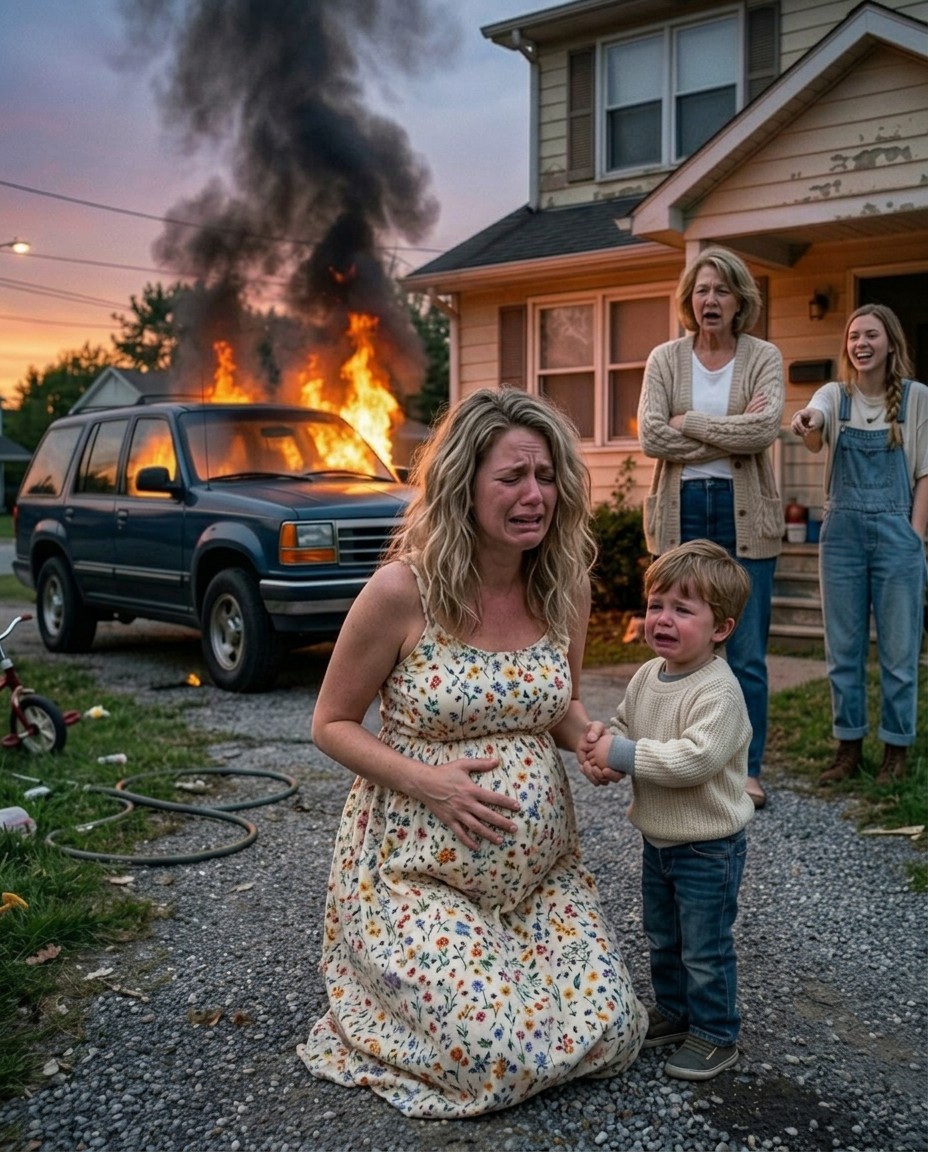
While I was kneeling in the driveway trying not to black out, Ryan tore away from me and ran barefoot across the yard to our neighbor’s house. I was too far gone to stop him. I remember shouting his name once, weakly, and seeing his little body disappear through the dark toward the porch light next door.
Then everything blurred.
I remember the smell of burning rubber. I remember Margaret yelling that somebody needed to move the car before it damaged her flower beds, as if that mattered more than the fact that I was soaked, shaking, and nearly crowning in her driveway. I remember Jessica pacing in circles, suddenly panicked by the size of the flames she had started, but still too proud to say she had done it on purpose. And I remember dropping sideways onto the grass while my contractions came so close together they stopped feeling separate.
Mrs. Holloway from next door was the one who called 911. Her husband came running after Ryan reached their house crying and screaming that his mommy was having the baby and Aunt Jessica had burned the car. Later, everyone said Ryan had also grabbed Mrs. Holloway’s phone and tried to call Michael on video because he knew that was what grown-ups did when something bad happened.
By the time the ambulance arrived, my mother had switched from cold indifference to frantic performance.
“She’s always been emotional,” she told the paramedics. “This all happened so fast.”
I was strapped onto a stretcher, sweating, sobbing, and half delirious, but I still found enough breath to point at Jessica and say, “She burned the car. She did it. Don’t let them say this was an accident.”
One of the EMTs, a broad-shouldered woman named Carla, squeezed my wrist and said, “I heard you.”
At the hospital, labor went wrong before it went right. My blood pressure crashed. The baby’s heart rate dipped. They rushed me into an emergency delivery room while Carla carried Ryan to a waiting area and promised him his mommy was fighting hard. I remember hearing my own voice begging them to save my daughter before I lost consciousness under the pain and panic.
When I woke up, Michael was beside my bed.
He looked like hell. Unshaven, red-eyed, still in work boots, like he had driven through the night without once stopping to think whether his body could take it. He was holding our newborn daughter wrapped in a pink blanket, and he was crying so hard he couldn’t even speak at first.
“She’s okay,” he finally said. “Emily, she’s okay. You’re okay.”
I reached for my baby and for him at the same time.
Her name was Sophia.
Ryan came in a little later, clinging to Carla’s hand, and the first thing he said was, “I protected Mommy.”
Michael knelt and pulled him close. “You did, buddy. You really did.”
It should have ended there—with survival, relief, gratitude—but families like mine don’t stop at one wound. They keep reopening it until someone finally locks the door.
By morning, a detective had taken my statement. The fire marshal confirmed the SUV was deliberately torched with gasoline. Mrs. Holloway gave her statement. So did Mr. Holloway. Even the church guests my mother cared about more than my labor ended up talking, because several of them had arrived early enough to see smoke, hear screaming, and catch enough fragments of Margaret and Jessica’s words to know something monstrous had happened.
Michael listened to all of it with the kind of silence that scares people more than shouting.
Then my mother and sister came to the hospital.
Jessica looked gray and puffy-eyed, like she had cried only after realizing consequences had finally found her. Margaret looked worse. Her hair was unbrushed, her lipstick gone, her hands shaking. They walked into my room together carrying flowers like we were all actors in a cheap play about forgiveness.
Margaret spoke first. “Emily, sweetheart, we were upset. Things got out of hand.”
I stared at her.
My husband stood by the window with Ryan in his arms and did not say a word.
Jessica started crying. “I didn’t mean to really hurt you. I just—I was angry. I don’t know why I did it.”
I looked down at my daughter sleeping against my chest, then at Ryan’s little fingers hooked around Michael’s collar, then back at the two women who had watched me go into labor and still chosen cruelty.
That was the moment something inside me changed permanently.
“You watched me beg,” I said. “You heard my son cry. You set my car on fire. And now you’re here because you’re scared, not sorry.”
Margaret stepped closer. “We’re family.”
“No,” I said. “We’re related. That’s not the same thing.”
Michael finally crossed the room, opened the door, and said in a voice so calm it sounded almost gentle, “Get out before I make this part of the police report too.”
They left in tears.
For the first time in my life, I felt no guilt watching my mother cry.
Title: When Family Fails, Strength Rises: A Story of Survival, Boundaries, and New Beginnings