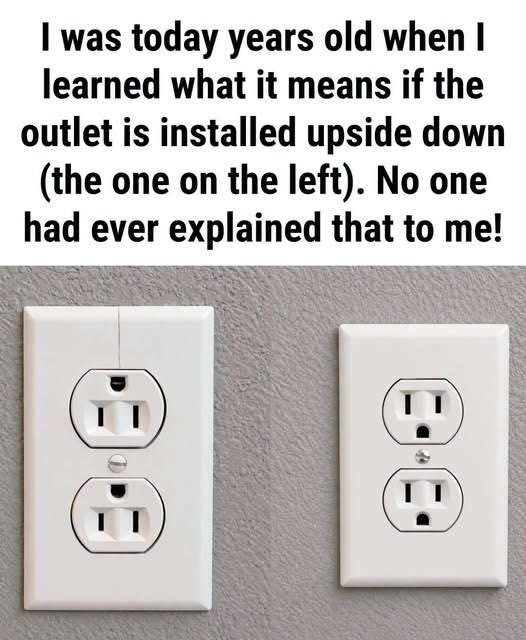
Have you ever noticed that some electrical outlets are installed upside down, with the round grounding hole at the top instead of the bottom? At first glance, it may seem like a simple installation mistake. However, in many homes and buildings, this unusual orientation is completely intentional.
Electricians sometimes install outlets this way for practical reasons, making it easier to identify specific wiring configurations or improve safety in certain situations. While not every upside-down outlet has the same purpose, there are several common explanations for why you might see one.
A Quick Way to Identify Switched Outlets
One of the most common reasons an outlet is installed upside down is to indicate that it functions differently from a standard outlet.
In many older homes, wall switches were designed to control lamps rather than overhead lighting. As a result, one receptacle on the outlet may be connected to a wall switch, while the other remains powered all the time.
This setup allows homeowners to plug a table lamp into the switched portion of the outlet, making it easy to turn the lamp on and off with a wall switch. At the same time, the always-powered half can still be used for devices like phone chargers, clocks, or other electronics.
Some electricians install these outlets upside down as a simple visual reminder that the outlet has a special function. Although this practice is fairly common, it is based on personal preference rather than an official requirement.
There Is No Universal Rule
Many people assume that electrical outlets must always face one specific direction. In reality, electrical codes generally do not require outlets to be installed with the ground pin facing either up or down.
Because there is no universal standard, the orientation often depends on the electrician, the builder, local construction practices, or even the homeowner’s preference.
This means you may find outlets facing different directions throughout the same house without anything being wrong.
Safety Can Also Play a Role
In some commercial buildings, hospitals, schools, and offices, outlets are intentionally installed with the grounding hole on top for an added layer of safety.
If a metal object, such as a picture frame or tool, accidentally falls between a partially plugged-in cord and the outlet, having the ground connection at the top may reduce the chance of the object touching the energized prongs first. While the safety benefit is relatively small, some facilities choose this orientation as an extra precaution.
An Upside-Down Outlet Doesn’t Always Mean Anything Special
Although switched outlets are a common reason for this installation style, an upside-down outlet is not always connected to a wall switch.
In some homes, the orientation simply reflects the habits of the electrician or builder. Others may have been installed during renovations or replaced over the years without any special meaning.
Because of this, it’s impossible to determine an outlet’s function based on its appearance alone.
How to Check if an Outlet Is Switched
If you’re curious about whether an outlet is controlled by a wall switch, the easiest method is to perform a simple test.
Plug a lamp into the outlet and flip the nearby wall switches. If the lamp turns on and off with one of the switches, you’ve identified a switched outlet. If nothing changes, the outlet is likely powered continuously.
If you’re unsure about your home’s electrical wiring or notice anything unusual, it’s always best to consult a qualified electrician rather than attempting to modify the wiring yourself.
The Bottom Line
An upside-down electrical outlet is usually not a mistake. In many cases, it serves as a practical indicator of a switched outlet, follows local installation practices, or is used for added safety in certain buildings.
Since there is no nationwide rule requiring outlets to face one direction, you’ll find both orientations in homes and commercial spaces. The next time you spot an upside-down outlet, you’ll know it’s often a thoughtful installation choice rather than an installation error.