
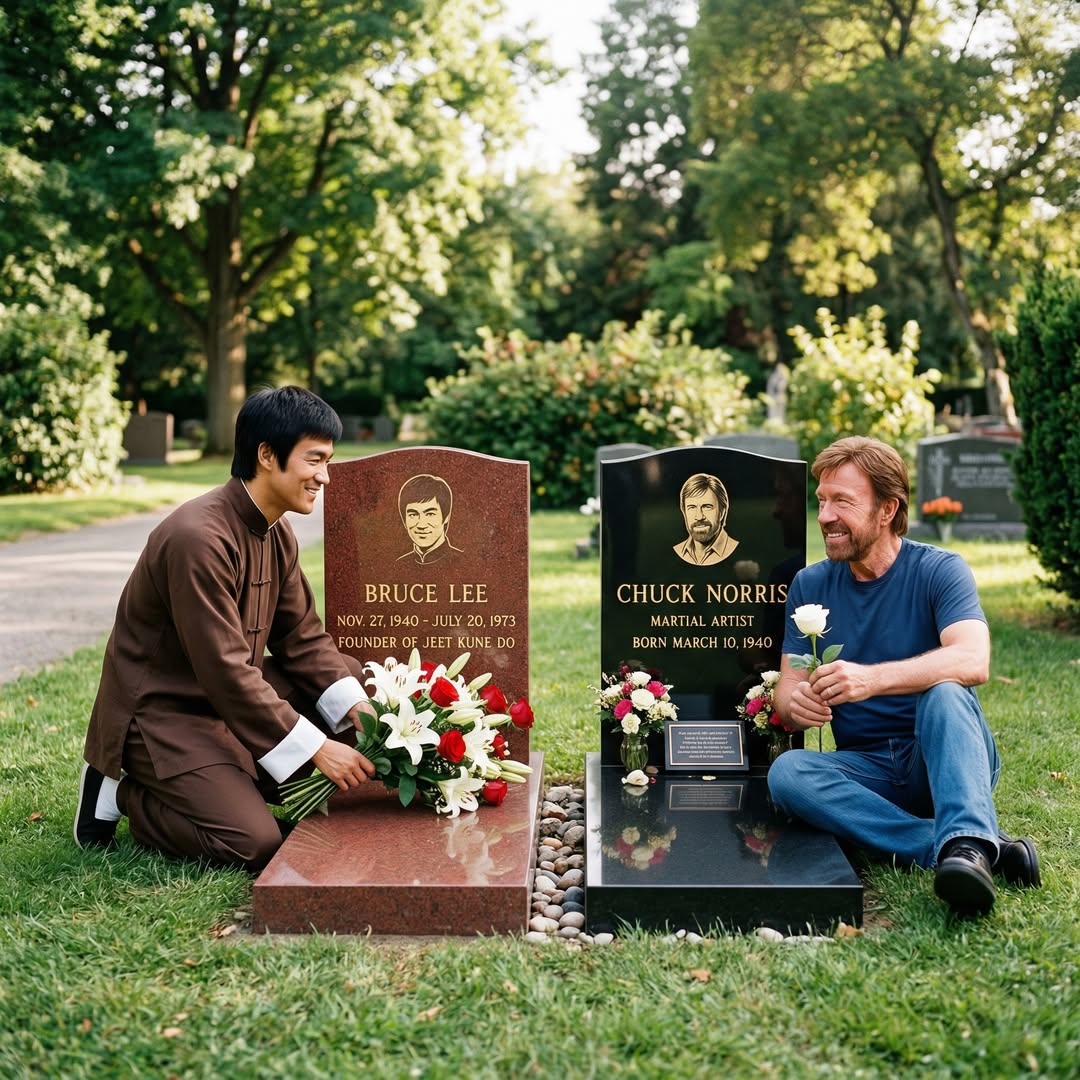
A Timeless Tribute to Martial Arts Legends
Bruce Lee (1940-1973), whose remarkable life ended far too soon at the age of 32, and Chuck Norris (1940-2026), who enjoyed a long and influential journey, stand as two of the most iconic figures in martial arts history. Though their paths were different, their impact on the world remains equally powerful and enduring.
Imagining a peaceful reunion between these legends offers a powerful and comforting image, one that goes beyond time, fame, and rivalry. In this serene setting, they sit side by side, not as competitors, but as pioneers who helped shape an entire culture. The noise of the world fades away, leaving only a quiet atmosphere filled with respect, wisdom, and shared understanding.
Two Paths to Greatness
Both Bruce Lee and Chuck Norris dedicated their lives to mastering their craft, but they did so in strikingly different ways.
Bruce Lee revolutionized martial arts with his philosophy of adaptability and self-expression, encouraging people to "be like water" and embrace change. He rejected rigid tradition in favor of what worked, creating Jeet Kune Do, a philosophy as much as a fighting style. His approach was revolutionary: question everything, absorb what is useful, discard what is not, and express yourself honestly.
Chuck Norris, known for his discipline and strength, built a legacy not only through martial arts but also through his influence in film, television, and public life. A world karate champion with an undefeated competitive spirit, Norris brought a different energy: the power of persistence, the value of traditional discipline, and an unshakeable work ethic.
Together, they represent a balance of innovation and tradition, speed and strength, philosophy and action. Where Lee was the lightning bolt of change, Norris was the mountain of endurance. Both were necessary. Both were extraordinary.
Breaking Barriers, Building Bridges
Their influence extends far beyond the screen. Bruce Lee played a crucial role in introducing martial arts to a global audience, breaking cultural barriers and inspiring countless individuals to pursue physical and mental excellence. At a time when Asian actors were rarely given leading roles, Lee shattered stereotypes and proved that a martial artist could be a philosopher, an actor, and a global icon all at once.
His films, from "Enter the Dragon" to "Fist of Fury," didn't just entertain. They introduced Western audiences to Eastern philosophy, to the idea that combat could be an art form and a path to self-knowledge. Millions of people around the world began studying martial arts because Bruce Lee showed them it was possible.
Chuck Norris, on the other hand, became a symbol of resilience and determination, motivating fans through both his performances and his personal story of perseverance. From his championship karate career to his starring roles in films like "Missing in Action" and the long-running television series "Walker, Texas Ranger," Norris embodied the values of toughness, integrity, and never giving up.
His journey from a shy, bullied kid to a world champion and cultural icon is itself an inspiration. Norris proved that discipline and hard work could transform anyone, and his public persona became synonymous with quiet strength and moral clarity.
The Reunion Without Rivalry
What makes this imagined reunion so meaningful is the absence of rivalry. While fans have long compared their skills and achievements, debating endlessly about who would win in a fight, this moment highlights something deeper: the mutual respect between two individuals who understood the dedication required to reach greatness.
In reality, Lee and Norris were friends and training partners. Norris appeared as Lee's opponent in the legendary colosseum fight scene in "Way of the Dragon," a sequence that remains one of the most celebrated martial arts scenes ever filmed. Behind the choreographed combat was genuine mutual admiration.
This imagined peaceful reunion captures that truth. It is a reminder that true legends do not compete for recognition; they inspire one another and those who follow in their footsteps. The greatest martial artists understand that the real opponent is oneself: one's limitations, one's fears, one's ego.
A Legacy That Never Fades
Their shared legacy continues to thrive today. From martial arts schools to fitness communities, from classic films to modern media, their influence is still felt around the world. Young athletes, actors, and dreamers continue to look up to them as symbols of what can be achieved through hard work, discipline, and belief in oneself.
Bruce Lee's philosophy continues to inspire far beyond martial arts. His writings on self-expression, adaptability, and honest self-knowledge are studied by entrepreneurs, artists, and athletes. "Be like water" has become a mantra for navigating change in an unpredictable world.
Chuck Norris's influence endures through his films, his charitable work, and his status as a cultural touchstone. His name has become shorthand for toughness and determination, and his example continues to motivate people facing their own battles.
What They Teach Us
In the end, the story of Bruce Lee and Chuck Norris is not just about martial arts. It is about inspiration, perseverance, and the timeless connection between two extraordinary individuals.
They teach us that mastery requires both innovation and discipline. That breaking barriers takes courage. That respect for others, even rivals, is the mark of true greatness. And that a life dedicated to excellence, whether it lasts 32 years or spans many decades, can echo through generations.
Their imagined reunion serves as a tribute to everything they stood for, reminding us that while time may pass, true legacy never fades.
Frequently Asked Questions
Who were Bruce Lee and Chuck Norris?
Bruce Lee (1940-1973) was a martial artist, actor, and philosopher who revolutionized martial arts and introduced them to global audiences. Chuck Norris (1940-2026) was a world karate champion, actor, and cultural icon known for his discipline, strength, and roles in film and television.
What was Bruce Lee's philosophy?
Lee advocated adaptability and self-expression, famously urging people to "be like water." He created Jeet Kune Do, emphasizing absorbing what is useful, discarding what is not, and expressing oneself honestly rather than following rigid tradition.
Were Bruce Lee and Chuck Norris rivals?
While fans often compared them, they were actually friends and training partners. Norris appeared as Lee's opponent in the famous colosseum fight in "Way of the Dragon," a scene built on genuine mutual respect.
How did they influence martial arts culture?
Lee broke cultural barriers and inspired millions to study martial arts while introducing Eastern philosophy to Western audiences. Norris demonstrated the power of discipline and perseverance, becoming a symbol of resilience through his championship career and entertainment work.
Why does their legacy endure?
Their influence spans martial arts schools, fitness communities, film, and popular culture. They represent timeless values, hard work, discipline, self-belief, and mutual respect, that continue to inspire new generations of athletes, actors, and dreamers.



