
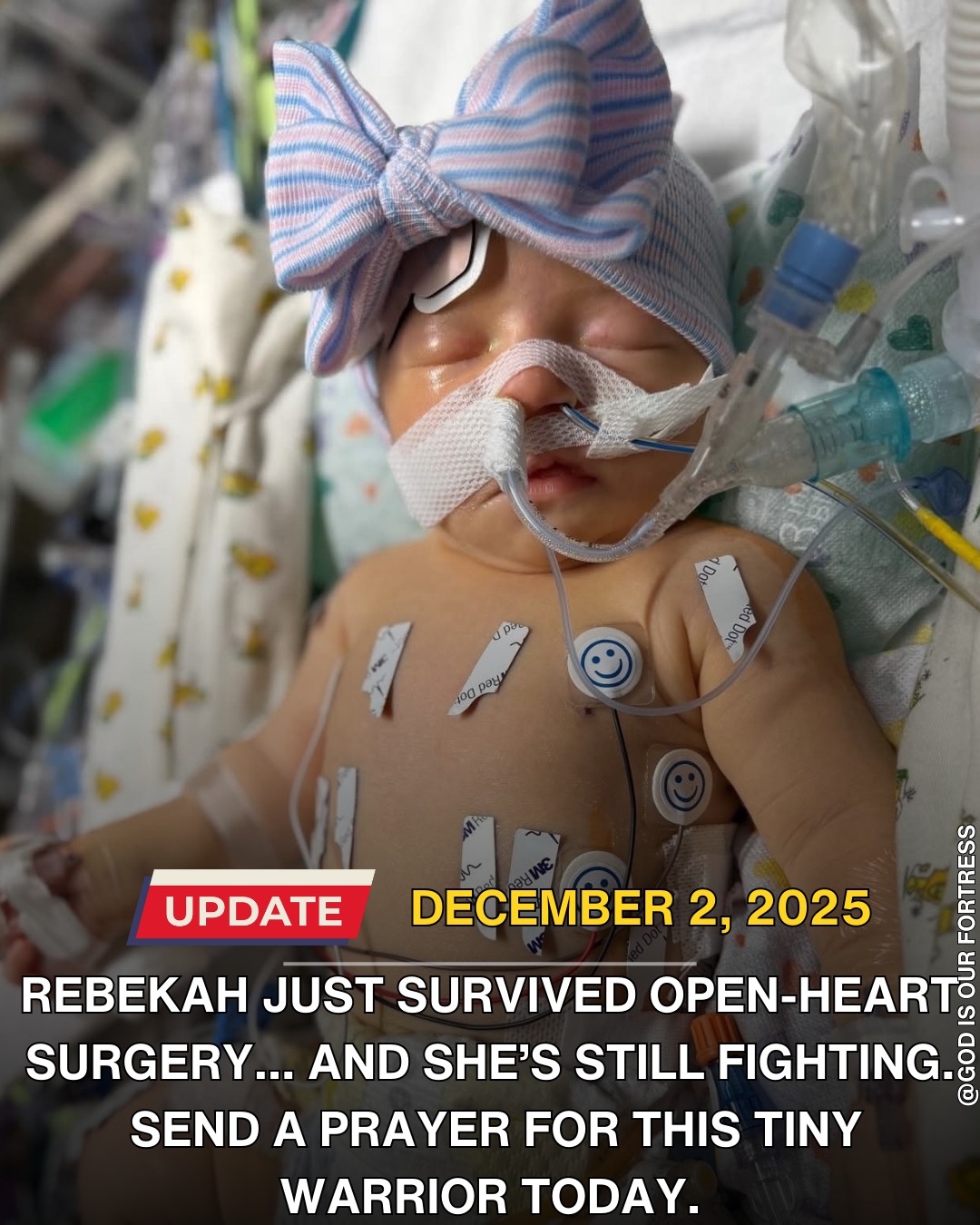
Born Fighting: Baby Rebekah's Brave Journey Through Open-Heart Surgery
She is only two months old, yet her life story already carries more weight than most people face in a lifetime. From the very beginning, baby Rebekah's days have been shaped by hospital rooms, medical charts, and the quiet strength of a family holding onto hope.
A Diagnosis No Parent Expects
Not long after her birth, doctors discovered that something was not right with her heart. Further testing revealed a rare and serious condition known as a hypoplastic aortic arch. This meant that the main artery responsible for carrying blood from her heart to the rest of her body was dangerously narrow, limiting healthy blood flow and placing stress on her developing system.
The aorta is the body's largest artery, the main highway carrying oxygen-rich blood from the heart to every organ. In a hypoplastic aortic arch, a segment of this highway is underdeveloped, dangerously narrow. Blood struggles to get through. The heart must pump harder to force blood past the narrowing, and the organs downstream receive less than they need.
As if that challenge were not enough, doctors also found that Rebekah had a ventricular septal defect (VSD). This is a small opening in the wall separating the lower chambers of the heart. Because of this opening, oxygen-rich blood and oxygen-poor blood were mixing, forcing her heart to work much harder than normal just to keep her body supplied.
A VSD is actually one of the most common congenital heart defects. Many small VSDs close on their own. But combined with a hypoplastic arch, it was not a minor issue. It was part of a dangerous combination.
When Every Breath Becomes a Medical Concern
Together, these conditions created a fragile and urgent situation. Her circulation weakened. Her oxygen levels became unstable. Simple actions that most newborns take for granted, breathing, resting, growing, became medical concerns requiring constant attention.
For parents, this is a special kind of torment. A newborn is supposed to sleep peacefully, feed hungrily, and grow visibly. When instead every breath is monitored, every feeding is a medical event, and growth stalls, the normal joys of new parenthood are replaced by vigilance and fear.
Doctors knew that without swift and specialized treatment, her chances of survival were limited. Congenital heart defects affect roughly 1 in 110 babies born in the United States, but the severe, complex combinations like Rebekah's are far rarer and far more dangerous.
The Decision for Open-Heart Surgery
When Rebekah was still only a few weeks old, her medical team made the difficult but necessary decision to proceed with open-heart surgery. For a newborn, this type of operation is especially delicate. Every movement matters. Every moment carries risk. The procedure required exceptional care, precision, and faith from everyone involved.
Pediatric open-heart surgery is among the most demanding procedures in all of medicine. Consider what it involves:
- A patient the size of a loaf of bread, with a heart roughly the size of a walnut.
- Cardiopulmonary bypass, where a machine temporarily takes over the work of the heart and lungs, adapted for a body with only ounces of blood.
- Microscopic precision, repairing structures measured in millimeters while the clock ticks.
- A specialized team, including pediatric cardiac surgeons, perfusionists, anesthesiologists, and intensive care specialists who do nothing but this.
Parents handing their weeks-old baby to a surgical team face an impossible emotional equation: the surgery might save her, but the surgery itself is terrifying. There is no good option, only the best available one. Rebekah's family chose hope.
Against the Odds
Against the odds, Rebekah made it through surgery. Today, her recovery continues under close medical supervision. Tubes, wires, and monitors surround her tiny body, each one playing a role in supporting her healing.
The days after pediatric heart surgery are their own trial. The child is kept sedated and stable in a cardiac intensive care unit. Ventilators breathe for her. Medications support her blood pressure. Nurses watch numbers that most people never think about: oxygen saturation, chest tube output, urine output, heart rhythm. Progress is measured in the smallest increments: one less medication, one tube removed, one stable hour after another.
Despite the challenges she has faced, there are moments that leave a lasting impression on everyone who sees her. One of those moments is when she wraps her small hand around her mother's finger, holding tightly with a strength far greater than her size suggests.
That grip is more than a sweet moment. For parents in the NICU or cardiac ICU, these small signs of vitality, a strong grasp, a cry, a gaze, are lifelines. They are proof that the child inside the medical machinery is still there, still fighting.
She Is Small, She Is Fragile, But She Is Incredibly Strong
Rebekah's journey is not over, but each passing day brings renewed hope. Her family remains deeply grateful for the doctors, nurses, and caregivers who have stood beside her, and for every sign of progress, no matter how small.
Recovery from complex heart surgery in infancy is measured in months, not days. There will be follow-up appointments, echocardiograms, possibly additional procedures as she grows. Children with repaired heart defects often go on to live full, active lives, but they remain under cardiac supervision long-term. Each milestone, first smile, first steps, first birthday, will carry extra weight for this family, because they know how close they came to losing them.
They continue to ask for prayers and positive thoughts: for healing over her heart, for protection during her recovery, and for strength with every beat that carries her forward.
What Families Facing This Should Know
Baby Rebekah's story is a reminder that courage does not depend on size or age. Sometimes, the strongest fighters come into the world in the smallest bodies, teaching everyone around them the true meaning of resilience, faith, and hope.
For families receiving a similar diagnosis, these points may help:
- Seek a specialized pediatric cardiac center. Outcomes for complex congenital heart defects are strongly linked to surgical volume and team experience.
- Ask questions relentlessly. Good medical teams welcome them. Understanding the plan reduces fear.
- Accept help. Meals, childcare for siblings, rides to the hospital, let people serve you.
- Take care of yourselves. Parental exhaustion and trauma are real. Sleep when you can, eat regularly, and consider counseling.
- Connect with other heart families. Organizations and support groups connect you with parents who have walked this exact road.
- Celebrate small wins. In the cardiac ICU, progress is measured in tubes removed and stable hours. Every one deserves recognition.
Frequently Asked Questions
What is a hypoplastic aortic arch?
It is a congenital condition in which a segment of the aortic arch, the curved part of the body's main artery, is underdeveloped and dangerously narrow. This restricts blood flow from the heart to the body and requires surgical repair.
What is a ventricular septal defect (VSD)?
A VSD is a hole in the wall separating the heart's two lower chambers (ventricles). It allows oxygen-rich and oxygen-poor blood to mix, forcing the heart to work harder. Small VSDs may close on their own, but larger ones, especially combined with other defects, require intervention.
How common are congenital heart defects?
They affect about 1 in 110 babies born in the United States, making them the most common type of birth defect. Most are mild, but complex combinations like Rebekah's are rare and serious.
What does recovery from infant open-heart surgery involve?
An initial stay in a pediatric cardiac intensive care unit with ventilator support, medications, and close monitoring, followed by gradual weaning from support, then ongoing cardiology follow-up. Full recovery takes weeks to months, with long-term cardiac supervision.
Can children with repaired heart defects live normal lives?
Many do. With successful repair and ongoing follow-up, most children with corrected congenital heart defects grow up to live full, active lives, including playing sports in many cases. Long-term cardiology care remains important.
How can I support a family going through this?
Offer practical help (meals, childcare, transportation), respect their emotional bandwidth, avoid minimizing their fear, celebrate small milestones with them, and consider donating to pediatric cardiac research or family support organizations.

