
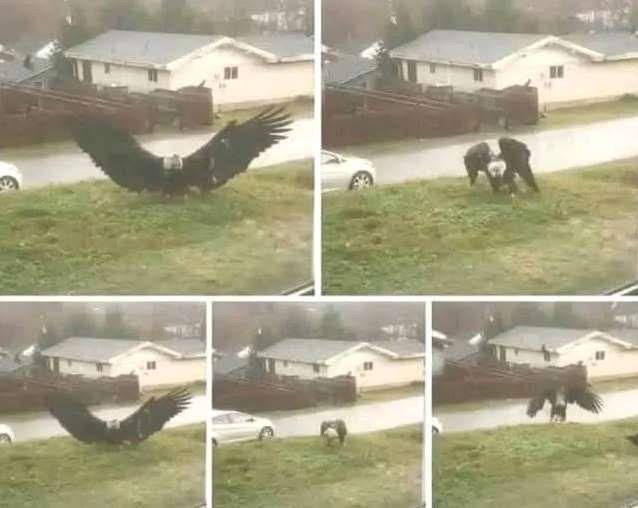
Giant Eagle Captured in Brownsville, Texas: A Discovery That Has Everyone Talking
Brownsville, Texas. A truly astonishing event has captured the attention of wildlife experts and residents across Texas. A massive eagle, far larger than anything typically seen in North America, was recently discovered and safely captured near the Brownsville area. The finding has sparked widespread curiosity, scientific interest, and countless conversations online.
Stories of extraordinary wildlife have a way of capturing the public imagination. Whether this bird represents an unknown subspecies, an exceptional individual, or something else entirely, its discovery has opened a fascinating window into the mysteries that still exist in the natural world.
A Truly Enormous Bird
The giant eagle, boasting an incredible wingspan estimated at nearly 10 feet, was first noticed by hikers exploring a wooded trail near the U.S.-Mexico border. According to witnesses, the bird perched calmly on a tall tree, its impressive size impossible to ignore. Observers described its powerful talons and sharp beak as unlike anything they had ever encountered in the wild.
To put that size in perspective:
- A bald eagle's wingspan typically measures 6 to 7.5 feet.
- A golden eagle's wingspan usually reaches 6 to 7.5 feet as well.
- The largest eagles in the world, such as the Philippine eagle and Steller's sea eagle, can approach 7 to 8 feet.
- Nearly 10 feet would exceed all of these, placing this bird in truly exceptional territory.
If the estimate is accurate, this bird would be remarkable by any standard, which is exactly why scientists are taking the discovery so seriously.
Safe Capture and Conservation Measures
After several days of careful monitoring, wildlife specialists and local authorities worked together to safely capture the eagle. Using professional, non-harmful methods, the team ensured the bird remained unharmed throughout the process.
It has since been transferred to a conservation facility in Brownsville, where researchers are now studying its diet, behavior, and possible origins.
The careful, patient approach matters. Capturing a large raptor is delicate work: the bird's welfare comes first, and rushed attempts can injure both the animal and the handlers. The multi-day monitoring period allowed specialists to observe the eagle's habits, assess its health from a distance, and plan a capture strategy that minimized stress.
A Mystery for Scientists
The discovery has opened the door to new scientific questions. Could this eagle be a previously unknown subspecies? Or is it an extraordinary example of a known species like the golden eagle or bald eagle? Experts are considering all possibilities as they conduct examinations and genetic testing to learn more about this mysterious creature.
Several hypotheses are worth considering:
- An exceptional individual. Just as humans vary in height, individual eagles can occasionally grow far beyond average size due to genetics, abundant food, or other factors.
- A known large species far from home. Large eagles from other regions occasionally wander far outside their typical range.
- A previously undescribed subspecies. The border region's varied habitats could conceivably shelter populations that science hasn't fully documented.
- Hybridization. Crosses between eagle species, while rare in the wild, can produce unusual characteristics.
Genetic testing will be the key. DNA analysis can determine the bird's species, reveal its geographic origins, and identify any unusual genetic markers. Physical examinations will document its measurements precisely, moving beyond eyewitness estimates to hard data.
But the mystery surrounding this enormous bird was far from over.
Excitement in the Community
Residents of Brownsville and nearby areas are buzzing with excitement. Many are eager to follow updates about the eagle and what its discovery could mean for local wildlife. City officials have even discussed the potential creation of a protected sanctuary to support ongoing research and promote eco-friendly tourism.
The Rio Grande Valley is already one of North America's premier birding destinations, drawing visitors from around the world to see species found nowhere else in the United States. A discovery like this one only burnishes that reputation. A protected sanctuary could serve double duty: advancing scientific understanding while giving the local economy a boost through wildlife tourism.
Why the Border Region Produces Wildlife Surprises
South Texas sits at a biological crossroads, which helps explain why remarkable wildlife encounters happen here:
- Convergence of ecosystems. The region blends subtropical, desert, and coastal habitats, supporting extraordinary biodiversity.
- Migration corridor. Millions of birds pass through the Rio Grande Valley annually, including raptors riding thermal currents.
- Proximity to Mexico. Species with ranges centered farther south occasionally appear in Texas, sometimes establishing new populations.
- Under-surveyed areas. Remote stretches of border land receive less scientific attention than they deserve, leaving room for surprises.
What Happens Next
For now, the eagle remains under professional care while research continues. The scientific process is methodical: measurements, blood samples, feather analysis, behavioral observation, and comparison with museum specimens and genetic databases. Definitive answers may take weeks or months.
Whatever the outcome, the discovery has already achieved something valuable. It has reminded the public that the natural world still holds surprises, that conservation science matters, and that paying attention to the wild places around us can lead to genuine wonder.
A Historic Wildlife Moment
The capture of this giant eagle is a remarkable moment for American wildlife studies. As scientists continue their research, the world waits for answers, and hopes that this magnificent bird will help deepen our understanding of nature's hidden wonders.
In an age when it can feel like every corner of the planet has been mapped and catalogued, a ten-foot eagle appearing on a Texas trail is a thrilling reminder: nature still has secrets, and sometimes they land right in front of us.
Frequently Asked Questions
How big do eagles normally get?
North America's bald and golden eagles typically have wingspans of 6 to 7.5 feet. The world's largest eagles reach about 7 to 8 feet, making a near-10-foot wingspan genuinely extraordinary.
What is the facility in Brownsville doing with the eagle?
Researchers are studying its diet, behavior, and origins through examination and genetic testing, while providing professional care in a conservation setting.
Could this be a new subspecies?
It's one possibility scientists are considering, alongside exceptional individual size, a far-ranging known species, or hybridization. Genetic testing will help narrow it down.
Is the eagle in danger?
According to reports, the capture used professional non-harmful methods, and the bird is now in a conservation facility receiving expert care.
Why is South Texas such a hotspot for unusual wildlife?
The region's mix of habitats, position on major migration routes, proximity to Mexico, and under-surveyed wild areas make it one of North America's most likely places for surprising wildlife discoveries.



