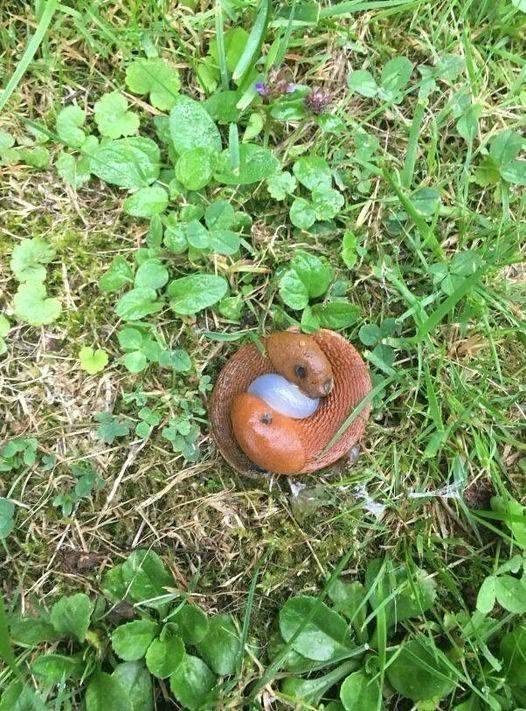
Mysterious Creatures Spotted Online Turn Out to Be Red Slugs in a Rare Natural Event
A photo of several unusual creatures recently captured the attention of internet users, leaving many people wondering what they were looking at. Shared widely on social media and discussion forums, the image sparked countless guesses as viewers tried to identify the mysterious animals.
Theories ranged from alien life forms to deep-sea creatures to elaborate hoaxes. As more people joined the conversation, experts and nature enthusiasts eventually solved the mystery. The creatures were identified as red slugs (Arion rufus) participating in a fascinating part of their reproductive cycle.
What Are Red Slugs?
Red slugs are large land slugs commonly found in damp forests, gardens, and other moist habitats throughout parts of Europe. They can grow impressively large, sometimes reaching 15 centimeters or more, with a distinctive reddish-orange coloration that makes them hard to miss when you do encounter one.
They play an important role in nature by feeding on decaying plants and organic matter, helping recycle nutrients back into the soil. Although many people overlook them, or recoil from them, these slugs are an essential part of healthy ecosystems. Their activity contributes to natural decomposition, which supports plant growth and overall environmental balance.
Think of them as the forest's cleanup crew. Fallen leaves, rotting vegetation, fungi, even carrion: red slugs process it all, returning nutrients to the soil where plants can use them again. Without decomposers like slugs, forests would drown in their own dead matter.
Why Did Their Behavior Look So Unusual?
The viral image showed the slugs during their mating process, which can appear unusual to those unfamiliar with the species. Unlike many other animals, red slugs are hermaphrodites, meaning each individual possesses both male and female reproductive organs.
During mating, two slugs exchange reproductive cells in a process known as mutual fertilization. This unique reproductive strategy has evolved over millions of years and helps ensure successful reproduction within the species.
The courtship itself is elaborate. Slugs circle each other, sometimes for hours, in a slow spiral dance. They exchange chemical signals, align their bodies, and eventually intertwine in a way that, photographed out of context, looks utterly alien. The resulting image, glossy red bodies twisted together in damp leaf litter, is the kind of thing that breaks brains on the internet.
Because this behavior is rarely witnessed by the general public, photos of the event often surprise people and quickly spread online. Most of us encounter slugs as solitary blobs on garden paths. Seeing them engaged in complex reproductive behavior is like discovering your quiet neighbor leads a double life.
The Biology of Hermaphroditism
Hermaphroditism is common among slugs and snails, and it's a brilliant evolutionary strategy for slow-moving animals. When you can't travel far to find a mate, being able to mate with any individual you encounter, rather than only half the population, doubles your reproductive opportunities.
During red slug mating:
- Two individuals meet and begin courtship circling
- Each extends reproductive organs, which in some slug species can be startlingly elaborate
- They exchange sperm mutually, so both partners become fertilized
- Each then goes on to lay eggs, potentially hundreds
This means a single encounter produces two clutches of offspring instead of one. For an animal that moves at a snail's pace (literally), maximizing each mating opportunity is essential.
Why Slugs Deserve More Respect
Gardeners often view slugs as enemies, and it's true they can damage crops and ornamental plants. But the ecological picture is more nuanced.
- Decomposers. They break down dead organic matter, recycling nutrients.
- Food source. Slugs feed hedgehogs, birds, frogs, toads, beetles, and other wildlife. They're a crucial link in the food web.
- Fungal partners. Some slugs disperse fungal spores, supporting the mycorrhizal networks that trees depend on.
- Indicators. Slug populations reflect soil and habitat health. Their presence signals a functioning ecosystem.
The red slug specifically is also facing pressure from the invasive Spanish slug in parts of Europe, making native slug conservation quietly important.
A Reminder of Nature's Diversity
Encounters like this highlight just how diverse and fascinating the natural world can be. Even common creatures living in gardens and woodlands can display behaviors that many people have never seen before.
The viral discussion also demonstrates how online communities can encourage learning. What began as a mystery eventually became an opportunity for thousands of people to discover something new about wildlife and appreciate the incredible variety of life on Earth. The comment section that started with “what IS that?!” ended with detailed explanations of hermaphroditic reproduction. That's the internet at its best.
Whether you're an experienced nature enthusiast or simply curious about the world around you, moments like these remind us that nature is full of remarkable discoveries waiting to be explored. Sometimes they're in remote rainforests. Sometimes they're mating in the leaf litter of a European garden, waiting for someone with a camera phone to notice.
If You Find Red Slugs in Your Garden
- Appreciate them. They're doing important ecological work.
- Protect vulnerable plants with barriers like copper tape or crushed eggshells rather than poisons, which harm the wider food web.
- Provide habitat. Log piles and damp corners support slugs and the wildlife that feeds on them.
- Observe. If you're lucky enough to witness mating behavior, watch quietly. You're seeing something most people never will.
Frequently Asked Questions
What were the mysterious creatures in the viral photo?
Red slugs (Arion rufus), large European land slugs, photographed during their mating process. Their intertwined bodies looked alien out of context.
What is Arion rufus?
A species of large land slug native to parts of Europe, recognizable by its reddish-orange coloration and size. It's an important decomposer in forest and garden ecosystems.
Why do slugs mate the way they do?
They're hermaphrodites, possessing both male and female reproductive organs. Two slugs exchange reproductive cells mutually, so both become fertilized, maximizing reproductive success for slow-moving animals.
Are red slugs harmful?
They can damage garden plants, but ecologically they're beneficial decomposers and an important food source for wildlife. Non-chemical deterrents are preferable to poisons.
Why did the photo go viral?
Because the mating behavior looks bizarre to anyone unfamiliar with slug biology. The mystery, combined with the striking appearance, made it perfect viral material, which then became an impromptu biology lesson for thousands.