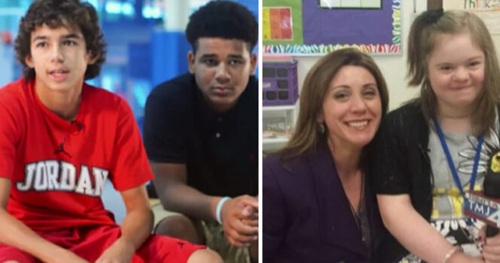
Teenage Cheerleader with Down Syndrome Bullied: Then Basketball Players Stop the Game and Do Something Incredible
Bullying is one of the most painful experiences any young person can face. Whether it happens at school, online, or in everyday life, it can leave deep emotional scars. But sometimes, even in the darkest moments, kindness shines the brightest, reminding us that compassion can change everything.
That's exactly what happened at Lincoln Middle School in Wisconsin, when a group of basketball players did something truly heartwarming for their classmate, Desiree Andrews.
A Cheerleader with a Big Heart
Desiree, a cheerful and talented girl with Down syndrome, loved being part of her school's cheerleading team. Her passion for dance and music made her a bright presence at every game. She cheered loudly for her team and always carried a big smile, a true example of school spirit.
For Desiree, cheerleading was more than an activity. It was where she belonged. On the sidelines, pom-poms in hand, she was not defined by her diagnosis. She was a teammate, a performer, and a vital part of the school community. Her enthusiasm was infectious, and her dedication inspired everyone around her.
Unfortunately, not everyone treated her with the kindness she deserved.
The Moment That Could Have Gone Unnoticed
During one basketball game, a few students in the stands began making rude and hurtful comments toward Desiree. It was an upsetting moment, one that could have easily gone unnoticed in the noise and excitement of the game.
Bullying often thrives in these in-between moments: loud enough to wound, quiet enough to escape consequences. The students making comments likely assumed no one important was listening. They were wrong.
Three of the basketball players noticed, and decided to take a stand.
Heroes on the Court
Scooter Terrien, Chase Vasquez, and Miles Rodriguez saw what was happening and refused to stay silent. Instead of ignoring the bullying, they called for a timeout and walked straight toward the group of students who were teasing Desiree.
Think about what that took. These were middle school athletes in the middle of a game, choosing to stop playing, walk into the stands, and confront their peers. That requires a kind of courage that has nothing to do with athletic ability. It is moral courage, the willingness to do the right thing when it would be easier to look away.
Calmly but firmly, they told the students to stop, making it clear that such behavior had no place in their school. They didn't resort to aggression or insults. They simply stood up, used their voices, and drew a line.
Their brave decision didn't just stop the bullying that day. It sent a powerful message to everyone watching: kindness and respect are stronger than cruelty.
Why Their Actions Mattered So Much
Bystander intervention is one of the most powerful tools against bullying, and also one of the rarest. Research consistently shows that bullying stops quickly when peers intervene, yet most witnesses stay silent, unsure of what to do or afraid of becoming targets themselves.
What Scooter, Chase, and Miles did illustrates several important principles:
- They acted immediately. They didn't wait for a teacher or hope someone else would handle it. Immediate action stopped the harm in its tracks.
- They acted together. There is strength in numbers. Three players standing united sent a far stronger message than one voice alone.
- They were calm and direct. They didn't escalate the situation. They stated clearly that the behavior was unacceptable.
- They used their influence. As athletes, they held social standing in the school. They used that influence to protect someone vulnerable rather than to gain status.
Their actions also mattered because of who Desiree is. Students with disabilities are disproportionately targeted by bullies, and they are often the least able to defend themselves. Standing up for Desiree wasn't just kind. It was a defense of the principle that every student deserves safety and dignity.
A Father's Emotional Words
Desiree's father couldn't hold back tears when he learned about what those boys had done for his daughter. "I just wanted to let them know, as a father, how much I appreciated it," he said.
Any parent can imagine his emotions. Sending a child with Down syndrome out into the world requires trust: trust that teachers will protect them, that classmates will accept them, that the world will be kind. Every parent of a vulnerable child carries a quiet fear of the day that trust is broken. And every parent dreams of the day someone proves that trust was justified.
His words touched the entire community, and the story quickly spread beyond the school walls. What happened in that gymnasium became a story that inspired people far beyond Wisconsin, a reminder that young people are capable of extraordinary compassion.
The Ripple Effect
Since that day, Desiree's teammates and classmates have continued to support her with pride and admiration. The culture of the school shifted. Students learned that bullying would not be tolerated, not just by authority figures, but by their own peers.
This is the ripple effect of moral courage. One act of intervention doesn't just help one victim in one moment. It changes what everyone watching believes is possible and expected. The next time a student considers making a cruel comment, they remember what happened at that basketball game. The next time a witness sees bullying, they remember that intervention works.
Scooter, Chase, and Miles probably didn't think about any of this in the moment. They just saw someone being hurt and decided to act. That instinct, to protect rather than to watch, is what makes their story so powerful.
A Lesson in Kindness
Stories like this remind us that doing the right thing doesn't always require grand gestures. Sometimes, it's as simple as standing up for someone who can't stand up for themselves.
If you're a student who witnesses bullying, remember these boys. You don't need to be an athlete. You don't need a plan. You just need the willingness to say, clearly and calmly, that cruelty is not okay. Tell a trusted adult. Support the person being targeted. Refuse to laugh along.
If you're a parent or educator, talk to the young people in your life about this story. Praise the behavior you want to see. Make it clear that standing up for others is not tattling or overreacting. It is one of the bravest things a person can do.
Scooter, Chase, and Miles showed that courage and compassion can change lives. Their actions turned an ordinary school basketball game into an unforgettable moment of unity and humanity. If more people followed their example, imagine how much kinder and safer our world could be.
Frequently Asked Questions
What happened at Lincoln Middle School?
During a basketball game, students in the stands began making hurtful comments toward Desiree Andrews, a cheerleader with Down syndrome. Three basketball players, Scooter Terrien, Chase Vasquez, and Miles Rodriguez, called a timeout, approached the students, and firmly told them to stop.
Who is Desiree Andrews?
Desiree is a cheerful student with Down syndrome who was a beloved member of her school's cheerleading team at Lincoln Middle School in Wisconsin. She was known for her passion, her big smile, and her school spirit.
How did Desiree's father react?
He was moved to tears. He expressed deep gratitude to the boys, saying he wanted them to know, as a father, how much he appreciated what they did for his daughter.
Why is bystander intervention so important in bullying?
Research shows that bullying often stops quickly when peers intervene. Witnesses who speak up not only help the immediate victim but also shift the culture, making it clear that cruelty will not be accepted by the community.
What can students do if they witness bullying?
Students can calmly tell the bully to stop, support the person being targeted, refuse to participate or laugh along, and tell a trusted adult. Acting together with friends makes intervention safer and more effective.