This Image Has People Perplexed: Can You Solve the Puzzle?
Riddles and visual logic puzzles can turn a simple scene into a surprisingly challenging test of observation. They encourage us to slow down, look carefully at the details, and think beyond the most obvious answer.
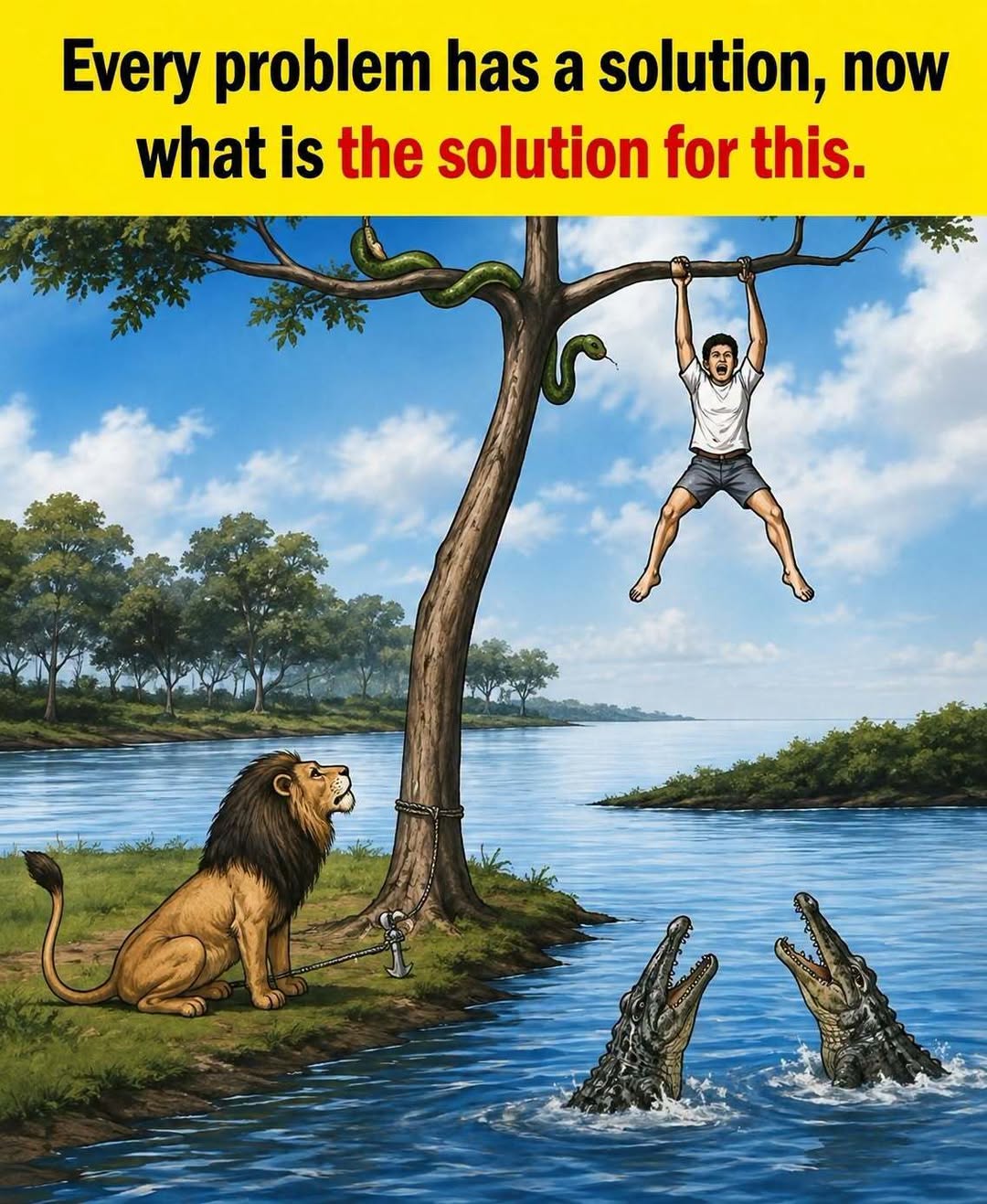
One classic puzzle shows a man surrounded by several dangerous animals. At first glance, it seems as though every possible escape route is blocked. But is the situation really as impossible as it appears? This article walks through the puzzle, its clever solution, and the thinking lesson hidden inside it.
The Setup: A Man Surrounded by Danger
Picture the scene. A man stands in an area with threats on nearly every side.
In one direction, a snake is nearby and appears ready to strike. In another direction, there is a tree beside a lake where crocodiles are waiting in the water. A lion is also moving through the area, cutting off another path.
With danger coming from several directions, finding a safe route looks almost impossible. Every obvious move seems to lead straight into trouble.
Why the Obvious Answers Fail
Run through the options and each one looks bad:
- Move toward the snake. Too risky. It is close and appears ready to attack.
- Head for the lake. The crocodiles are waiting there. Water that looks like an escape route is actually a trap.
- Go around the lion. The lion is mobile and alert, blocking the remaining open ground.
Most people presented with this puzzle cycle through these options, reject each one, and conclude the man is doomed. That conclusion feels logical, but it rests on a hidden assumption: that the scene is frozen in time.
The Key Insight: Scenes Change
The puzzle is not really about being faster or stronger than the animals. It is about paying attention to something most solvers ignore: the situation is not static.
Animals move. They get hungry, thirsty, distracted, and tired. A scene that looks hopeless in one moment can open up in the next, but only if you are watching instead of panicking.
In the classic telling of this puzzle, the turning point comes when the lion gets thirsty and walks to the lake to drink. That single movement rearranges everything. The crocodiles in the water shift their attention to the lion, a much bigger and more interesting development from their point of view. With the predators focused on each other, the man's path clears, and he can move away while the animals are distracted.
The escape was never about outrunning anything. It was about waiting for the board to change.
The Lesson Behind the Puzzle
This brain teaser highlights a principle that applies far beyond puzzles: do not assume that the first situation you see will remain unchanged.
When every option looks risky, the instinct is to act immediately, to pick the least-bad move under pressure. But sometimes the best move is no move at all. Taking a moment to observe can reveal possibilities that are not available yet but will be soon.
This shows up in real life constantly:
- In negotiations, the party that waits often learns something that changes the deal.
- In emergencies, a few seconds of assessment beats a rushed reaction.
- In problem-solving, stepping back from a "hopeless" situation lets new information arrive.
- In conflicts, giving a heated moment time to cool changes what options exist.
Patience is not passivity. It is active observation, and it is a skill.
Why This Puzzle Fools So Many People
Several mental habits conspire to make the puzzle feel unsolvable:
We freeze dynamic scenes. When we look at a picture, we treat it as a snapshot. The puzzle exploits this by presenting a moment that looks final. The solution requires imagining the next moment, which most people never do.
We frame it as a speed contest. The presence of predators makes us think about running, fighting, or climbing. The actual solution involves none of those. Reframing the problem from "how do I beat them" to "what happens next" is the whole trick.
We ignore the animals' needs. Solvers treat the snake, crocodiles, and lion as obstacles, like walls. But animals are agents with their own drives. The lion wants water. The crocodiles want food. Those drives create the opening.
We decide too fast. The puzzle rewards the solver who says "let me think" over the one who says "he's trapped." That pause is the entire difference.
How to Get Better at Puzzles Like This
Visual logic puzzles share a family resemblance. These habits help with all of them:
- Question your assumptions. Ask what you are taking for granted. Here, the assumption was that nothing would change.
- Look for what is not drawn. The solution involves an event that has not happened yet. Train yourself to imagine the next frame.
- Consider every actor's motives. In puzzles with people or animals, ask what each one wants. Motives create movement, and movement creates openings.
- Resist the first answer. Your first read of a puzzle is often the one the creator intended you to have. The real answer is usually one level deeper.
- Explain it out loud. Describing the scene to someone else forces you to notice details you skipped silently.
Try It on Friends
This puzzle works great as a conversation piece. Describe the scene, or better yet, show the image, and ask someone how the man escapes. Give them a minute. Most people will declare it impossible.
Then ask one question: "What happens if you wait five minutes?" Watch their face change. That moment, when the static scene starts moving in their mind, is the puzzle doing its job.
Frequently Asked Questions
Is there only one correct solution?
The thirsty-lion explanation is the classic answer, but the deeper point is the method: observe, wait, and let the situation evolve. Any solution built on that principle captures the spirit of the puzzle.
Are these puzzles good for kids?
Yes, with guidance. They teach patience and creative thinking, though young children may need help seeing past the "he's trapped" reaction.
Why do such simple puzzles go viral?
Because they create a satisfying "aha" moment that people want to share. The gap between "impossible" and "obvious in hindsight" is exactly what makes something shareable.
The next time a problem looks hopeless, remember the man, the lion, and the lake. Sometimes the situation just needs a minute to change, and the smartest thing you can do is watch and wait.