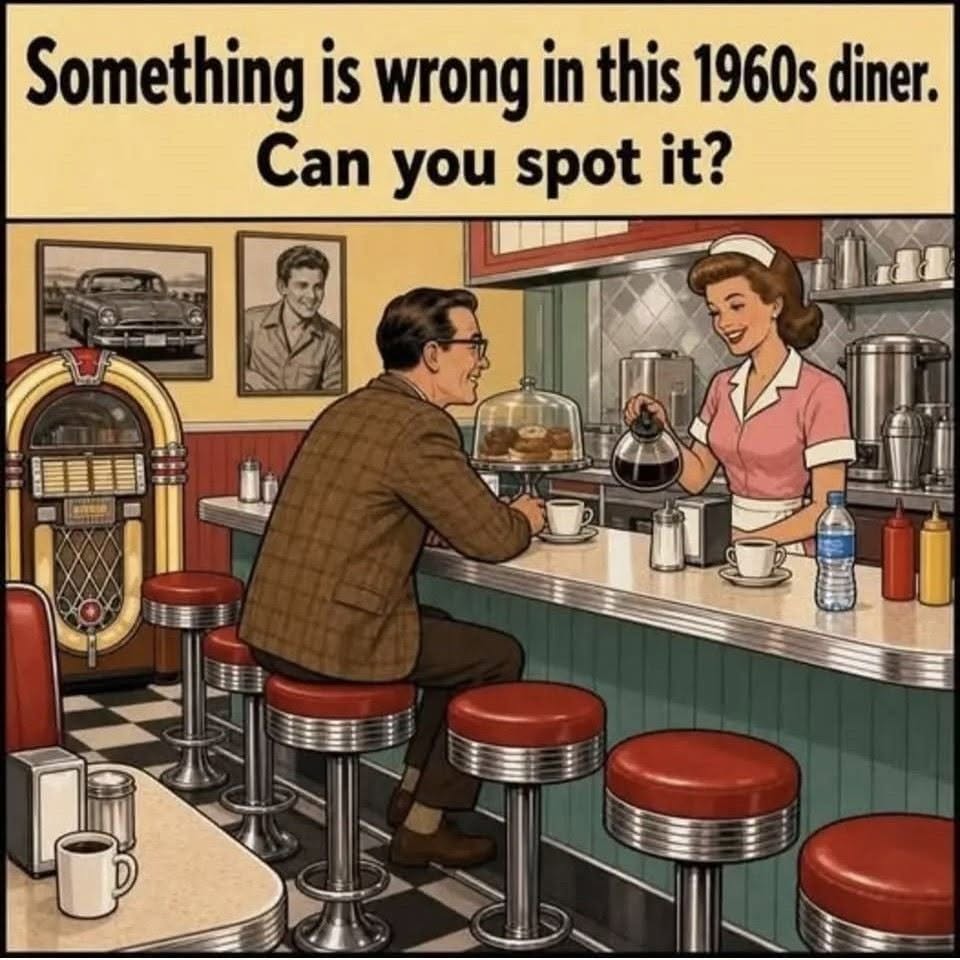
One small detail gives away that something in this nostalgic diner scene isn’t quite right. Can you find it before reading the answer?
At first glance, this illustration looks like a classic American diner from the 1960s. The checkered floor, chrome stools, jukebox, counter seating, and smiling waitress all seem to fit the period perfectly.
But there is one detail that doesn’t belong.
It is easy to miss because the object looks so ordinary to modern eyes. In fact, most people probably look directly at it without giving it a second thought.
Take another careful look at the picture.
Can you spot the mistake?
Chapter 1: A Scene That Looks Completely Authentic
The illustration is filled with familiar details associated with the classic American diner.
The shiny counter immediately catches the eye. Nearby, customers sit casually as they enjoy the atmosphere, while the waitress moves around the restaurant. The checkered floor and vintage decorations add to the feeling that the scene belongs to another era.
There is also a jukebox, another detail that helps establish the nostalgic setting.
Because so many elements look appropriate, your brain quickly accepts the entire picture as historically believable.
That is what makes visual puzzles like this surprisingly difficult.
Instead of examining every object individually, we naturally process the image as one complete scene. Once our brain decides that the setting looks like a 1960s diner, we tend to stop questioning the smaller details.
That can make an obvious clue surprisingly easy to overlook.
Some viewers might first examine the jukebox. Others may look at the waitress, the customer’s clothing, the decorations, or the items sitting on the counter.
But the real clue is much smaller.
And it is hiding in plain sight.
Chapter 2: The Detail That Gives It Away
The answer is an object that looks completely normal today.
Near the waitress and the restaurant’s condiments is a plastic bottle of water.
For someone living in the modern world, there is nothing unusual about seeing bottled water in a restaurant. Plastic water bottles are now common in stores, offices, homes, restaurants, sporting events, and countless other places.
That familiarity is precisely why the object can be so easy to overlook.
When we see a water bottle, our brain immediately recognizes it as an ordinary everyday object. We don’t normally stop to consider when that type of packaging became common.
But the puzzle is asking us to look at the scene from a historical perspective.
A disposable plastic water bottle appearing in a supposedly 1960s diner creates the inconsistency the puzzle is built around.
The widespread popularity of bottled water in the form familiar to consumers today came much later than the 1960s. That makes the bottle stand out as a modern-looking detail placed inside an otherwise vintage setting.
And because it blends so naturally into the scene, many people can look at the image several times without noticing it.
Why Is It So Easy to Miss?
The trick has less to do with eyesight and more to do with attention.
When we look at a familiar environment, our brains often focus on the overall meaning rather than carefully examining every individual object.
In this case, the checkered floor, diner counter, vintage clothing, jukebox, and other decorations immediately communicate one message:
“This is an old-fashioned diner.”
Once that impression is established, smaller objects can escape our attention.
The water bottle doesn’t look strange by itself. It only becomes strange when you compare it with the historical period represented by the rest of the image.
That is what makes the puzzle interesting.
The object itself isn’t unusual.
Its context is.
A Second Look Can Change Everything
Visual puzzles often work by encouraging people to make quick assumptions.
At first, you may simply see a charming diner scene. After being told that there is a mistake, however, your eyes begin searching differently.
Suddenly, the little objects become more important.
You may notice the items on the counter, inspect the waitress’s area, and look at objects that you previously ignored.
This change in attention is part of what makes observation puzzles so enjoyable.
The picture hasn’t changed.
Your way of looking at it has.
Chapter 3: Why People Enjoy “Spot the Mistake” Puzzles
Picture puzzles have remained popular for generations because they offer a simple challenge that almost anyone can understand.
There are no complicated rules.
You simply look carefully and try to find something that doesn’t belong.
That simplicity makes them easy to share with friends and family. One person may notice the answer immediately, while another can spend several minutes searching through the same image.
Sometimes the discussion becomes part of the fun.
“Did you see the bottle?”
“Where is it?”
“Look near the waitress.”
Moments like these turn a simple picture into a small social challenge.
They Encourage Careful Observation
A puzzle like this also reminds us how easily our attention can be directed toward large or familiar objects.
We naturally notice the things that stand out: people, signs, bright decorations, unusual shapes, and major objects.
Small everyday items often receive much less attention.
That is why the smallest clue can sometimes be the most important one.
In this diner scene, the water bottle doesn’t appear particularly dramatic. It isn’t placed in the center of the image or highlighted with a bright circle.
It simply sits there.
Yet that ordinary object changes the way we interpret the entire scene.
The Historical Clue
The puzzle also works because everyday objects can tell us something about different periods of history.
Technology, packaging, clothing, furniture, appliances, and food containers have all changed over time.
An object that seems completely ordinary today might have looked unusual—or been unavailable in its familiar modern form—several decades ago.
That makes historical picture puzzles especially interesting.
Instead of searching only for something visually strange, you can ask a different question:
“Would this object really have been there during the period being shown?”
That simple question can reveal clues that aren’t immediately obvious.
Did You Find It?
If you noticed the plastic water bottle before reaching the answer, you were paying close attention to the smaller details.
If you missed it, you’re certainly not alone.
The scene is designed to look convincing, and the bottle is exactly the kind of familiar object that people tend to ignore.
That’s what makes the puzzle work.
The next time you see a historical photograph, illustration, or “spot the difference” challenge, don’t just look at the biggest objects.
Look at the little things.
Check the items sitting on tables and counters. Examine clothing, packaging, signs, technology, and everyday objects.
Sometimes the smallest detail tells the biggest story.
The Takeaway
The mystery of this 1960s diner comes down to one simple observation: the modern-looking plastic water bottle doesn’t fit comfortably into the period represented by the rest of the scene.
What initially appears to be an ordinary vintage illustration becomes a much more interesting puzzle once you notice that small inconsistency.
And that’s the appeal of visual challenges.
They remind us that our first impression isn’t always the whole picture. Taking a few extra seconds to examine the details can reveal something that was hiding right in front of us.
So, did you spot the bottle on your first attempt—or did you need a second look?