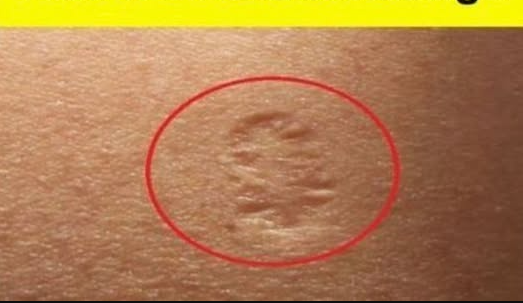
As a child, I clearly remember noticing a distinctive scar on my mother’s upper arm. It sat high near her shoulder, visible when she wore short sleeves. Its placement felt intentional—noticeable, yet not always on display.
What stood out most was its unusual shape. The scar formed a small circle, made up of tiny impressions surrounding a slightly deeper mark at the center. Even at a young age, I knew it wasn’t caused by an injury or everyday accident. It looked deliberate, as if it carried a specific purpose.
At the time, I couldn’t explain why it fascinated me. Children often fixate on small details without understanding why. Perhaps it was the symmetry, or how it contrasted gently against smooth skin. Whatever the reason, it stayed in my mind.
Over time, that curiosity faded. The scar never changed, but my attention did. I stopped wondering about it, and it slowly slipped into the background of memory.
Years later, the mystery returned unexpectedly. While helping an older woman step off a train, her sleeve shifted slightly, revealing the same circular scar—identical in shape, size, and placement.
The sight was startling. Seeing the same mark on someone else made it clear this wasn’t a coincidence. It was something shared by many people of a certain generation.
Later that day, I called my mother. She laughed gently and reminded me that she had explained it years earlier. The scar, she said, came from the smallpox vaccine.
That explanation opened the door to a much larger historical story.
For centuries, smallpox was one of the most dangerous diseases known to humanity. Caused by the variola virus, it spread easily and affected people of all ages. The illness often began with fever and fatigue, followed by a rash that developed into fluid-filled bumps. Many survivors were left with permanent scarring, and some experienced lasting complications.
Before widespread vaccination, outbreaks caused widespread fear. In the 20th century alone, millions of lives were lost worldwide.
The introduction of the smallpox vaccine changed everything.
Unlike most modern vaccines, the smallpox vaccine was administered using a special two-pronged needle. The needle was dipped into a solution containing the vaccinia virus and pressed into the skin several times in quick succession. This method triggered a localized reaction that developed into a small blister.
Over the following weeks, the blister healed and formed a scab. When the scab eventually fell off, it left behind a permanent scar with a distinctive circular pattern.
For people born before the early 1970s, this vaccination was routine in many countries. Although smallpox had already been eliminated in some regions, vaccinations continued as a preventive measure. In 1980, the World Health Organization officially declared smallpox eradicated—the first and only human disease to be completely eliminated worldwide.
The scar became quiet proof that the body had been trained to recognize and defend against a once-deadly virus.
Today, those marks serve as reminders of a major global achievement. They reflect the impact of scientific progress, international cooperation, and public health efforts that protected generations of people.
What once felt mysterious now feels meaningful. That small scar represents resilience, shared responsibility, and a chapter of history written not just in books, but on the human body itself.