The next morning started peacefully. Sunlight came through the windows, birds were singing, and I was making coffee when I opened the front door.
Then I stopped.
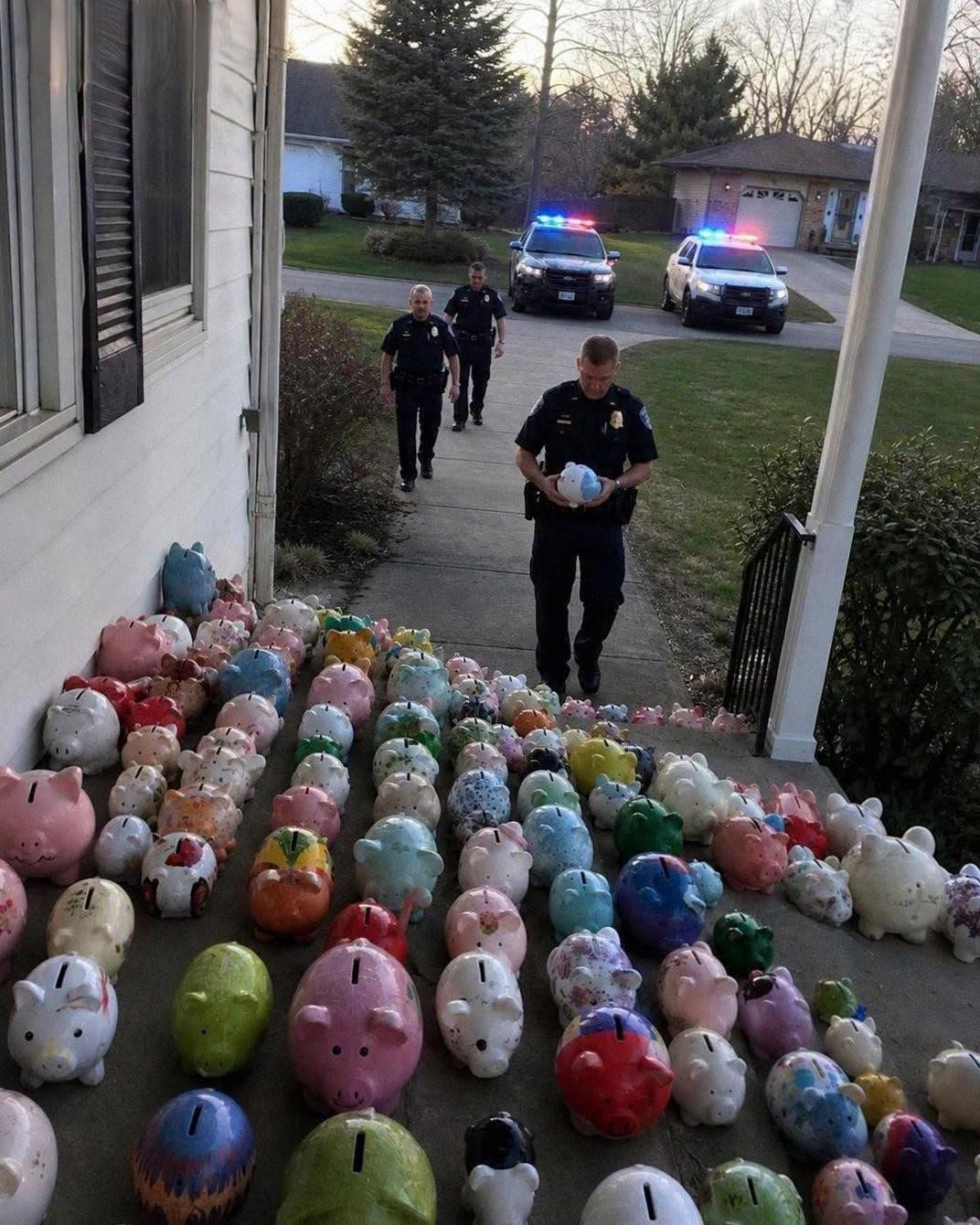
Our porch was covered with piggy banks.
There were dozens of them—ceramic pigs, glass jars, plastic animals, metal boxes, and even a few shaped like trains and churches. They were lined up carefully from our front door to the bottom of the steps.
There was no note and no obvious explanation.
Then I noticed two police cars parked at the end of our driveway.
An officer walked toward me and introduced himself as Sergeant Miller.
“Ma’am,” he said, “we need you to open one of these.”
I looked at the strange collection covering our porch.
“Why?” I asked.
He glanced at the piggy banks.
“That’s what we’re trying to understand.”
What Was Inside the Piggy Banks?
I picked up a small ceramic pig and carefully broke it open.
Instead of coins, several folded pieces of paper fell onto the porch.
They weren’t receipts or financial documents. They were handwritten notes.
One read:
“For the man who gave me his coat when I needed one. 1987.”
Another said:
“For the nurse who stayed late when I was afraid. 2003.”
A third read:
“For the boy who mowed my lawn every summer and never asked for money. 1995.”
I looked at Sergeant Miller.
There were dozens of piggy banks, and each one appeared to contain memories of people who had shown kindness to someone.
That’s when my son Oliver appeared at the door.
He looked at the police cars and then at the broken piggy bank.
“Mom,” he asked, “did Mrs. Adele get her electricity back?”
Suddenly, the events of the previous evening started making sense.
The Neighbor Who Saved Memories Instead of Money
Mrs. Adele was an elderly woman who lived across the street.
The night before, Oliver had noticed that her house was dark. He knew she was having trouble paying her electricity bill, so he brought her his savings.
It wasn’t much, but to a six-year-old, handing over his entire piggy bank was a big gesture.
That simple act apparently meant more to Mrs. Adele than we realized.
Sergeant Miller explained what had happened earlier that morning.
Mrs. Adele had been found sitting safely in her home, surrounded by dozens of piggy banks of her own.
She explained that the banks weren’t really about money.
For years, she had written down memories of people who had helped her during difficult moments. Whenever someone showed her kindness, she recorded what happened and placed the note inside a piggy bank.
She had been collecting those memories for decades.
When Oliver gave her his savings, she realized that she had been holding onto those memories instead of sharing them.
So she decided it was time to return them.
During the night, she placed piggy banks on the porches of people connected to the memories she had saved.
Then she contacted the police because she was worried that people might throw the unusual gifts away without opening them.
A Simple Lesson From a Young Child
Oliver had no idea what was happening behind the scenes.
He didn’t know about Mrs. Adele’s collection of memories.
He didn’t know how long she had been saving the notes.
He simply saw an elderly neighbor who needed help and decided to share what he had.
That was the part that stayed with me.
Adults often make kindness complicated. We think about whether we have enough time, money, or energy to help someone.
Children sometimes see things differently.
Oliver saw a problem and wanted to help.
What We Found in the Notes
We spent the morning opening several of the piggy banks with Sergeant Miller and the other officers.
Inside were hundreds of handwritten memories.
There were notes about a firefighter who had once helped Mrs. Adele.
There was one about a teenager who helped change her tire.
Another remembered a librarian who had allowed her to stay late at the library during a difficult period.
Each note represented a small act that someone might have forgotten.
But Mrs. Adele hadn’t forgotten.
One note in particular brought tears to my eyes.
It was addressed to:
“The little boy across the street who will change the world without even trying.”
It was written before Oliver had ever given her his savings.
He kept the note in his bedroom afterward.
Mrs. Adele’s Electricity Was Restored
By that afternoon, Mrs. Adele’s electricity had been restored.
Neighbors also began checking on her regularly, and a local organization offered additional assistance.
Oliver and Mrs. Adele developed a small tradition they called “butterscotch hour,” when he would visit her and they would talk.
The collection of piggy banks became something different too.
Instead of being reminders of old favors, they became reminders that kindness can continue from one person to another.
Oliver and I eventually started leaving small notes of appreciation for people who had helped our family.
It didn’t require much money.
Sometimes it was simply a handwritten thank-you.
Frequently Asked Questions
Is Mrs. Adele doing okay?
Yes. After the incident, neighbors became more involved in checking on her, and local support helped her with her immediate needs.
Why were the police involved?
Mrs. Adele contacted them because she wanted the recipients to understand that the piggy banks contained meaningful notes rather than simply being random objects left on their porches.
What happened to Oliver’s savings?
Mrs. Adele initially wanted to return the money. Eventually, part of it was used toward her immediate electricity needs, while another portion was donated to a local food bank in Oliver’s name.
Where did all the piggy banks come from?
Mrs. Adele had collected them over many years from thrift stores, garage sales, gifts, and other places.
Each one eventually became a container for a different memory.
Did you open every piggy bank?
Not all of them.
A few remained unopened.
Oliver called them “emergency kindness,” saying they could be saved for a day when someone needed a reminder that people still care.
I couldn’t argue with that.
The Lesson I’ll Remember
Looking back, I almost stopped Oliver from helping Mrs. Adele that evening.
I wondered whether an adult should handle the situation instead.
But I’m glad I let him make his own choice.
He didn’t solve every problem.
He didn’t have a lot of money.
He simply noticed that someone needed help and shared what he had.
Mrs. Adele later told me something I’ll never forget:
“People think kindness has to be something big. Sometimes it’s just a little boy sharing what he has.”
That experience changed the way I look at small acts of generosity.
A kind word, a helping hand, a meal, a ride, or even a few coins can mean more to someone than we realize.
And sometimes, the smallest gesture can create a chain of kindness that reaches much farther than we ever expected.