
A Night of Surprises at St. Mary’s: From Twins to 7UP
St. Mary's Hospital witnessed a truly unforgettable evening in its maternity ward, a night so full of coincidences and laughter that it's still talked about by staff and families today. It began like any other evening shift: fluorescent lights humming, the distant beeping of monitors, and in the waiting area, four expectant fathers, each anxiously awaiting news of his wife in labor.
Though they were strangers, the shared tension made every squeak of a shoe or distant phone ring feel like an omen. One man paced nervously, another stared blankly at a magazine, a third hummed softly to himself, and the fourth sat frozen, his knee bouncing like a drumbeat. None of them could have guessed what the night had in store.
Surprise Number One: Twins
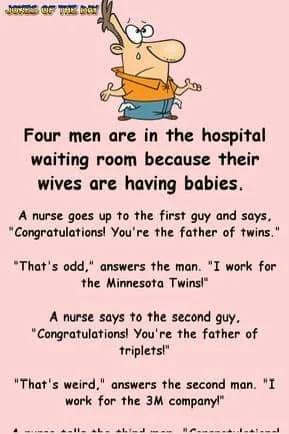
After hours of waiting, a smiling nurse emerged from the delivery rooms. She turned to the first father and announced, "Congratulations! Your wife has delivered twins, two healthy babies."
"Twins? Amazing!" he exclaimed. Then, with perfect comedic timing: "You won't believe this, I work for the Minnesota Twins!"
The room erupted in laughter at the coincidence. The tension that had been building for hours cracked open, and suddenly the four strangers were grinning at each other like old friends. What are the odds, they marveled, that the twins dad works for the Twins?
They had no idea the night was just getting started.
Surprise Number Two: Triplets
Moments later, the nurse returned to the second father with more news: "Congratulations! You're the father of triplets."
He nearly dropped his coffee. "Triplets? Incredible! I work at 3M!"
Again, the tension melted into laughter, louder this time. The men were now leaning forward in their chairs, caught up in the unfolding pattern, half delighted and half disbelieving. Two fathers, two astonishing coincidences. The waiting room had transformed from a chamber of anxiety into the best show in town.
Surprise Number Three: Quadruplets
The third father's news was even bigger. "Sir," the nurse said, "your wife has given birth to quadruplets."
Half in shock and half in delight, he jumped up: "Quadruplets? You've got to be kidding! I work at the Four Seasons Hotel!"
By now the laughter was shaking the walls. Nurses passing by stopped to hear what was happening. The pattern was undeniable and perfect: twins for the Twins employee, triplets for the 3M man, quadruplets for the Four Seasons worker. It was the kind of cosmic joke that no screenwriter would dare invent, because no audience would believe it.
The Punchline: 7UP
Amid the joy, a gentle thud came from the corner of the waiting room. The fourth father, the one who had been sitting frozen with the bouncing knee, had quietly fainted dead away.
When the staff revived him and asked what was wrong, he looked around wild-eyed at the three celebrating fathers and whispered his explanation: he worked for 7UP.
The waiting room exploded. Nurses laughed until they cried. The three fathers, still giddy with their own news, roared with sympathetic laughter. It remains, by all accounts, the funniest moment in St. Mary's maternity ward history.
Why This Story Endures
On the surface, it's a joke with a perfect structure: setup, escalation, punchline. But the reason the story has been retold for years, passed around the internet and shared in break rooms, goes deeper than the humor.
It captures a universal experience. Almost everyone has waited anxiously for medical news, for a loved one in surgery, a child being born, test results that feel like they take forever. The pacing fathers, the bouncing knee, the magazine stared at but not read: anyone who has been there recognizes themselves instantly.
Laughter is medicine for fear. The story's arc mirrors what actually happens in waiting rooms everywhere. Strangers thrown together by anxiety often bond through humor. Shared laughter doesn't just pass the time; it regulates stress, lowers the perceived duration of waiting, and creates fleeting but genuine human connection.
Coincidence delights us. Human brains are pattern-seeking machines, and nothing satisfies that machinery like a perfect, escalating coincidence. Twins, triplets, quadruplets, each matched to a workplace: it's the universe winking at us, and we can't resist winking back.
The Deeper Truth About Waiting Rooms
Beneath the comedy, the St. Mary's story is really about one of life's most vulnerable passages. Each of those four men was waiting to become a father, or to become one again, multiplied. Behind every joke was a woman in labor, medical teams working through the night, and the profound, terrifying, wonderful moment when a family changes forever.
Hospital staff see this duality every day: the clinical and the miraculous, side by side. A maternity ward at 2 a.m. is simultaneously the most ordinary workplace on earth and the site of the most extraordinary event in human life. The nurses who still tell this story remember the laughter, but they also remember the healthy babies, the relieved mothers, and four fathers who walked out of that waiting room changed men.
Frequently Asked Questions
Is the St. Mary's story true?
It circulates as a beloved hospital anecdote and internet story. Like many great waiting-room tales, its exact origins are hard to verify, but its enduring popularity speaks to how perfectly it captures a universal experience.
Why do multiple births seem to come in clusters in stories like this?
They don't, really. Multiple births are uncommon, and four in one night in one ward would be extraordinary. The story's charm comes precisely from its delightful implausibility.
How do hospitals support anxious waiting families?
Modern maternity wards often provide comfortable waiting areas, regular updates from staff, and clear communication protocols. Many also allow birth partners in delivery rooms, reducing the anxious waiting-room experience altogether.
Why is humor so common in stressful medical situations?
Psychologists note that humor is a well-documented coping mechanism. It reduces perceived stress, builds social bonds among strangers in shared adversity, and provides psychological distance from fear.
What are the odds of the workplace coincidences in the story?
Astronomically low, which is exactly why the story works. The escalating pattern, twins/3M/Four Seasons, followed by the 7UP punchline, is structured like a classic joke because it essentially is one, wrapped in a heartwarming setting.



