After 50 Years of Marriage I Asked for a Divorce, But the Letter He Left Behind Changed Everything
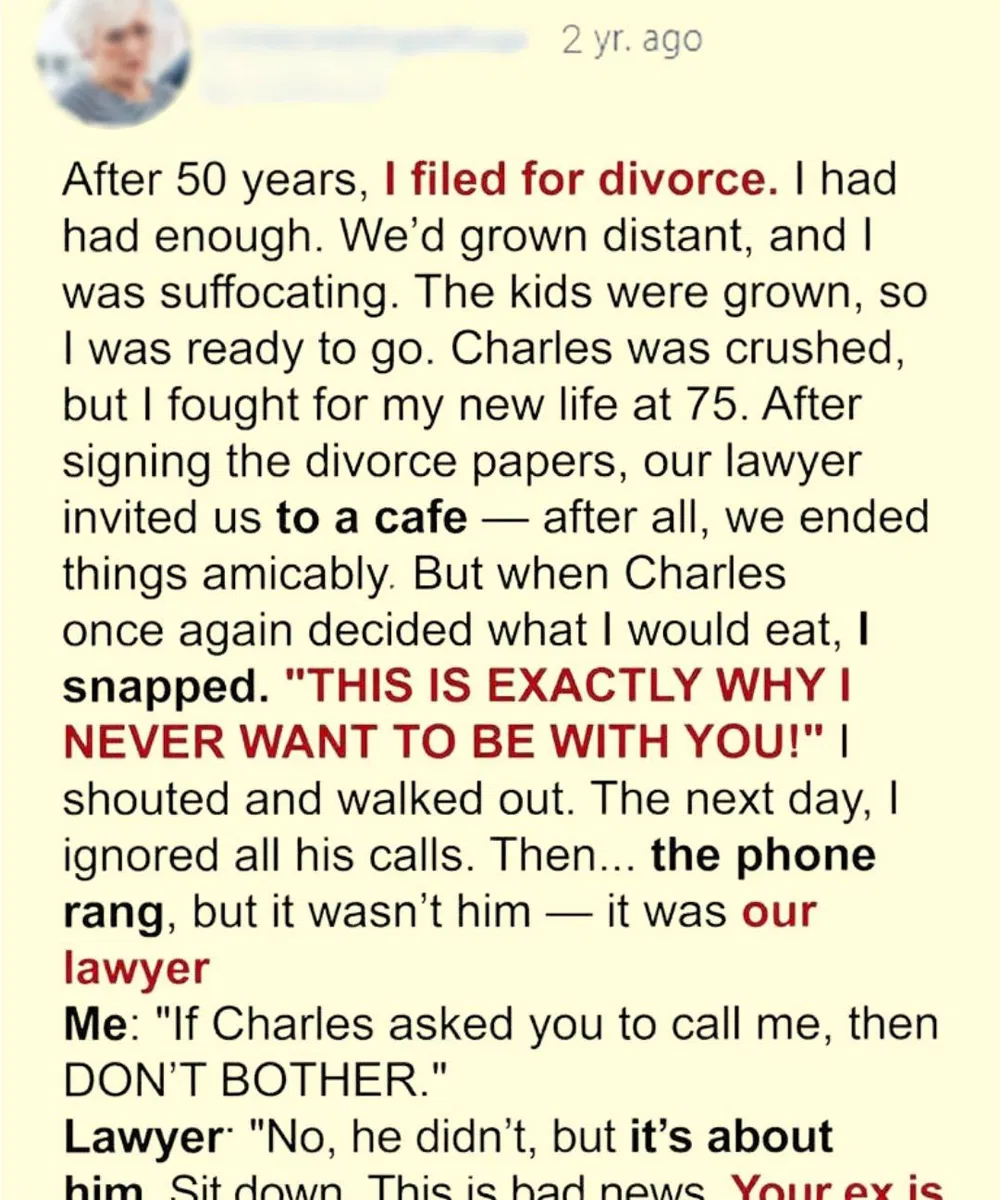
After half a century of marriage, a woman files for divorce. She feels unheard and overwhelmed, ready at 75 to choose herself. The split is respectful. Papers are signed without drama, followed by an almost comfortable coffee. Then, at the cafe, her husband orders for her out of decades of habit, and something in her snaps. She walks out. She ignores his calls. Then the lawyer calls with different news: her husband has collapsed from a severe heart attack and did not survive. At the hospital, collecting his belongings, her daughter hands her an envelope with her name on it. Inside is a handwritten letter. He writes that he was not always good at listening, that he led when he should have learned to follow, but that loving her was the one thing he never doubted. Even after the divorce, in his heart, she was still his wife.
It is a devastating pivot, and it is why the story stays with readers. The anecdote itself cannot be verified, so it should be read as an illustration rather than a proven event. But the emotions it describes are profoundly real for many people: grief tangled with regret, love tangled with the choice to leave, and the particular ache of words that arrive too late. Here is honest guidance on navigating grief, regret, and complicated loss.
When Grief and Regret Arrive Together
Most grief is straightforward in its sorrow. This kind is not. When someone dies shortly after a divorce, especially one you initiated, grief arrives hand in hand with a brutal question: did I do the right thing? The mind replays the cafe walkout, the unanswered calls, the final argument about being ordered for like a child. Every small harshness gets magnified by the finality of death.
A few truths that can steady you:
- Regret is a normal part of grief, not evidence you were wrong. Almost everyone who loses someone replays their last interactions. That is grief talking, not a verdict on your decisions.
- You made the choice with the information you had. You felt unheard and chose yourself after fifty years. Death does not retroactively invalidate that.
- Two things can be true. You can be at peace with the divorce and devastated by the loss. The human heart holds contradictions.
- The last chapter does not erase the whole book. A painful ending does not cancel fifty years of shared life.
The Letter: Why Final Words Hit So Hard
The letter in the story does several things at once, which is why it lands with such force. It acknowledges fault without groveling. It names the specific failure, not listening, leading when he should have followed. And it affirms the one thing she most needed to hear: that she was loved, steadily, to the end.
Final letters carry outsized weight because they feel like conclusions. A few things worth knowing about them:
- They are a gift, not a verdict. His letter tells you how he felt. It does not tell you that you should have stayed. Read it as love, not as instruction.
- Consider writing back. An unsent letter, written by you to him, can be a powerful grief tool. Say what you never said: the anger, the gratitude, the love. You write it to get it out, not to send it.
- Revisit it sparingly. Rereading a final letter daily can keep the wound fresh. Let it become something you visit, not something you live inside.
Complicated Grief After a Chosen Ending
Grieving someone you chose to leave has its own texture. Well meaning people may say confusing things, and neither "at least you had closure" nor "you must feel so guilty" helps. What helps is understanding the specific shape of this grief:
- Relief may mix in, and that is okay. Relief that the struggle is over does not mean you did not love him.
- Anger may point in several directions. At him, at yourself, at the timing, at a letter arriving when conversation is no longer possible.
- The "what if" loop is grief's favorite trap. What if you had answered the calls? These questions have no answers. When the loop starts, name it and redirect to something grounding.
If grief feels stuck, if months pass and the intensity does not shift at all, or if you cannot function day to day, that may be complicated grief, and a grief counselor can help. Seeking help is not weakness. It is maintenance for the hardest work a heart does.
Honoring a Late Spouse After Divorce
You do not need to have been married at the end to honor what was. Some meaningful ways people do this:
- Tell the true stories. Not the sanitized version, the real one: the funny habits, the stubbornness, the way he laughed. Truth honors more than polish.
- Keep one ritual. Morning coffee in his favorite mug. A walk you used to take. One small continuity can anchor chaotic grief.
- Finish something kind in his name. A donation, a planted tree, a contribution to a cause he cared about. Action transforms helplessness into meaning.
- Let your children grieve their father separately. Your complicated feelings are yours. Their loss of their dad is theirs. Make room for both without merging them.
- Forgive the cafe moment. You walked out because you were at your limit after fifty years. He would almost certainly want you to forgive yourself for that.
Supporting an Older Adult Through This Kind of Loss
If someone you love is living this story, an older parent or friend widowed right after a late divorce, here is how to actually help:
- Do not editorialize the divorce. This is not the time for "maybe you should not have left." Ever.
- Show up with specifics. "I am bringing dinner Thursday" beats "let me know if you need anything."
- Listen to the same stories repeatedly. Repetition is how the brain processes loss. Your patience is the therapy.
- Watch for isolation. Older adults who lose a spouse can withdraw quickly. Gentle, regular contact matters more than grand gestures.
- Help with the paperwork. Practical tasks pile up exactly when energy is lowest.
- Suggest counseling as strength, not sickness. "A grief counselor helped my friend so much" lands better than "you need therapy."
Rebuilding a Life at 75 and Beyond
The woman in the story chose herself at 75, and then life rewrote the plan. Whatever comes next, the project remains the same one she started: building a life that is hers. That project is entirely possible at any age:
- New routines. Grief disrupts every habit. Rebuilding deliberate ones, morning walks, regular meals, restores a sense of agency.
- New people and new purpose. Old friendships may need tending, new ones are still possible, and volunteering or mentoring gives the days meaning. Purpose is one of the strongest predictors of wellbeing in later life.
- Patience with the timeline. Rebuilding after fifty years plus a loss does not happen in a season. Measure progress in months, not weeks.
Frequently Asked Questions
I feel guilty for divorcing him before he died. How do I live with that?
Guilt after loss is nearly universal, and it is usually disproportionate to reality. You made a considered decision about your own life. His death does not turn a legitimate choice into a wrong one. If guilt becomes relentless, a grief counselor can help you separate real responsibility from grief's exaggerations.
Is it strange that I miss someone I chose to leave?
Not at all. Missing is about attachment, not about whether the marriage was working. Fifty years of attachment does not dissolve with a signature.
Should I tell people we were divorced when they offer condolences?
Share whatever feels honest and comfortable. "We had recently divorced, but we shared fifty years" is plenty. You do not owe strangers the full story.
How do I handle his family's grief alongside my own?
With clear, kind boundaries. You can attend the service, share memories, and support his children without taking responsibility for everyone's feelings. Your grief is legitimate regardless of the divorce.
The Takeaway
The letter changed everything in the story, but notice what it did not do: it did not undo the divorce, and it did not ask her to. It simply told the truth, that he had loved her all along, imperfectly and completely. If there is a lesson here, it is that love and leaving can coexist, that regret deserves compassion rather than obedience, and that even the most painful endings can contain a final grace note. Hold the letter. Forgive the walkout. And keep building the life you chose, now carrying his love with you instead of his absence against you.