
After Two Decades of Silence, My Brother Spoke Again: Because of My Newborn Son
When my younger brother, Keane, was diagnosed with autism at the age of four, I was still a child myself. Over time, his words slowly disappeared until he stopped speaking altogether. Teachers and neighbors often labeled him, placing him into categories that never quite fit. To me, however, he was simply my brother, gentle, kind, and full of quiet strength.
For more than twenty years, our family communicated with Keane without words. We learned his gestures, his expressions, his routines. We loved him completely in the silence. We had accepted, or thought we had accepted, that his voice was gone for good.
Then my son was born, and everything changed.
Bringing Keane Home
After our mother passed away two years ago, I brought Keane to live with me. It wasn't even a question. Family means being there for one another, and Keane had lost the person who had been his primary world. I wanted him to know, without any doubt, that he still had a home and a family.
Life settled into a calm rhythm. Keane adapted to the new house with the quiet resilience that had always defined him. Not long after, I welcomed my baby boy, Milo, into the world.
I watched Keane watch Milo with fascination. He would sit nearby during feedings, his eyes following the baby's every movement. There was a gentleness in how he observed my son that I recognized immediately. It was the same gentleness our mother had shown him.
The Morning Everything Changed
One quiet morning, everything changed. I had just stepped into the shower when I heard Milo crying from his room. The sound stopped suddenly, replaced by silence. Worried, I rushed to check on him, water still dripping, heart pounding.
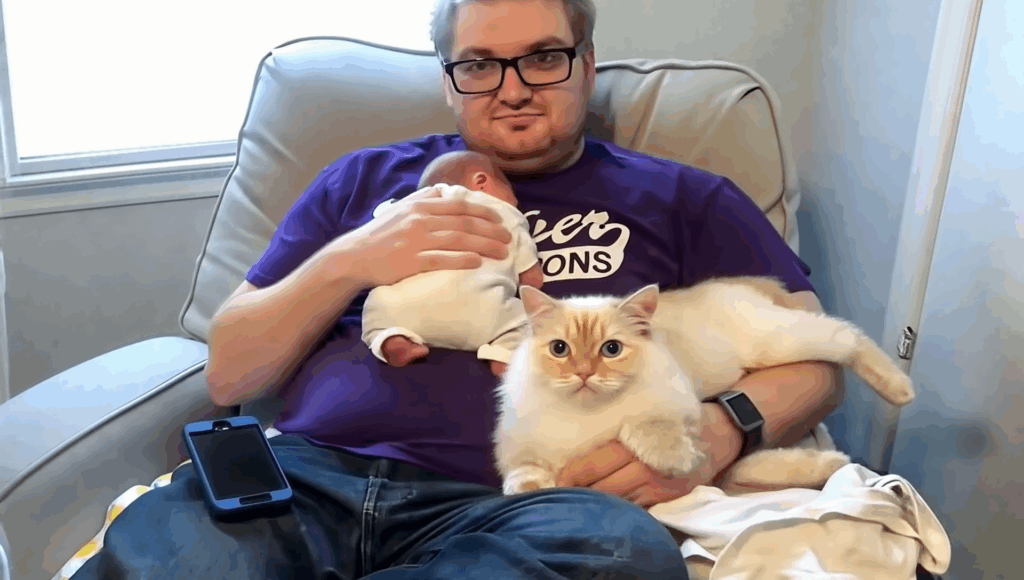
There was Keane, sitting in the rocking chair, gently holding Milo and softly patting his chest. He had heard the crying, gone to the baby, and done exactly what needed doing, calmly, instinctively, perfectly.
Then he looked up at me and said, "He was scared. I made him a heartbeat."
Those were the first words Keane had spoken in more than twenty years.
I stood frozen in the doorway, barely breathing. My brother, who had not spoken since childhood, had just explained, clearly and tenderly, that he had comforted my son by patting a steady rhythm on his chest, giving the frightened baby a heartbeat to hold onto.
What the Specialists Say About Moments Like This
Stories like Keane's, while extraordinary, are not entirely unknown to specialists who work with nonverbal autistic individuals. Researchers and clinicians offer several perspectives on why profound breakthroughs sometimes occur:
- Motivation matters enormously: Speech and communication are deeply tied to motivation. A powerful emotional catalyst, like the drive to comfort a distressed infant, can unlock capacities that lower-stakes situations never reach.
- Regression isn't always permanent: Some autistic children who lose speech retain the underlying neurological architecture for language. The pathways may be dormant rather than destroyed, waiting for the right conditions.
- Routine and safety enable risk: Keane's stable, loving home environment, first with our mother and then with me, provided the safety net that made a communicative leap possible. Stress suppresses; safety invites.
- Nonverbal doesn't mean non-thinking: One of the most important understandings in modern autism research is that lack of speech never meant lack of thought, feeling, or comprehension. Keane had been understanding the world all along. He simply hadn't been speaking to it.
His words that morning weren't random. They were purposeful, empathetic, and articulate, proof of a rich inner life that had been quietly present for decades.
The Weeks That Followed
From that day forward, something remarkable happened. The next morning, he asked for "coffee" and offered to help feed Milo. He began making eye contact, something he had rarely done before. Caring for the baby seemed to unlock something deep inside him.
As the weeks went on, Keane's voice grew stronger, his connection to others deepened, and his confidence blossomed. He started with single words and short phrases, then longer observations. He asked questions. He expressed preferences. He laughed at jokes and, wonder of wonders, made a few of his own.
Our family watched in awe as the brother we had always known, but never heard, finally introduced himself in words.
What Keane Taught Us About Patience and Presumption
Keane's story carries lessons that extend far beyond our family.
Never mistake silence for absence. For twenty years, the world treated Keane as though his quietness meant emptiness. It didn't. His first sentences revealed a person who had been perceiving, feeling, and understanding all along. How many other silent people are similarly misjudged every day?
Love is a long game. Our mother never stopped talking to Keane, reading to him, including him, even when he gave nothing verbal back. I continued the same after she passed. That decades-long investment of love and inclusion created the foundation his breakthrough stood on. Patience isn't passive. It's faith with endurance.
Purpose can unlock what pressure cannot. Years of therapy and structured intervention hadn't produced speech. What produced it was a crying baby who needed comfort and an uncle whose heart responded before his doubts could intervene. Sometimes the key isn't trying harder but caring about something more.
Everyone deserves to be spoken to. One of the quiet tragedies of Keane's silent years is how many people stopped really talking to him, as if conversation required reciprocation. Our mother never made that mistake, and I try not to either. Speak to people as if they understand. They often do.
A New Chapter
Today, Keane is Milo's devoted uncle, and Milo, now growing fast, adores him with the uncomplicated worship toddlers reserve for their favorite people. They have their own games, their own jokes, their own language built from twenty silent years and one miraculous morning.
When I hear my brother's voice now, whether he's asking for coffee or narrating Milo's antics, I still feel a catch in my throat. Two decades of silence, broken by seven words: "He was scared. I made him a heartbeat."
It turns out Keane had been listening to heartbeats all along. He was just waiting for the right one to answer.
Frequently Asked Questions
Can nonverbal autistic adults regain speech?
It is uncommon but documented. Some individuals who lost speech in childhood retain underlying language capacity that can emerge later, often triggered by strong motivation, reduced anxiety, or significant life changes. Every person's neurology is different.
Does this mean all nonverbal autistic people could speak?
No. Autism is a spectrum with diverse neurological profiles. Some nonverbal individuals have the capacity for speech that hasn't emerged; others communicate best through alternative methods like devices, sign, or typing, which are equally valid and complete forms of communication.
What helped most in this story?
A lifetime of being included, spoken to, and loved without conditions, plus a powerful emotional motivation: comforting a frightened baby. Safety, patience, and purpose combined to create the breakthrough.
Should families keep talking to nonverbal loved ones?
Absolutely. Specialists strongly recommend continuing rich verbal interaction, reading, narration, and conversation, regardless of whether speech is returned. Comprehension often far exceeds expression.
What is the takeaway for how we treat nonverbal people?
Presume competence. Interact with nonverbal individuals as full, thinking, feeling people. Silence is a mode of being, not a measure of worth or awareness.



