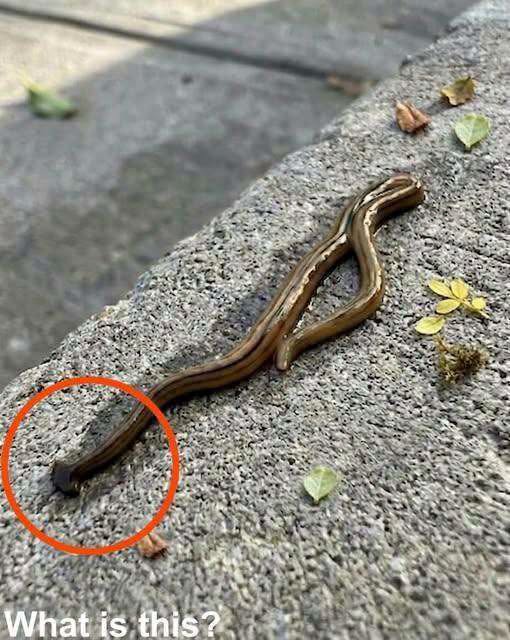
Early one morning, I stepped outside to enjoy some fresh air when something unusual on the ground immediately caught my attention.
A long, shiny creature was slowly moving across the soil. At first glance, I assumed it was some kind of worm. But after taking a closer look, I noticed that its body and head looked very different from the earthworms I was familiar with.
Its body was dark and elongated, with visible markings along its surface. What really stood out, however, was its head. It was unusually flat and wide, with a shape that reminded me of a small shovel or hammer.
I watched from a safe distance as the creature moved smoothly across the ground. Its movement was different from that of a typical earthworm, which made me even more curious about what I had discovered.
Rather than touching it, I decided to observe it and take note of its appearance. The unusual shape of its head was the biggest clue that this was not an ordinary garden worm.
What Was the Strange Creature?
After searching for information and comparing photographs, I learned that the creature appeared to be a hammerhead worm, a type of terrestrial flatworm known for its distinctive head shape.
Hammerhead worms belong to a group of flatworms that live on land. They are generally recognized by their elongated bodies and flattened heads, which can vary in shape depending on the species.
Unlike earthworms, which help break down organic material in the soil, hammerhead worms are predators. They feed on smaller organisms and other invertebrates, including earthworms and related creatures.
Their unusual appearance can make them seem mysterious when encountered for the first time, especially if you have never seen one before.
Why Does Its Head Look Like a Hammer?
The most recognizable feature of these flatworms is their head.
Depending on the species, the head can have a broad, flattened appearance that resembles a hammer or shovel. This distinctive shape is one of the main characteristics used to identify them.
As the animal moves across the ground, its broad head can appear to sweep from side to side. This behavior contributes to its unusual appearance and can make it look quite different from familiar garden creatures.
Should You Touch One?
If you come across an unfamiliar animal in your garden, the safest choice is usually to observe it without handling it.
Some hammerhead worm species produce substances associated with capturing and consuming their prey. Because different species can have different characteristics, there is little reason to handle an unknown specimen with bare hands.
It is also a good idea to keep children and pets from disturbing unfamiliar wildlife. If you need to move around the area, simply give the creature plenty of space and allow it to continue on its way.
There is generally no need to panic simply because you have spotted one. Seeing an unusual flatworm is more likely to be an interesting nature encounter than an immediate cause for concern.
A Reminder That Nature Can Be Surprisingly Diverse
What initially looked like a strange worm turned out to be a fascinating example of how diverse life can be around our homes.
Many creatures look unfamiliar simply because we rarely notice them. A garden, lawn, or patch of soil can contain a surprising variety of insects, worms, fungi, and other organisms that quietly play their part in the local ecosystem.
This experience also reminded me how easy it is to make assumptions based on appearance. I initially thought I had found an ordinary worm, but its unusual head and movement suggested otherwise.
Sometimes, the best way to understand a strange discovery is simply to observe it carefully and learn more about it.
The next time you notice something unusual moving through your garden, you might be looking at a creature you have never encountered before. Instead of immediately assuming what it is, take a moment to observe its features from a safe distance. You may discover something surprisingly interesting living right beneath your feet.