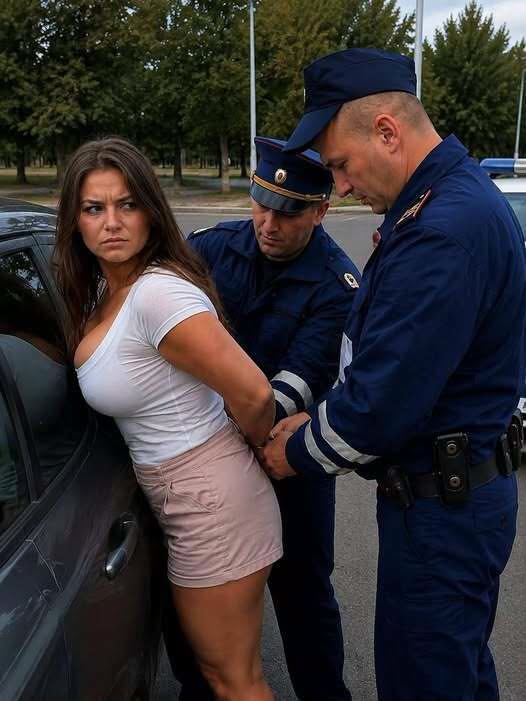
What began as a routine traffic stop quickly became an unexpected situation for two police officers.
During the encounter, one officer searched a small leather case belonging to Victoria. When he opened it, he noticed an official badge and identification card from Internal Affairs. His attitude immediately changed.
Victoria was not simply a driver caught up in an ordinary traffic stop. She worked as an investigator whose responsibilities included examining allegations of police misconduct and reviewing whether officers had followed proper procedures.
The second officer looked at the identification carefully. The situation suddenly took on a different meaning. Just moments earlier, the officers had been giving Victoria firm instructions and treating her as a routine traffic-stop subject. They now understood that their actions could potentially be reviewed as part of an official investigation.
The officers removed the handcuffs and began explaining their decisions. They maintained that they had been following procedure and believed the situation had required their actions. However, the events that had already taken place could not simply be undone.
Victoria remained calm and focused on documenting the encounter. She made it clear that the incident would be reviewed through the appropriate channels.
There was also another important detail the officers did not appear to realize at first: the encounter had been recorded.
Victoria’s vehicle had captured part of the interaction, while her phone was also recording. The footage preserved important portions of the traffic stop, including the initial interaction, the officers’ instructions, and the subsequent use of handcuffs.
The recordings had also been backed up, helping preserve the evidence for later review.
After supervisors arrived, the incident was examined more closely. According to the story, the recordings raised questions about whether the officers had sufficient justification for how they handled the situation and whether their actions were consistent with department procedures.
The case eventually resulted in disciplinary consequences. One officer reportedly lost his position and faced criminal allegations related to the incident, while the other received significant disciplinary action and was subjected to additional review.
The incident serves as a broader reminder of why accountability and proper procedures are important during interactions between law enforcement officers and the public.
A routine traffic stop can sometimes become complicated, but remaining calm, documenting events when legally permitted, and following established procedures can help ensure that disputes are properly reviewed.
In this case, the recordings became an important part of the investigation. What initially appeared to be an ordinary roadside encounter ultimately received much greater scrutiny because questions were raised about how the situation had been handled.