
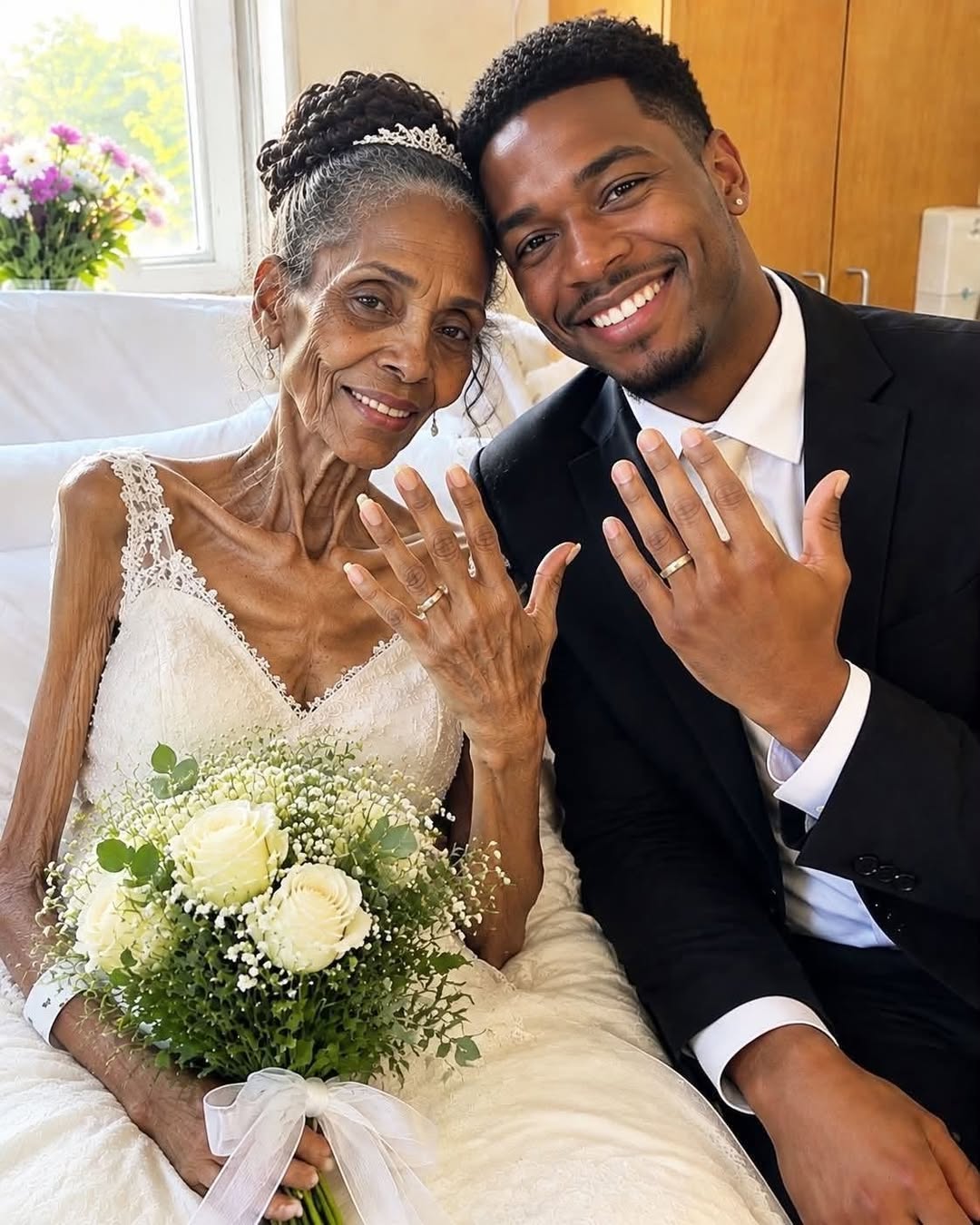
When I agreed to help a 70-year-old hospice patient fulfill her lifelong dream of wearing a wedding dress, I believed I was giving her one final happy memory. I never imagined that, after her funeral, her lawyer would approach me with an old photograph and a sealed envelope that could change everything I knew about my own past.
“I need you to see something,” he said quietly. “Eleanor didn’t choose you by accident.”
I had no idea what he meant.
A few years earlier, I had begun volunteering at a local hospice, hoping to spend time with people who needed companionship and someone willing to listen. That was where I met Eleanor Marsh, a 70-year-old woman whose illness had left her with limited time but had not completely taken away her warm personality.
Despite the difficult circumstances, Eleanor still had moments when her sense of humor and gentle smile filled the room. During my visits, we talked about ordinary things, read books together, and shared stories about life.
Over time, our conversations became something I looked forward to. Eleanor had a way of making even a quiet afternoon feel meaningful.
She often spoke about the things she had experienced and the opportunities she believed had passed her by. Although she rarely complained, there was one regret she eventually shared with me that I never forgot.
She had never experienced what it felt like to be a bride.
Eleanor explained that she had always imagined wearing a beautiful wedding dress, holding a bouquet, and having someone stand beside her on a day devoted to celebrating her. It was a simple wish, but one that carried years of unspoken sadness.
“I just want to know what it feels like to be chosen,” she told me one afternoon.
Her words stayed with me long after I left her room.
By then, Eleanor had become much more than someone I visited as a volunteer. I genuinely cared about her, and I wanted her remaining days to include something beautiful to remember.
So I decided to help make her wish come true.
I found a simple white gown and arranged for a chaplain to visit the hospice. We planned a small ceremony that would allow Eleanor to experience the moment she had imagined for so many years.
On the day of the ceremony, something wonderful happened. Eleanor seemed to have more energy than usual. She stood beside me, smiling brightly, and proudly raised her hand so that the camera could capture the ring on her finger.
For those few precious moments, the room felt different. There were no conversations about her illness or the uncertainty of the future. Instead, there was laughter, happiness, and the excitement of a woman finally experiencing a long-held dream.
I watched Eleanor smile in her white dress and realized how much a small act of kindness could mean to someone.
A few weeks later, Eleanor passed away peacefully.
Her funeral was quiet and simple. Only a few hospice nurses and I stood near her grave beneath a gray sky. We had come to say goodbye to someone who had touched our lives, and the silence that followed the service made her absence feel even more real.
As the nurses began returning to their cars, a man wearing a dark suit approached me. He introduced himself as Mr. Hale, Eleanor’s lawyer, and offered his condolences.
At first, I assumed he had come to discuss routine matters concerning her estate. However, his expression changed as he looked around to make sure nobody else was close enough to hear our conversation.
He opened his briefcase and removed a thick, sealed envelope.
“I need you to see something,” he said.
Then he added a sentence that immediately caught my attention.
“She didn’t choose you by accident.”
I stared at him, confused, before accepting the envelope. I had spent countless hours with Eleanor, but she had never suggested that there was a hidden reason behind our friendship.
What could she possibly have wanted me to discover?
The Photograph That Changed Everything
My hands trembled slightly as I opened the envelope.
Inside was an old photograph of a young woman standing alone in front of a church. She wore a simple white dress and had a bright smile, the kind that suggested she believed her future was full of possibilities.
I turned the photograph over.
On the back, Eleanor had written a sentence in her own handwriting:
“This was the day everything was taken from me.”
I looked at the lawyer, hoping he could explain what I was holding.
“What does this mean?” I asked.
Mr. Hale paused before answering.
“Eleanor didn’t always live alone,” he said. “She once had a family. A husband and a daughter.”
His words surprised me.
During all the time I had known Eleanor, she had given me the impression that she had spent most of her life without close family. She had never told me about a husband or a daughter, and I had never suspected that there was a painful history behind her quiet life.
“She never told me any of this,” I replied.
The lawyer explained that there had been circumstances that prevented Eleanor from discussing certain parts of her past for many years. Before her death, however, she had asked him to investigate my background and family history.
That revelation left me with more questions than answers.
“Why would she want to know about my family?” I asked.
Mr. Hale looked at me carefully before revealing the reason.
According to him, Eleanor had given birth to a daughter many decades earlier. The child had been given up for adoption, and Eleanor had spent approximately forty years trying to find her.
I could hardly believe what I was hearing.
The woman I had known as a lonely hospice patient had apparently spent much of her life carrying the pain of losing a child. And somehow, she had connected that long-buried story to me.
“There is more inside the envelope,” the lawyer explained. “A name, a date, and a hospital record.”
He studied my face for a moment before preparing to leave.
“I think you already know whose name is on it,” he said.
But I wasn’t sure I was ready to discover the answer.
The Documents Eleanor Left Behind
I returned to my car and sat quietly for several minutes before examining the remaining papers.
The cemetery had almost emptied. The last vehicles had disappeared through the entrance, leaving me alone with the envelope resting on my lap.
Beneath the photograph were three documents.
The first was a hospital record from St. Agatha’s Medical Center. The date was approximately fifty-one years earlier, and the mother’s name was listed as Eleanor Ruth Marsh.
The space for the father’s name was blank.
Another section recorded the outcome of the birth and contained the words “relinquished voluntarily.”
I read the document more than once, trying to understand what it meant for Eleanor and the child she had once carried.
The second paper was an adoption agency intake form. It contained an assigned case number and part of the receiving family’s surname. Some information had been covered, but the city remained visible.
It was the same city where I had grown up.
That detail made the situation feel much more personal. Until then, I had considered Eleanor’s story a mystery about someone else’s past. Now, I was beginning to wonder whether it might have something to do with my own life.
I placed the first two documents on the passenger seat and picked up the final item.
It was a handwritten letter on pale blue stationery.
The ink had faded slightly, but the words were still readable.
Eleanor had written it for me, knowing that Mr. Hale might deliver it after she was gone.
“If you are reading this, then Mr. Hale found you, and I am already gone,” the letter began.
“I am sorry for that. I would have preferred to tell you myself, sitting in that chair by the window where we used to read together. I would have preferred to watch your face.”
I stopped reading for a moment.
I remembered the chair beside the east-facing window in Eleanor’s room. I had sat there every Tuesday and Thursday afternoon for nearly two years. It was where we had shared stories, read together, and talked about the little things that made life meaningful.
I also remembered our final conversations.
The week before she passed away, Eleanor had held my hand and told me how much my visits had meant to her.
At the time, I thought she was simply expressing gratitude for the companionship we had shared.
Now, those memories seemed to carry a different meaning.
I flattened the letter against my knee and continued reading.
“I did not choose you because you were kind, though you were. I did not choose you because you were patient, though you were that too.”
The next lines made my heart beat faster.
“I chose you because of your birthday. Because of the name of the town on your volunteer application. Because when I looked at your face the very first day, I saw something I had not seen in fifty years.”
Then came a short sentence that left me struggling to understand what I had just read.
“I saw myself.”
I stared at the page, thinking about the photograph, the hospital record, and the adoption documents. The details seemed to be connecting in a way I had never anticipated.
Eleanor had recognized something familiar in me from the beginning. My birthday and the town where I had grown up had apparently given her reasons to investigate my family history.
But she had also been careful not to make a definite claim.
In the letter, she explained that she could not be completely certain of what the evidence meant. She was neither a scientist nor a judge, and she understood that her suspicions needed to be examined carefully.
Then she mentioned that she had hired Mr. Hale to help investigate the connection.
I held the letter in my hands, knowing that the remaining words might finally explain why Eleanor had chosen me to share such an important moment with her.
For the first time since the funeral, I began to understand that the wedding ceremony might have meant far more to Eleanor than I had ever realized.
What I had believed was a final act of kindness might have been connected to a family story that had remained unresolved for decades.
And the truth, whatever it turned out to be, was waiting in the rest of her letter.
