
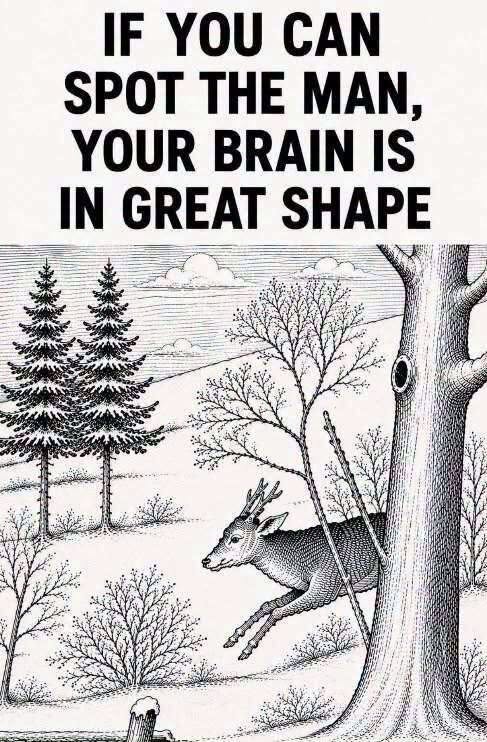
At first glance, this black-and-white illustration looks like a peaceful winter scene straight out of an old storybook. Tall evergreen trees stand quietly in the distance, delicate branches stretch toward the sky, and a deer appears to be leaping across the snowy landscape. A massive tree dominates the right side of the picture, adding depth and detail to the woodland setting.
But there is more to this illustration than meets the eye.
Hidden somewhere in the scene is the shape of a man, and finding him may be more difficult than you expect. The human figure blends into the surrounding details so naturally that many people initially focus on the deer, the trees, and the snowy ground without noticing the hidden image.
The challenge is simple: Can you spot the man hiding in the picture?
Take a moment to examine the illustration before reading any further. You might discover the answer quickly, or you may need to look at the image several times before the hidden figure becomes clear. Either way, the challenge is a fun opportunity to test your attention to detail and see how easily your eyes can recognize familiar shapes in an unusual setting.
A Peaceful Forest With a Hidden Surprise
The illustration contains several elements that make it easy to overlook the concealed figure. On the left side, two tall evergreen trees rise above the snowy landscape. Their layered branches create a repeating pattern of dark lines against the lighter background.
Near the center, a leafless tree spreads its thin branches in different directions. Smaller bushes and patches of vegetation cover parts of the ground, while distant trees create the impression of a quiet forest extending into the background.
On the right, the thick trunk of a large tree immediately attracts attention. Its textured bark, visible roots, and dark opening provide plenty of detail for the eye to explore.
Then there is the deer.
The animal appears to be moving through the snow, with its legs stretched forward and backward as though it has been caught in the middle of a leap. Its antlers, body, and legs create several intersecting lines that add even more complexity to the composition.
With so many details competing for your attention, it is easy to concentrate on the most recognizable objects and miss the unusual shape hidden within the picture.
That is precisely what makes this visual puzzle so engaging. The image encourages you to move beyond your first impression and examine the scene from a different perspective.
How to Search for the Hidden Man
If you have already looked at the picture and cannot find the man, do not worry. Sometimes, the hardest part of a hidden-picture challenge is knowing where to direct your attention.
Instead of scanning the entire illustration randomly, try examining it in sections.
Begin with the trees on the left. Look at the branches, the spaces between them, and the outlines formed by the surrounding landscape. Then gradually move toward the center, paying attention to the bare tree and the bushes beneath it.
Next, examine the deer. Its body contains several distinct shapes, and its position may naturally draw your eyes toward the middle of the illustration. However, try not to assume that the animal is the only important figure in the scene.
Finally, turn your attention to the large tree on the right. Study the trunk, the dark opening, and the surrounding contours. Look for arrangements of lines that might resemble a human face or another recognizable part of a person’s body.
The key is to remain open to different interpretations. A line that initially looks like a branch might form part of another shape when viewed alongside nearby details.
Why Your Eyes Might Miss Something So Obvious
Have you ever searched for an object in a room, only to discover that it was sitting directly in front of you?
A similar experience can happen when solving visual puzzles.
Human vision does not work like a camera that records every detail with equal attention. Instead, the brain continuously organizes incoming information, recognizes patterns, and prioritizes objects that seem important.
When you look at a forest illustration, your attention naturally goes toward familiar elements such as trees, animals, and the landscape. Once your brain identifies those objects, you may stop examining their outlines as carefully.
This tendency can make a hidden figure surprisingly difficult to recognize, even when the relevant shapes are visible.
The same principle explains why some optical illusions seem to change when you look at them again. At first, you may see one object or pattern. After noticing a new arrangement of shapes, the entire image can suddenly appear different.
With this puzzle, the challenge is not simply to look at every part of the picture. It is to reconsider what those parts might represent.
The Importance of Looking at Negative Space
One useful technique for solving hidden-picture puzzles is to pay attention to negative space.
Negative space refers to the empty areas surrounding and separating objects. People often concentrate on the objects themselves, but the spaces between them can sometimes reveal unexpected patterns.
For example, the gaps between branches may create outlines that resemble familiar shapes. The edges of an animal’s body may also interact with nearby objects to form a second image.
Instead of focusing only on the dark lines in the drawing, examine the lighter areas around them. Look at the boundaries between the tree, the deer, and the background.
You may find that the hidden figure becomes easier to recognize when you stop treating each object as a separate element and start examining how the shapes fit together.
This approach is useful for many types of visual puzzles, including hidden animals, concealed faces, illustrated riddles, and classic optical illusions.
Why These Picture Puzzles Remain Popular
Hidden-image challenges have entertained people for generations. Long before online brain teasers became common, illustrated puzzles appeared in newspapers, magazines, activity books, and children’s publications.
Their appeal comes from their simplicity. You do not need special equipment, technical knowledge, or complicated instructions. All you need is the image and a little patience.
They are also easy to share. A person can send a picture to a friend, ask a family member to solve it, or challenge a group of people to find the hidden object first.
Different viewers may approach the same illustration in completely different ways. One person might immediately notice a shape near the edge of the image, while another spends several minutes studying the center.
That difference makes the experience entertaining, especially when people compare their observations afterward.
The winter forest puzzle is particularly effective because the scene already contains several familiar objects. Your attention has plenty of obvious places to go, making the hidden figure less noticeable during the first few seconds.
Can Solving This Puzzle Improve Your Brain?
Visual challenges are often advertised as tests of intelligence or signs of exceptional mental fitness. However, a single puzzle cannot determine how intelligent someone is or provide a reliable assessment of overall brain health.
That does not mean these activities have no value.
Looking for hidden objects can encourage careful observation, visual discrimination, and attention to detail. Puzzles can also provide a relaxing break from everyday routines and offer an enjoyable way to spend time with others.
The most important thing is to approach the challenge as entertainment rather than a formal test.
Whether you find the man in five seconds or need several attempts, the result does not define your intelligence. Some people are simply more familiar with this particular style of illustration, while others may notice different visual details first.
If you enjoy the challenge, you can try other puzzles that involve finding hidden faces, identifying unusual objects, or discovering multiple images within a single drawing.
A Helpful Hint Before You Give Up
Still searching?
Here is a clue that may help you narrow down the possibilities without immediately giving away the answer.
Pay special attention to the large tree trunk on the right side of the picture, particularly the dark opening and the shapes around it.
Do not look only for a complete human figure standing in the forest. Instead, consider whether the lines and contours in that area could form part of a face or another recognizable human feature.
You can also try changing the distance between your eyes and the screen. Looking at the image from slightly farther away may help you notice a broader pattern, while moving closer can make individual lines and small details easier to examine.
Another useful trick is to take a short break. After staring at a complicated image for too long, you may become fixated on your original interpretation. Looking away for a few seconds and returning with fresh eyes can help you notice details you previously overlooked.
Give yourself another opportunity to solve the puzzle before checking the comments or asking someone else for help.
The Final Challenge: Did You Find Him?
Now that you have examined the forest, studied the deer, and explored the large tree, take one last look at the original illustration.
Try to identify the man without relying on the hint. Once you recognize the hidden shape, see whether you can explain exactly which lines helped you discover it.
If you solved the puzzle quickly, you may enjoy challenging a friend who has not seen the image before. Avoid pointing toward the answer immediately; let them explore the scene and develop their own interpretation.
If you needed more time, there is no reason to feel discouraged. Hidden-image puzzles are designed to make ordinary shapes appear in unexpected ways, and the solution is not always obvious at first.
So, did you spot the hidden man? How long did it take you to find him: a few seconds, a couple of minutes, or several attempts?
Share your experience in the comments and challenge someone else to solve the puzzle. You might discover that the person sitting beside you notices the hidden figure almost immediately—or struggles to find it even after receiving a hint.
Sometimes, all it takes is a different perspective to reveal what was hiding in plain sight.
