
I Stepped Outside for Fresh Air What I Found on My Porch Left Me Stunned
It was supposed to be a quiet, ordinary morning. I stepped onto my porch to enjoy some fresh air and ease into the day. The neighborhood was calm, the weather was pleasant, and nothing seemed out of the ordinary.
Then I noticed something resting near the edge of the porch. At first, I couldn't quite make sense of what I was seeing.
The Discovery
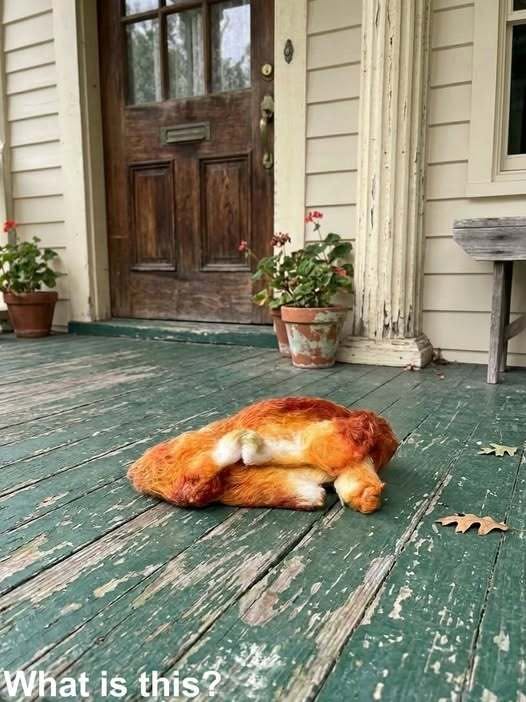
There, against the weathered wooden boards, was a small bundle of reddish fur. From a distance, it looked remarkably like an animal curled up and sleeping peacefully. The sight immediately caught my attention and brought me to a stop.
For several moments, I simply stood there watching. I looked carefully for any sign of movement: a twitch, a shift in position, or even the slightest indication that the creature was awake. But everything remained perfectly still.
The unexpected discovery filled me with questions. How had it gotten there? Was it injured? Had it wandered onto the porch during the night? My mind raced through scenarios, each more concerning than the last. Should I call animal control? Try to help it? Leave it alone?
Wanting answers, I moved closer for a better look. As the details became clearer, my initial assumptions quickly changed.
The Truth Revealed
What appeared to be a sleeping fox was actually a patch of fox fur that had likely been left behind after a nighttime encounter in the surrounding area. No animal. No emergency. Just fur, arranged by chance into a shape that my pattern-seeking brain instantly interpreted as a living creature.
The realization brought an immediate sense of relief, followed quickly by amusement at myself. I had stood frozen on my own porch, heart pounding, over a clump of fur.
But the experience stuck with me longer than the embarrassment lasted, because it revealed something fascinating about how our minds work.
Why Our Brains See Animals Everywhere
What happened on my porch has a name: pareidolia, the tendency to perceive meaningful patterns, especially faces and living creatures, in random stimuli. It's the same phenomenon that makes us see faces in electrical outlets, animals in clouds, and figures in shadows.
This isn't a glitch. It's a feature, shaped by evolution:
- Predator detection: For our ancestors, mistaking a clump of fur for a sleeping predator was a cheap error. Mistaking a predator for a clump of fur was fatal. Evolution favored the overcautious brain.
- Agent detection: Humans are hypersensitive to signs of other living beings. We'd rather see ten false animals than miss one real one.
- Pattern completion: The brain constantly fills in gaps, constructing whole creatures from fragments of color, shape, and texture. A reddish blur plus a curved shape equals "fox" before conscious thought gets a vote.
- Emotional priming: In a quiet morning moment, slightly alert and alone, the brain's threat-detection systems run a little hot, making false positives more likely.
So my porch "fox" wasn't foolishness. It was ancient survival software doing exactly what it was designed to do.
Nature Is Always at Work Around Us
At the same time, the discovery served as a powerful reminder of something many of us rarely think about. Nature is constantly at work around our homes, even when we don't see it.
That fox fur told a story: sometime in the night, while I slept, wild animals moved through my yard. Perhaps two foxes tangled in a territorial dispute. Perhaps a predator and prey crossed paths inches from my door. An entire drama unfolded in the dark, and I slept through all of it, waking only to find the evidence.
Our homes sit within ecosystems, not apart from them. Raccoons patrol at midnight. Owls hunt from the rooftops. Foxes, coyotes, deer, and countless smaller creatures treat our neighborhoods as their habitat, because they are. We're the newcomers who built porches in the middle of their world.
What To Do When You Find Wildlife (or What Looks Like It)
My false alarm is a good prompt for the real protocol. If you find what appears to be a wild animal on your property:
- Observe from a distance first. Many "injured" animals are simply resting. Give it time and space.
- Don't touch. Wild animals can bite or scratch when frightened, and some carry diseases. Admire with your eyes.
- Keep pets and children away until you know what you're dealing with.
- Call professionals if the animal is clearly injured, trapped, or behaving strangely. Local animal control or wildlife rehabilitators know what to do.
- Check for nests or young nearby before assuming an animal is abandoned. Many mothers leave babies temporarily while foraging.
And if it turns out to be a patch of fur? Laugh at yourself, take a photo, and enjoy the story. Not every mystery needs to be an emergency.
The Morning After
I still step onto my porch most mornings. I still scan the boards out of habit, half expecting another visitor. Most days there's nothing but wood and weather. But every so often, I find some small sign of the night's activities: a feather, a footprint in the dust, a chewed corner of something.
Each one is a reminder that the world is wilder and more alive than our routines suggest, and that sometimes, the most startling discoveries are just nature leaving its calling card.
Even if it's only fur.
Frequently Asked Questions
What is pareidolia?
It's the psychological phenomenon of perceiving meaningful patterns, like faces or animals, in random or ambiguous stimuli. It's a normal, universal feature of human perception rooted in evolutionary survival mechanisms.
Why do we mistake objects for animals?
Evolution favored brains that err on the side of detecting living threats. A false alarm costs little energy; missing a real predator could cost your life. This bias persists in modern humans.
What should I do if I find an injured wild animal?
Observe from a distance, don't touch it, keep pets and children away, and contact local animal control or a licensed wildlife rehabilitator for guidance.
Is fox fur on my porch a cause for concern?
Generally no. It usually indicates normal wildlife activity, such as a territorial encounter or grooming. Foxes are typically shy and avoid humans. Only be concerned if you see aggressive behavior or signs of illness.
How can I learn about the wildlife around my home?
A simple wildlife camera, a field guide to local species, or a nature observation journal can reveal the hidden activity in your own yard. You might be surprised what's been visiting all along.



