SEO Title: Morning Rush Hour Multi-Vehicle Highway Crash Brings Traffic to a Standstill
Meta description: A serious multi-vehicle crash during morning rush hour brought a busy highway to a standstill and triggered a major emergency response. Here is what was reported, what drivers saw, and what is still unconfirmed.
For thousands of commuters, the morning began like any other ordinary weekday.
Cars filled the roads, buses carried passengers toward their destinations, and workers hurried through familiar routines while trying to arrive at their offices on time. Parents were taking their children to school, delivery drivers were preparing for busy schedules, and countless travellers were making their way through the usual rush hour congestion.
Nothing about the morning appeared particularly unusual.
The familiar sounds of engines, traffic signals, and impatient horns created the soundtrack of another busy day. Drivers moved slowly through crowded lanes, occasionally glancing at their dashboards or checking the time as they navigated the constant flow of vehicles.
But within moments, that ordinary scene transformed into a frightening emergency.
A Morning That Began Like Countless Others
Morning rush hour is one of the busiest periods on any major roadway.
Thousands of drivers often travel along the same routes at approximately the same time, creating conditions in which even a small disruption can have widespread consequences.
Some commuters leave home early to avoid congestion. Others have little flexibility because their work schedules, school commitments, or appointments require them to travel during peak hours.
As traffic builds, vehicles frequently move in tightly packed groups. Drivers accelerate when gaps appear, slow when congestion increases, and change lanes in hopes of finding a faster route.
Under ordinary circumstances, this movement can seem predictable. Experienced commuters know where traffic typically slows, which lanes tend to become congested, and how long their journeys usually take.
However, familiarity can sometimes create a false sense of security. A roadway travelled hundreds of times may still present unexpected hazards. A sudden mechanical problem, an abrupt lane change, poor visibility, or a momentary lapse in attention can create conditions that require immediate action.
In the reported incident, witnesses described traffic as already heavy before the collision occurred. That detail is significant because congested roadways leave drivers with less room to respond when something goes wrong.
The Initial Impact and the Chain Reaction
According to the account provided by witnesses, the accident appeared to begin with an impact involving two cars.
The precise circumstances surrounding that first collision were not established in the available account. There was no confirmed information explaining whether the initial impact resulted from sudden braking, a lane changing manoeuvre, a mechanical problem, reduced visibility, or another factor.
Determining the cause of a traffic collision generally requires more than eyewitness impressions. Investigators may need to examine physical evidence, review available recordings, assess roadway conditions, and interview the people involved before reaching reliable conclusions.
What witnesses described, however, was the rapid escalation that followed the initial impact.
As the two vehicles collided, nearby drivers apparently reacted by braking suddenly. The abrupt reduction in speed created a dangerous situation for vehicles travelling immediately behind them.
In heavy traffic, stopping distances become critically important. A vehicle moving at highway speed cannot stop instantaneously, even when its brakes are functioning properly.
The driver must first recognise the hazard, decide how to respond, and physically apply the brakes. During those moments, the vehicle continues moving forward. Once braking begins, additional distance is required to bring the vehicle to a complete stop. If the available distance is insufficient, a collision may become difficult or impossible to avoid.
This helps explain why one accident can trigger several others in rapid succession.
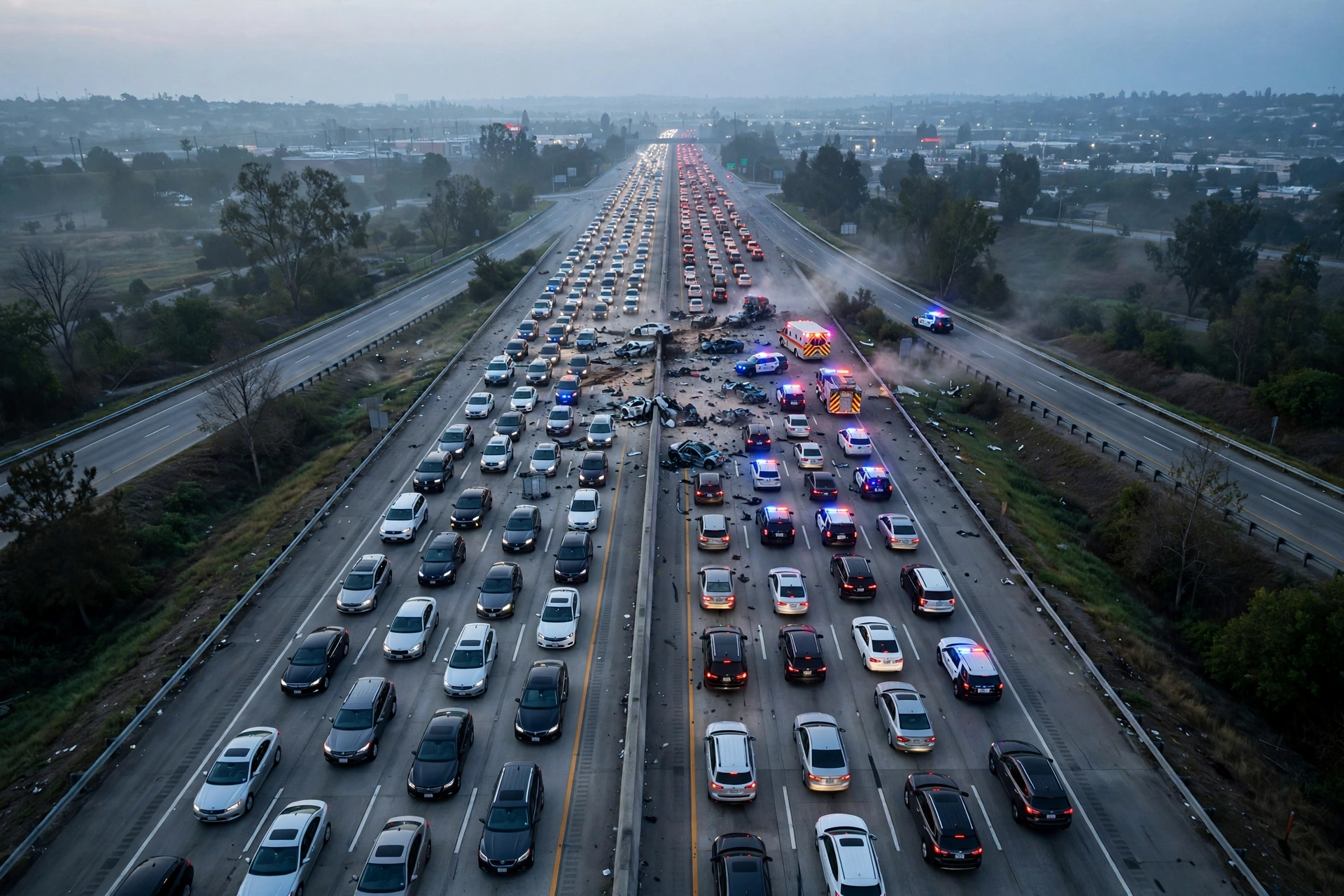
In the reported crash, the first impact was apparently followed by additional collisions involving vehicles travelling through nearby lanes. The resulting chain reaction reportedly extended across multiple portions of the roadway.
Some vehicles suffered relatively minor damage, while others sustained much more substantial impacts. Several were described as badly crumpled, indicating that considerable force had been involved.
As damaged vehicles came to rest, they obstructed traffic and prevented other motorists from passing safely. The accident quickly became more than a collision between two cars. It developed into a complicated roadside emergency involving damaged vehicles, uncertain injury conditions, blocked lanes, and potential hazards that required immediate professional attention.
What Drivers Saw as They Approached the Wreckage
Motorists who were travelling shortly behind the accident described a disturbing scene.
Instead of the usual flow of traffic, they encountered sudden congestion and vehicles that had stopped unexpectedly. Some reported seeing dust rising from the roadway. Others noticed scattered glass and debris surrounding disabled cars.
The damaged vehicles were reportedly positioned across multiple lanes, leaving little room for other traffic to continue.
For drivers approaching at speed, such conditions can be especially dangerous. The first indication of an accident may be a line of brake lights appearing ahead. If visibility is limited by a curve, a hill, dust, smoke, weather, or surrounding traffic, motorists may have even less time to react.
An important part of avoiding a secondary collision is recognising that the traffic ahead has slowed or stopped. Unfortunately, drivers approaching an unexpected obstruction may not immediately understand the seriousness of the situation. Some may assume that congestion is temporary. Others may try to change lanes at the last moment, which can create further risk.
For those caught in the congestion, the situation was both confusing and deeply unsettling. Some motorists immediately pulled over and contacted emergency services. Others remained inside their cars, uncertain whether it was safe to move forward or leave their vehicles.
Emergency Response at the Scene
Within minutes, emergency responders began arriving.
Police officers worked to secure the scene, firefighters assessed damaged vehicles, and paramedics prepared to provide medical assistance to anyone who might have been injured. Flashing emergency lights soon illuminated the roadway.
For responders, this type of scene presents several challenges at once. Their first responsibility is to protect human life, but they must also prevent the situation from becoming even more dangerous. That means identifying possible injuries, checking for trapped occupants, controlling traffic, and assessing the risk of additional collisions.
A multi-vehicle incident can require coordination between several emergency services because no single team can safely manage every aspect of the situation alone.
There were also reports of helicopters overhead and a growing crowd of concerned bystanders. Those reports were not confirmed in the available account, and they added to the atmosphere of urgency around the scene.
Meanwhile, information about the accident spread rapidly through social media, where eyewitness observations mixed with speculation and unverified claims. In fast developing incidents, early online reports often contain details that later turn out to be incomplete or incorrect, which is why official updates matter.
Traffic Comes to a Standstill
The crash brought a normally busy roadway to an almost complete standstill.
Vehicles that could no longer move remained in the lanes. Debris blocked parts of the road. Emergency vehicles needed space to work. As a result, traffic behind the scene backed up quickly, affecting far more people than those directly involved in the collision.
Commuters who were nowhere near the impact still found themselves delayed, rerouted, or stuck in congestion for a long period. School runs, work arrivals, deliveries, and appointments were all disrupted.
The incident illustrates how quickly a routine journey can become a dangerous situation and how an unexpected collision can affect far more people than those directly involved.
It also highlights the importance of emergency preparedness, responsible driving, public cooperation, and accurate information during a rapidly developing roadside crisis.
What Is Still Unknown
As emergency crews concentrated on their work, several important questions remained unanswered:
- What caused the initial collision
- How many vehicles were involved in total
- Whether anyone was trapped inside the wreckage
- How many people were injured, if any
- How long the roadway would remain closed
- When normal traffic flow would resume
Until official sources confirm those details, they should be treated as unknown rather than assumed.
What to Do If You Approach a Crash Scene
General road safety guidance is clear in situations like this. Slow down early when you see brake lights ahead. Increase the distance between your vehicle and the one in front. Do not change lanes suddenly. Keep emergency lanes clear. If you can pull over safely and call emergency services, do so without putting yourself in danger.
Above all, avoid relying on rumours while the scene is still active. Follow instructions from police and emergency crews, and check official traffic updates for confirmed information about closures and reopening times.
Frequently Asked Questions
What caused the crash?
The cause has not been confirmed in the available account. It will require investigation.
How many vehicles were involved?
The report describes a multi-vehicle chain reaction, but it does not give a confirmed total number.
Was anyone injured?
No confirmed injury figure was provided in the available account. Paramedics were on scene to assess anyone who might have been hurt.
How long was the road closed?
That information was not confirmed at the time of the report.
Where did the crash happen?
The location was not named in the available account, which is why this article does not state a specific highway, city, or date.