My Only Daughter Refuses to Give Me Grandchildren: Now She Won't Get My Inheritance
Family decisions are never easy, especially when emotions, expectations, and money all become tangled together. One of the most sensitive topics in any household is the question of children. While some couples choose to have them, others may decide against it, or face challenges beyond their control. Unfortunately, when parents and grandparents step into the picture with strong opinions, family bonds can quickly unravel.
This is exactly what happened in one mother's story. Her daughter's decision regarding children completely changed the way she viewed her inheritance, and what followed left the entire family shaken.
A Mother's Hope for Grandchildren
The mother recalls, "My daughter got married last year, and like any parent, I quietly dreamed of becoming a grandmother. I imagined birthday parties, holidays with little ones running around, and carrying on the family name."
The longing for grandchildren is one of the most common and deeply felt desires among parents of adult children. It is rarely about control. More often, it is about continuity: the wish to see the family story continue, to experience the particular joy of a new generation, and to play a meaningful role in a grandchild's life.
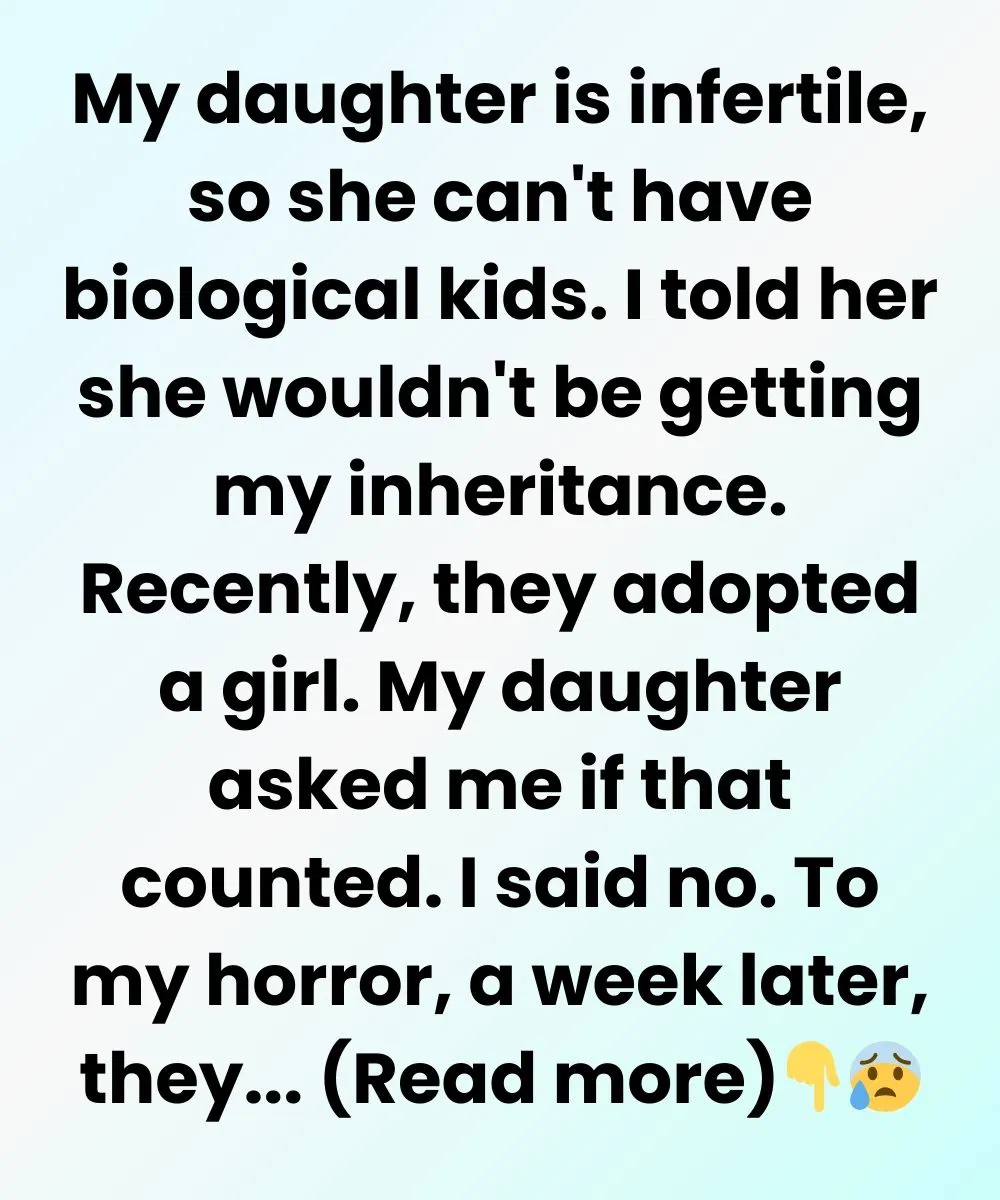
But her dream took an unexpected turn when her daughter sat her down and confessed that she was infertile. "I was stunned," the mother admitted. In that emotional moment, she even told her daughter that without biological grandchildren, she would not leave her any inheritance.
When Grief Speaks Before Wisdom
The mother's reaction, harsh as it sounds, came from a place of shock and grief. Learning that a long-held dream will not come true in the way you imagined is a genuine loss, and people do not always respond to loss gracefully.
Still, tying inheritance to biology was a decision with consequences she could not yet see. Inheritance is one of the most emotionally loaded tools a parent holds. Using it as leverage over a child's reproductive choices, especially when infertility is involved, transforms a gift into a weapon, and a relationship into a transaction.
The Unexpected Twist: Adoption
Months later, the daughter and her husband made a life-changing decision. They chose to adopt a little girl. Filled with hope, the daughter asked her mother whether this counted toward her dream of grandchildren. But the response was not what she expected. The mother replied, "No, she isn't biologically yours."
That answer deeply hurt the daughter. For the mother, it may have felt like honesty. For the daughter, it was a rejection, not only of her choice but of her child. Adoption advocates have long argued that love, not genetics, defines a family. To the daughter, her mother was saying that the little girl she had chosen, waited for, and loved was somehow less than family.
A Family Torn Apart
Days later, the couple returned to the mother's home, holding adoption papers and accompanied by a lawyer. With tears in her eyes but determination in her voice, the daughter told her mother, "You made it clear that blood is all that matters to you. So we made a decision." Her husband then handed over legal documents. To the mother's shock, it was a petition to formally terminate her rights as a grandmother.
The daughter's final words before leaving were heartbreaking: "If she isn't your family, then neither are we." The door closed, leaving the mother stunned and filled with regret. She realized that in her longing for a biological grandchild, she had pushed away the family she already had.
Why This Story Resonates
This story strikes a nerve because it touches on conflicts playing out in families everywhere:
- The clash of expectations. Parents imagine a certain future; adult children choose their own. The gap between those visions can become a battleground.
- Money as a message. Inheritance decisions are never just financial. They communicate love, approval, disappointment, or control.
- The definition of family. As adoption, blended families, and chosen families become more common, the old equation of family equals blood is being rewritten, sometimes painfully.
- The cost of ultimatums. Drawing lines around love almost always backfires. The mother intended to motivate; instead, she alienated.
What Family Therapists Recommend
When generations disagree about children, money, or the meaning of family, therapists suggest several principles:
- Separate the grief from the decisions. It is okay to mourn a dream. It is not okay to punish people for it.
- Never use inheritance as leverage. If you want to influence your children's choices, have an honest conversation. Financial threats breed resentment, not compliance.
- Examine your beliefs about biology. Ask yourself why a biological connection feels essential, and whether that belief is serving your family or harming it.
- Apologize specifically. "I'm sorry I hurt you" heals more than "I'm sorry you feel that way." Name what you did wrong.
- Accept the family you have. The grandchildren question has many answers: biological, adopted, step, or chosen. Each can bring the joy you are seeking if you let it.
Can Relationships Like This Be Repaired?
The mother's regret is real, but regret alone does not rebuild trust. Repair would require sustained effort:
- Acknowledging the hurt without excuses or conditions.
- Welcoming the adopted granddaughter fully and warmly, with actions over time, not just words.
- Respecting the daughter's boundaries while consistently showing up.
- Accepting that forgiveness, if it comes, will be on the daughter's timeline, not the mother's.
Some families do find their way back from ruptures like this one. It takes humility, patience, and the willingness to admit that being right matters less than being together.
A Painful Lesson
This story is a powerful reminder that family is about love, not just blood. While inheritance and tradition can sometimes cloud judgment, what truly matters are the bonds we build and the love we share. In the end, the mother lost more than just the chance to pass down her wealth. She lost her relationship with her daughter. And that is a loss no amount of money can ever replace.
The question for every parent reading this is simple: what are you willing to risk for the sake of being right? The mother in this story has her answer now. The hope is that others can learn from it before the door closes.
Frequently Asked Questions
Is it legal to disinherit a child over personal disagreements?
In most U.S. states, parents generally have the legal right to disinherit adult children, with limited exceptions. However, legal right and wisdom are different things, and such decisions often fracture families permanently.
How should parents handle disappointment about not having grandchildren?
Acknowledge the grief honestly, talk about it with a partner or counselor, and avoid pressuring adult children. Grandparent-like fulfillment can also come from mentoring, community involvement, or close relationships with other children.
Does adoption create the same family bonds as biology?
Research consistently shows that adoptive families form bonds just as strong as biological ones. Love, commitment, and daily care, not genetics, are what build family attachment.
What is grandparent alienation?
It refers to situations where grandparents are cut off from grandchildren, sometimes formally through legal means. It is painful for everyone involved and is often the result of unresolved conflict between the adult generations.
Can a broken parent-child relationship be repaired?
Yes, often, but it requires genuine accountability, changed behavior over time, and respect for the hurt person's boundaries. Family therapy can provide a structured path forward.