
The Power of Kindness: How One Stranger Changed Our Family Forever
Life has a way of teaching us powerful lessons when we least expect them. Years ago, my wife and I experienced one of those moments, a night that reminded us of the true power of human kindness, and it started with a broken-down car on a deserted road.
The Night the Car Died
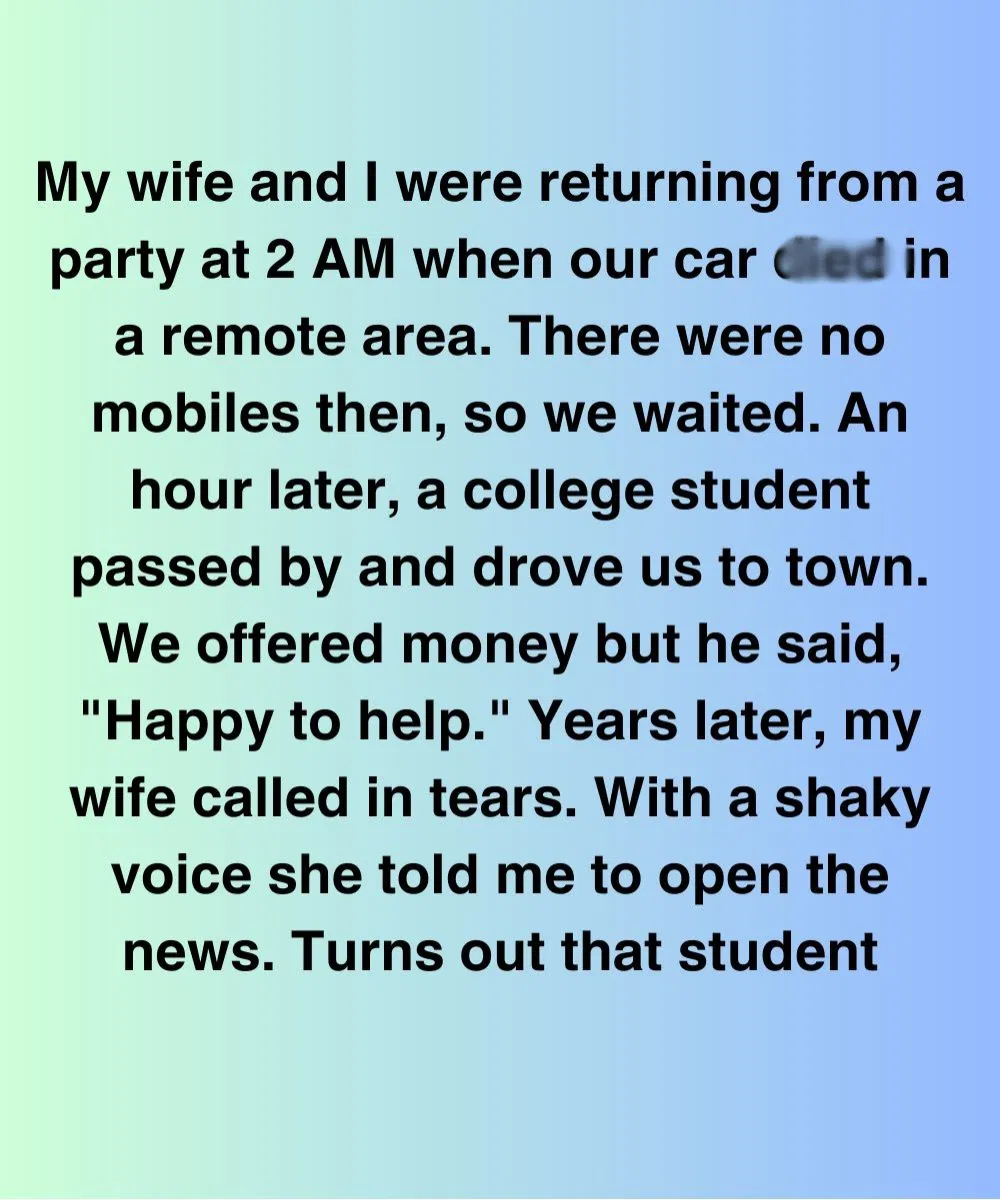
We were driving home late one evening when our car suddenly broke down. It was long before the age of cell phones, and there was no way to call for help. The road was deserted, the night was dark, and the quiet felt heavier with every passing minute.
Just as we began to panic, headlights appeared behind us. A young college student pulled over, rolled down his window, and asked if we needed assistance. Without hesitation, he offered us a ride into town. His friendly smile and calm voice immediately eased our worry.
There was nothing remarkable about what he did, and that is precisely what made it remarkable. He didn't know us. He owed us nothing. He simply saw two stranded strangers and stopped, the way decent people have done for one another since roads were invented.
When we tried to give him money to thank him, he simply shook his head and said something we would never forget: "Just pass it on."
Three Words That Stayed With Us
"Just pass it on."
Those three simple words stayed with us for years. They became a kind of family motto, invoked whenever we had the chance to help someone and whenever we needed a reason to be generous when it would have been easier not to be.
The philosophy is disarmingly simple. Kindness isn't a transaction to be repaid to its source. It's a current to be kept moving. The student didn't want our money because our money wasn't the point. The point was that the next stranded stranger, the next person in need, would encounter someone willing to stop, because we had been willing to remember.
We tried to live that way. We helped neighbors, gave rides, covered tabs, volunteered hours. None of it felt extraordinary. It felt like paying a debt we could never repay directly, so we repaid it sideways, into the world.
Though life eventually moved on and the memory of that night faded into the background of busy years, the habit it planted never left us.
A Familiar Face on the News
One afternoon, my wife called me at work, her voice trembling. "Turn on the news," she said.
I did, and there he was. The same young man who had once helped us on that dark road was now a doctor. But the story wasn't celebrating his achievements. It was honoring his bravery. He had lost his life while saving others during a tragic accident.
Seeing his face again brought tears to my eyes. The memory of that dark road and his selfless gesture came rushing back with overwhelming force. At that moment, I finally understood the full measure of the man we had met for perhaps twenty minutes on a night decades earlier.
He hadn't just been a kind stranger. He had been someone for whom helping others wasn't a choice but a character trait, so deeply ingrained that it defined his profession and, ultimately, his final act. The young man who stopped for two stranded strangers grew into a doctor who ran toward danger when others needed saving. The through-line of his life was service, from that roadside to his last moment.
Grief, Gratitude, and Resolve
Learning of his death hit us harder than we expected. We hadn't known his name for most of our lives. We had no photographs, no contact, no way to thank him properly. And yet his three words had shaped our family's values for decades.
In our grief, we found a renewed sense of purpose. If his life had been about passing kindness on, then the greatest tribute we could offer was to redouble our own commitment to it. We started volunteering more deliberately. We talked to our children about the stranger on the road, making sure the story, and its moral, would outlive us.
We also learned something about the strange mathematics of a good life. This man lived a relatively short life, yet its impact radiated outward in ways he never witnessed: through us, through our children, through every person we helped because he once helped us. How many lives did that one roadside stop eventually touch? Dozens? Hundreds? We'll never know, and neither did he. That's the nature of passed-on kindness. Its full accounting is invisible.
The Ripple Effect Is Real
Researchers who study prosocial behavior have confirmed what this story illustrates intuitively:
- Kindness is contagious: Witnessing or receiving help makes people significantly more likely to help others, creating chains of generosity that extend far beyond the original act.
- We underestimate our impact: Studies consistently show that helpers undervalue how much their actions matter to recipients, while recipients remember and are shaped by kindness for years.
- Small acts compound: A ride, a meal, a moment of attention: these seemingly minor interventions can alter the trajectory of someone's day, decisions, and even life philosophy.
- Legacy isn't about fame: The doctor on the news never knew he had changed our family. Most meaningful influence works this way, quietly, without recognition, through people who carry it forward.
Passing It On: A Practice for Everyone
You don't need a dramatic encounter to live this philosophy. The practice is beautifully ordinary:
- Help without keeping score, and resist turning kindness into a transaction.
- When someone thanks you, consider passing the credit forward: "Just do the same for someone else sometime."
- Notice the stranded, the struggling, the overlooked in your daily path. Proximity is opportunity.
- Teach the story, not just the rule. Children (and adults) internalize values through narratives like the stranger on the road far more than through lectures.
- Remember that you will rarely see the full results. Pass it on anyway.
Somewhere tonight, someone is broken down on a dark road, literal or metaphorical, waiting to learn whether strangers still stop. Because one young man stopped for us decades ago, and because we never forgot his three words, the answer in our family will always be yes.
Just pass it on.
Frequently Asked Questions
Is "pay it forward" kindness really contagious?
Yes. Multiple psychology studies demonstrate that observing or receiving kind acts increases the likelihood of the witness acting kindly toward others, a phenomenon sometimes called "moral elevation" or "prosocial contagion."
Why do small kindnesses matter so much to recipients?
Because they often arrive at moments of vulnerability, when the recipient feels alone or helpless. In those moments, a stranger's help carries disproportionate emotional weight and is remembered for years.
How can I teach my children to "pass it on"?
Tell them stories like this one, model helpful behavior consistently, involve them in volunteering, and when they receive kindness, help them think about how they might extend similar kindness to someone else.
Does the helper ever learn about the ripple effects?
Rarely, which is why this story is unusual. Most kindness ripples are invisible to their originators. The lesson is to act generously without needing to witness the outcome.
What is the best way to honor someone who lived generously?
By continuing their work. Donations in their name, volunteering for causes they cared about, and, most powerfully, adopting their philosophy of generosity as your own daily practice.



