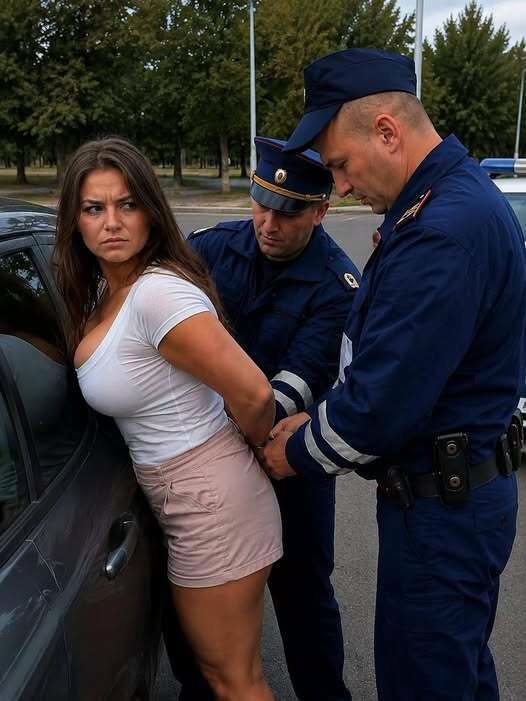
The Unexpected Traffic Stop That Took a Surprising Turn
What began as an ordinary traffic stop quickly became an unexpected situation for two police officers. Neither of them knew who they had pulled over. By the time they found out, everything had already been recorded, and the consequences would follow them long after the flashing lights faded.
The Stop
According to the story, the encounter started like countless others: a vehicle pulled over, officers approaching with questions, a driver asked to comply with instructions. Victoria, the driver, was questioned and treated as a regular motorist involved in a routine traffic stop.
But routine is a fragile thing. It depends on everyone playing the role assigned to them. And Victoria was not who the officers assumed she was.
The Discovery
One of the officers searched through a small leather case belonging to Victoria and discovered an official badge and identification card. The documents revealed that Victoria worked in Internal Affairs, the department responsible for reviewing allegations of police misconduct.
The discovery immediately changed the atmosphere at the scene.
Only moments earlier, the officers had been questioning Victoria and treating her as a regular driver. After seeing her credentials, however, they appeared to realize that their actions could be subject to an official review. The power dynamic inverted in an instant. The person they had been commanding was someone whose job was to judge whether commands like theirs were lawful.
The Shift in Behavior
The officers removed her handcuffs and began explaining their decisions. They reportedly insisted that they had been following standard procedures and that the situation had become more complicated than expected.
This sudden shift is the most telling part of the story. If the officers’ actions were truly standard procedure, the identity of the driver should not have mattered. The fact that their behavior changed so dramatically upon learning who she was suggests they knew, on some level, that their actions would not withstand scrutiny.
Victoria remained calm and focused on documenting what had taken place. She did not argue. She did not pull rank. She simply made sure the record was complete.
The Detail They Did Not Know
There was another important detail the officers apparently did not know about. The encounter had been recorded.
Victoria’s vehicle was recording the interaction, and her phone was also being used to document what happened. The recordings preserved important parts of the encounter, including the initial traffic stop, the officers’ instructions, and the subsequent detention. Because the recordings had already been backed up, the evidence could be reviewed later rather than relying only on the accounts of those involved.
This is the modern equalizer. A badge can change how officers behave in the moment, but a recording preserves how they behaved before they knew. The camera does not care about credentials. It simply records.
The Review
Supervisors eventually arrived and examined the circumstances surrounding the incident. The recordings reportedly became an important part of the review. Investigators examined whether there had been a valid reason for the escalation and whether the officers had followed proper procedures during the encounter.
This is how accountability is supposed to work: evidence reviewed dispassionately, procedures measured against standards, conclusions based on documentation rather than competing memories.
An Investigation Followed
The incident eventually led to disciplinary consequences.
According to the account, one officer lost his position and faced criminal allegations related to the incident. The second officer received significant disciplinary action and was placed under additional review.
These are severe outcomes, and they underscore how seriously the department treated the findings. An unjustified escalation, a detention without proper basis, and behavior that changed only when authority was recognized: together, they painted a picture the department could not ignore.
Why This Story Resonates
The case served as a reminder that police encounters can be examined carefully when questions arise about the use of authority or whether proper procedures were followed. But its deeper resonance comes from what it reveals about power:
- Authority should not depend on who you are. The officers’ correct behavior should not have required Victoria’s badge to trigger it.
- Documentation changes everything. Without recordings, this would have been conflicting accounts. With them, it was evidence.
- Composure is powerful. Victoria’s calm documentation accomplished more than confrontation ever could.
- Accountability protects everyone. Including the many officers who do their jobs properly and are undermined by those who do not.
The Power of Recording
For Victoria, the most important factor may have been that the encounter was documented. Rather than relying solely on memory or conflicting accounts, investigators had recordings that could be reviewed as part of the process.
This reflects a broader shift in how police encounters are understood. Dash cameras, body cameras, and civilian recordings have transformed accountability, creating records that protect both citizens and officers. When everyone knows an encounter may be reviewed, behavior improves on all sides.
Lessons for Everyone
What initially appeared to be a routine roadside encounter therefore became a much more serious matter. The discovery of Victoria’s professional credentials may have changed the officers’ understanding of the situation, but the recordings provided an independent record of what had already occurred.
The story ultimately highlights the importance of accountability, proper procedures, and accurate documentation when disputes arise during official encounters. Whether you carry a badge or not, the principles are the same: know your rights, stay calm, document what happens, and trust the process to examine the evidence fairly.
Frequently Asked Questions
What happened during the traffic stop?
Victoria was pulled over and treated as a regular driver, including being handcuffed. When officers found her Internal Affairs badge and ID in her leather case, their behavior changed dramatically.
What is Internal Affairs?
It is the department within a police agency responsible for investigating allegations of misconduct by officers. Learning the driver worked there meant the officers’ actions could face official review.
How was the encounter documented?
Victoria’s vehicle was recording the interaction and her phone was also documenting it. The recordings were backed up, preserving evidence of the stop, the officers’ instructions, and the detention.
What were the consequences for the officers?
According to the account, one officer lost his position and faced criminal allegations, while the second received significant disciplinary action and was placed under additional review.
What is the main lesson of the story?
That accountability matters: proper procedures should apply to everyone regardless of who they are, and accurate documentation through recordings provides an independent record when disputes arise.