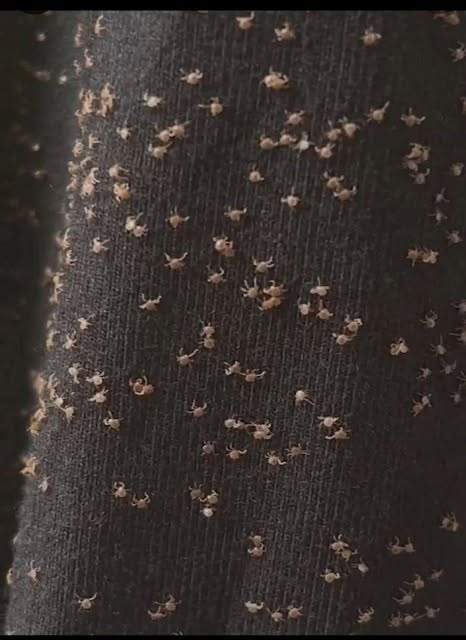
What began as a completely ordinary walk turned into an unexpected lesson about the fascinating ways plants survive and spread. After returning home from a stroll outdoors, I happened to glance down at my clothing and noticed something unusual. One side of my pant leg was covered with dozens of tiny dark objects that seemed to have appeared out of nowhere.
At first, I assumed they were simply bits of dirt, dried grass, or small pieces of debris picked up along the trail. Since outdoor walks often leave traces of nature behind, I didn’t think much of it. However, when I tried brushing them away, I quickly realized these tiny objects were holding on much more firmly than ordinary dirt would.
Curious, I took a closer look. The small objects appeared seed-like, but they were unlike any seeds I had seen before. Some were clustered together, while others were attached individually to the fabric. Their unusual shape and strong grip made them seem almost engineered to stick to clothing.
As I examined them, I started retracing my route in my mind. Earlier in the walk, I had passed through a narrow section of trail lined with tall grasses, weeds, and wild vegetation. In several spots, the plants brushed directly against my legs as I moved through. At the time, I barely noticed the contact and continued walking without a second thought.
The mystery became even more interesting when I checked my shoes. There, tangled among the laces and around the edges of the soles, were many more of the same tiny objects. Clearly, they had attached themselves during the walk, but I had never felt them making contact.
Wanting an answer, I showed a few of the samples to someone familiar with local plants. The explanation came immediately. The tiny objects were burrs, a type of seed pod produced by certain plants. Their purpose is surprisingly clever: they are designed to latch onto passing animals, clothing, and other surfaces so they can travel away from the parent plant.
This strategy is one of nature’s most effective methods of seed dispersal. Instead of relying solely on wind or water, these plants use movement as a transportation system. When a person or animal brushes past, the hooked seed pods cling to fur, feathers, or fabric. Eventually, they fall off in a different location, giving the plant a chance to grow in new areas.
Looking more closely at the burrs, it became easy to see why they were so difficult to remove. Many are covered in tiny hooks or barbs that catch on fibers with remarkable efficiency. Even though they are extremely small, their design allows them to stay attached through movement, weather, and long distances.
What seemed like a minor annoyance turned out to be a fascinating example of natural adaptation. The plants responsible for these seed pods have evolved a simple but highly effective way to increase their chances of survival. By hitching a ride on anything that passes by, they can spread their seeds far beyond the place where they originally grew.
Interestingly, burrs have even inspired human innovation. Scientists and engineers have studied the hook-and-loop mechanism found in certain seed pods, leading to ideas that influenced everyday fastening systems. Nature often provides solutions that are both simple and remarkably efficient.
The experience also served as a reminder of how much activity takes place in the natural world without us noticing. During the walk, I never felt the seeds attaching themselves, yet they had covered parts of my clothing by the time I arrived home. Small interactions like this happen constantly between plants, animals, and people, often without drawing attention.
What started as a puzzling discovery on a pant leg ultimately revealed a remarkable survival strategy that has existed for generations. The next time I walk through tall grass or along an overgrown trail, I’ll pay a little more attention to what might be quietly hitching a ride. Sometimes the most interesting lessons about nature come from the smallest things we encounter along the way.