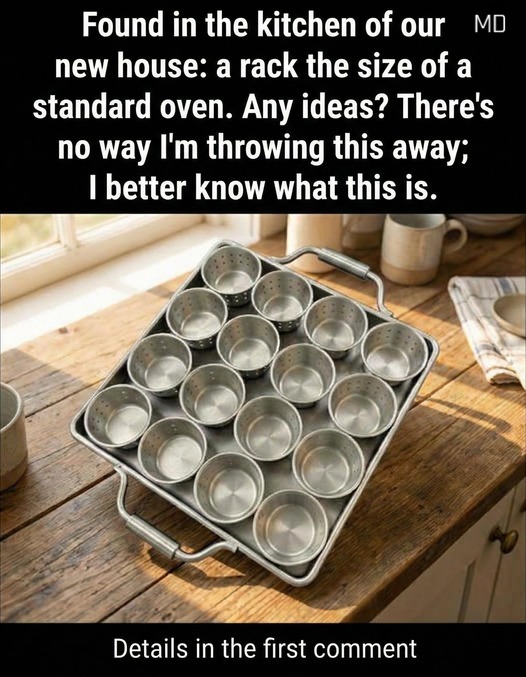
Unusual Oven-Sized Rack Found in Newly Purchased Kitchen Leaves Homeowners Searching for Answers
Buying a new home often comes with a mix of excitement, anticipation, and small surprises. From discovering hidden storage spaces to uncovering old paint colors beneath fresh coats, each house carries subtle reminders of its past. For one group of homeowners, however, their surprise came in the form of a mysterious metal rack left behind in the kitchen.
The Discovery
Shortly after moving in, they noticed the object tucked away inside a cabinet. Roughly the size of a standard oven rack, the metal piece featured evenly spaced ridges across its flat surface. It looked purposeful and sturdy, clearly designed for practical use, yet it did not resemble anything commonly found in modern kitchens.
At first, they assumed it might belong to one of the appliances in the house. They checked the oven, broiler, and warming drawer, but the rack did not fit any of them. It was not part of the refrigerator or dishwasher either. The more they searched, the more puzzling the discovery became.
The Theories Multiply
The design hinted that it once served a functional role. The ridged surface suggested it could have supported something, perhaps trays, cookware, or food items. As the homeowners asked around, theories multiplied:
- A cooling rack for baked goods. Some friends speculated it might have been used for cooling large batches of cookies or bread. The ridged surface would allow air circulation underneath.
- Part of an older oven model. Others wondered if it belonged to a discontinued appliance no longer in production. Manufacturers change dimensions over the years, and a rack from a 1970s oven would not fit a modern one.
- A broiler or grill insert. The ridges could have been designed to elevate food above drippings.
- A vintage kitchen tool. Vintage kitchen enthusiasts offered additional theories rooted in how kitchens worked in previous decades.
In previous eras, kitchens contained specialized tools that have since vanished from common use. Before nonstick surfaces and multi-function appliances, cooks relied on a wider array of single-purpose implements, many of which would baffle a modern homeowner.
Why Old Houses Keep Secrets
This kind of mystery is more common than people realize. Houses accumulate objects the way attics accumulate dust: gradually, and without documentation. Previous owners leave things behind for reasons that made sense at the time:
- Appliances get replaced but accessories survive. The oven goes; its extra rack stays in the cabinet.
- "Might need it someday" thinking. Many people keep functional-looking objects indefinitely rather than discarding them.
- Estate and rental turnovers. When homes change hands quickly, leftover items get overlooked.
- Built-in obsolescence of knowledge. The person who knew what the rack was for may have moved away decades ago.
Every older home is a small museum of its previous occupants' lives, curated by accident and interpreted by strangers.
The Investigation: How to Identify Mystery Objects
The homeowners' search followed a pattern familiar to anyone who has tried to identify an unknown object:
- Check the obvious first. They tried fitting it into every appliance, the right first step.
- Ask people. Friends, neighbors, and especially longtime residents of the area often recognize objects from their own pasts.
- Consult enthusiasts. Vintage kitchen collectors, restoration forums, and antique appliance groups possess deep, specialized knowledge.
- Post photos online. Communities dedicated to identifying unknown objects can work remarkably fast, with thousands of eyes on a single image.
- Examine markings. Manufacturer stamps, patent numbers, or model codes can unlock an object's identity instantly.
The internet has transformed this process. What once required a trip to the library or a lucky encounter with an expert now takes a single well-photographed post.
The Most Likely Explanations
While the exact identity of this particular rack remains part of the mystery, objects matching this description most commonly turn out to be:
- An oven rack from a discontinued model, kept as a spare or forgotten during an appliance upgrade.
- A roasting or broiling rack designed to sit inside a larger pan, elevating meat above drippings.
- A commercial kitchen item that migrated into a home kitchen, common when restaurant workers bring home useful tools.
- A canning or preserving rack, used to keep jars elevated off the bottom of a water bath canner. The ridged design and oven-rack size fit this use well.
The canning theory deserves special attention. Water bath canners use racks to prevent jars from sitting directly on the heat source, and these racks are roughly oven-rack sized with ridged or wire surfaces. A previous owner who did home preserving could easily have stored it in a kitchen cabinet, where it waited years for new owners to puzzle over it.
The Charm of Household Mysteries
There is something delightful about a mystery with no stakes. Nobody was harmed by the unidentified rack. Nothing depended on solving it. It was simply a small, genuine puzzle embedded in daily life, the kind of thing that sparks conversations, invites theories, and connects new homeowners to the history of their house.
In an age when most questions are answered in seconds by a search engine, objects that resist immediate identification have a special charm. They remind us that the physical world still contains unknowns, that previous generations lived differently enough to leave artifacts we cannot name, and that curiosity is its own reward.
The homeowners may eventually identify the rack definitively, or it may remain pleasantly ambiguous, a conversation piece in a cabinet. Either way, it has already served a purpose its maker never intended: it made a new house feel like a home with a past.
Frequently Asked Questions
What did the homeowners find?
A sturdy metal rack roughly the size of a standard oven rack, with evenly spaced ridges across its flat surface, tucked inside a kitchen cabinet. It did not fit any of their appliances.
What are the leading theories about its purpose?
An oven rack from a discontinued appliance model, a roasting or broiling rack, a commercial kitchen item, or a canning rack for elevating jars in a water bath.
How can you identify a mystery household object?
Try fitting it with related items, check for manufacturer markings, ask longtime residents, consult enthusiast communities, and post clear photos to online identification forums.
Why do old houses contain unidentifiable objects?
Previous owners leave accessories behind during appliance upgrades, keep "might need it" items indefinitely, and take their knowledge of the objects with them when they move.