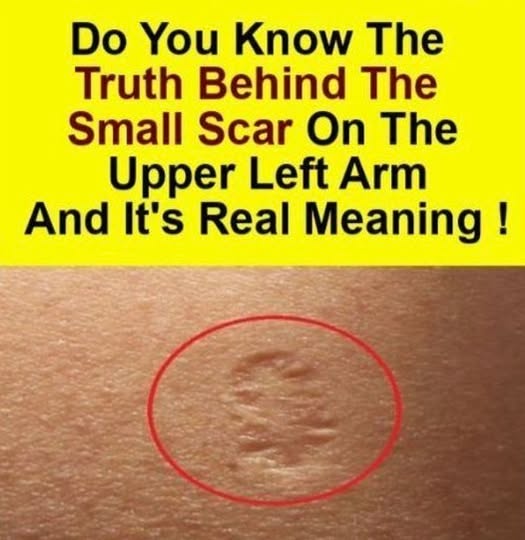
I have a vivid childhood memory of noticing a small but unusual scar on my mother’s upper arm.
It sat high near her shoulder, in a spot that felt intentional—visible enough to notice, yet easy to overlook. The scar wasn’t like the scrapes or marks children usually collect. It had a distinct pattern: a slightly larger circle in the center, surrounded by smaller indentations. Even at a young age, I sensed it wasn’t accidental.
There was something deliberate about it, almost as if it carried a story.
At the time, I didn’t know why that scar fascinated me so much. Children often fixate on details without understanding why. Maybe it was the symmetry, or maybe it was how different it looked from ordinary scars. Whatever the reason, I remember wondering what could have caused something so precise.
As childhood curiosities often do, the question eventually faded. The scar stayed exactly the same, but my interest in it quietly disappeared. Years passed, and I stopped thinking about it altogether.
Until one unexpected moment brought it all rushing back.
Several years ago, I was helping an elderly woman step off a train. As she steadied herself by holding my arm, I noticed her upper arm—and there it was. The same scar. Same location. Same unmistakable circular pattern.
The sight stopped me cold.
Seeing that familiar mark on someone else made it clear this wasn’t unique to my mother. It was something shared, something intentional, and something rooted in history. I wanted to ask the woman about it, but the moment passed too quickly.
So instead, I called my mother.
When I described what I had seen, she laughed and told me she had explained it to me before—more than once, apparently. The scar, she said, was from the smallpox vaccine.
That simple answer opened the door to a much larger story.
A Disease That Once Shaped the World
Smallpox was once one of the most dangerous diseases known to humanity. Caused by the variola virus, it spread easily and often with devastating consequences. Early symptoms included fever, fatigue, and severe body aches, followed by a rash that turned into painful, fluid-filled blisters.
Many people who survived were left with permanent scars, and some lost their eyesight. For centuries, smallpox affected entire populations, influenced wars, and altered the course of history. Fear of outbreaks was constant, and families and communities could be devastated in a matter of weeks.
Everything changed with the development of the smallpox vaccine.
Unlike most modern vaccines, the smallpox vaccine used a related virus called vaccinia. This virus trained the immune system to recognize and fight smallpox without causing the disease itself. Through coordinated global vaccination efforts, smallpox cases steadily declined.
By the early 1950s, the disease had been eliminated in many countries. Routine vaccination continued for several more decades, but by the early 1970s, it was no longer necessary for the general public. In 1980, smallpox became the first human disease ever declared completely eradicated worldwide.
Why the Vaccine Left a Scar
For people born before the early 1970s, the smallpox vaccine was a routine part of childhood—and it almost always left a permanent mark.
The reason lies in how the vaccine was administered. Instead of a single injection into muscle, the vaccine was applied to the skin using a special two-pronged needle. The needle made several quick punctures in the surface of the skin, delivering the vaccine just below the outer layer.
This process triggered a localized reaction. Over the following days, a small bump formed, then developed into a blister. Eventually, it scabbed over and healed. This visible reaction was expected and indicated that the vaccine was working.
When the scab finally fell off, it left behind a scar. While the exact size and shape varied, most scars shared the same general look: a round indentation, sometimes surrounded by smaller marks from the needle.
That scar rarely faded completely.
A Quiet Reminder of Progress
Today, smallpox vaccine scars serve as physical reminders of a battle humanity won.
In an age where many once-deadly diseases are no longer part of everyday life, it’s easy to forget how vulnerable people once were. That small circular mark tells a story of fear, resilience, and global cooperation. It represents decades of research, trust in science, and collective effort across borders.
What once seemed mysterious to me as a child now feels meaningful.
When I see that familiar scar—on my mother’s arm or someone else’s—I don’t just see an old mark on the skin. I see a chapter of medical history. I see proof of what coordinated public health efforts can achieve.
And I’m reminded that sometimes, history isn’t only written in books. Sometimes, it’s quietly carried with us, etched into the skin, lasting long after the danger has passed.