It began as something so small it almost didn’t seem worth noticing.
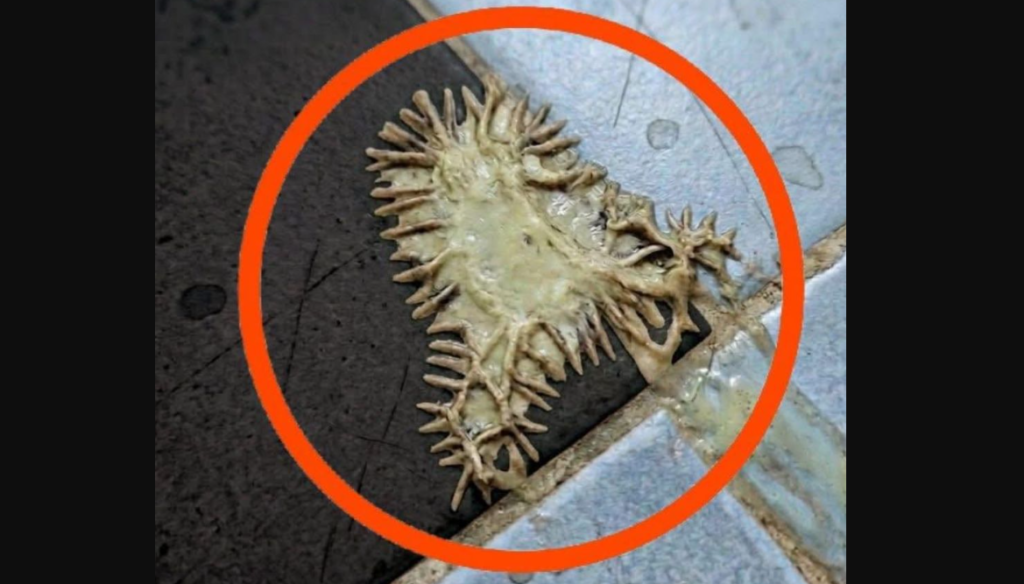
On the cold, smooth tiles of our bathroom floor sat a strange, shapeless patch—quiet, still, and completely out of place. At first glance, it looked like nothing more than a damp spot. But something about it didn’t sit right. It didn’t belong there, and the longer we looked at it, the more unsettling it became.
My girlfriend and I found ourselves standing in silence, staring at it far longer than two rational adults probably should. We expected one of us to quickly identify it, to laugh it off and move on. But that moment never came.
Instead, questions started forming.
What exactly was it?
The shape was irregular, slightly raised, and had an unusual texture that made it look almost organic. It didn’t resemble anything we were used to seeing in a clean, well-maintained bathroom. The more we examined it, the less confident we became.
Naturally, our minds began filling in the gaps.
At first, the theories were reasonable. Maybe it was mold. Bathrooms are prone to moisture, after all. But then the thoughts started drifting into more uncomfortable territory. Could it be something growing from inside the walls? A sign of hidden damage? Or worse, something potentially harmful?
Each new idea seemed more unsettling than the last.
It’s interesting how quickly uncertainty can shift your perspective. Just minutes earlier, the bathroom had been a completely ordinary space—familiar, predictable, safe. But now, it felt different. The presence of something unknown had quietly changed the atmosphere.
Even though part of us recognized we might be overreacting, that didn’t make the feeling go away. In fact, the lack of clear answers only made it stronger.
We circled around the spot, careful not to get too close, as if distance alone could somehow protect us. My girlfriend voiced concerns about possible toxins or hidden structural issues. I tried to reassure her, suggesting it was probably something harmless. But if I’m being honest, I wasn’t entirely convinced myself.
Because the truth is, the discomfort didn’t come from what the object was.
It came from not knowing.
When there’s a gap in understanding, the human mind has a tendency to fill it—and not always with calm, logical explanations. Instead, it often jumps to worst-case scenarios. What we were experiencing wasn’t really about the object on the floor. It was about uncertainty taking control of our imagination.
Eventually, curiosity outweighed hesitation.
We decided to take a closer look and do a bit of research. After comparing what we saw with reliable information, we finally arrived at an answer.
It was a type of slime mold.
Despite its unusual appearance, it turned out to be harmless—something that can occasionally appear in damp indoor environments. While it may look strange or even concerning at first, it doesn’t pose a significant risk in most cases.
The relief didn’t come instantly, but it did come.
Once we understood what we were dealing with, the tension in the room slowly faded. What had felt mysterious and unsettling just moments before now seemed almost trivial. We cleaned the area thoroughly, made sure the space was well-ventilated, and took a few simple steps to reduce excess moisture.
Before long, we were laughing.
Not at the situation itself, but at how far our imaginations had taken us. Two grown adults, completely thrown off by a small, harmless patch on the floor.
But even after everything was cleaned and back to normal, something about the experience stayed with me.
It was a subtle but powerful reminder of how fragile our sense of certainty can be. We like to believe we understand our surroundings, especially in familiar places like our own homes. But all it takes is one unexpected detail to challenge that confidence.
The unfamiliar has a way of standing out.
It interrupts routine, demands attention, and forces us to question what we thought we knew. And until we find an explanation, that uncertainty can feel far more significant than the reality itself.
Now, every time I step into that bathroom, I catch myself glancing at the floor.
Not because I expect to see anything unusual again—but because the experience changed something small in the way I see that space. It’s no longer just a bathroom. It’s a reminder that even the most ordinary environments can surprise you.
And sometimes, those surprises say less about the world around us—and more about how we respond when we don’t have all the answers.