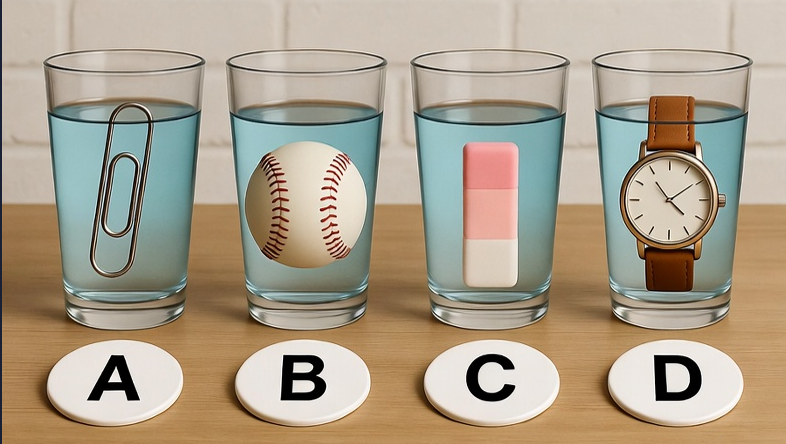
Visual puzzles have a unique way of grabbing attention. At first glance, they seem simple, but a closer look often reveals an interesting twist. One popular brain teaser asks a straightforward question: Which glass actually contains the most water?
Four identical glasses are lined up side by side, each filled to the same visible water level. Inside every glass sits a different object:
- Glass A contains a paperclip
- Glass B contains a baseball
- Glass C contains an eraser
- Glass D contains a wristwatch
Although the water levels appear equal, only one glass truly holds the greatest amount of water.
The Science Behind the Puzzle
The key to solving this riddle lies in a simple scientific principle called displacement.
When an object is placed into water, it takes up space inside the container. That means the object pushes water aside, reducing the amount of water the glass can actually hold. The larger the object, the more space it occupies, and the less room remains for water.
The Correct Answer
Glass A holds the most water.
The paperclip is the smallest object among the four choices, so it displaces the least amount of water. Because it takes up very little space, more water can remain inside the glass.
By contrast, the baseball in Glass B occupies a large amount of space, meaning that glass contains the least water despite looking full from the outside.
Why This Puzzle Tricks So Many People
This visual riddle is effective because our brains naturally focus on appearances first. Since all four glasses seem equally full, many people assume they contain the same amount of water.
However, once you consider the size of the objects inside each glass, the answer becomes much clearer. The puzzle reminds us that surface appearances do not always tell the full story.
What Your Choice Might Say About Your Thinking Style
While the puzzle has one scientifically correct answer, people often choose differently based on how they approach problems. That is part of what makes these riddles so entertaining.
Glass A — The Careful Thinker
People who choose Glass A often pay close attention to detail and prefer logical reasoning over first impressions. They enjoy analyzing problems carefully before reaching conclusions.
Glass B — The Quick Decision-Maker
Choosing Glass B may reflect confidence in instinct and fast judgment. These individuals often trust what they see immediately and feel comfortable making rapid decisions.
Glass C — The Flexible Problem Solver
Those drawn to Glass C may prefer keeping several possibilities open before deciding. They tend to adapt easily and are willing to reconsider their ideas when new information appears.
Glass D — The Creative Interpreter
People who pick Glass D are often imaginative and thoughtful. They may focus on symbolism or emotional meaning as much as practical details.
Why Brain Teasers Like This Become So Popular
Simple visual puzzles spread quickly because they are fun, easy to share, and encourage conversation. They challenge people to slow down, think critically, and look beyond what seems obvious.
More importantly, they highlight an important real-world lesson: small details can completely change the outcome of a situation.
Whether you solved the puzzle instantly or needed a moment to think it through, the value comes from the process itself. Puzzles like this encourage curiosity, observation, and careful reasoning — skills that are useful far beyond a simple glass of water.
So, did you choose Glass A?