A Clever Riddle That Left the Internet Scratching Its Head
From optical illusions to wordplay challenges, the internet has no shortage of puzzles that test how carefully we read and think. One particular riddle has recently gained traction online, not because it is complex, but because it quietly plays on our assumptions. It is only three sentences long, and it has stumped millions.
The Riddle
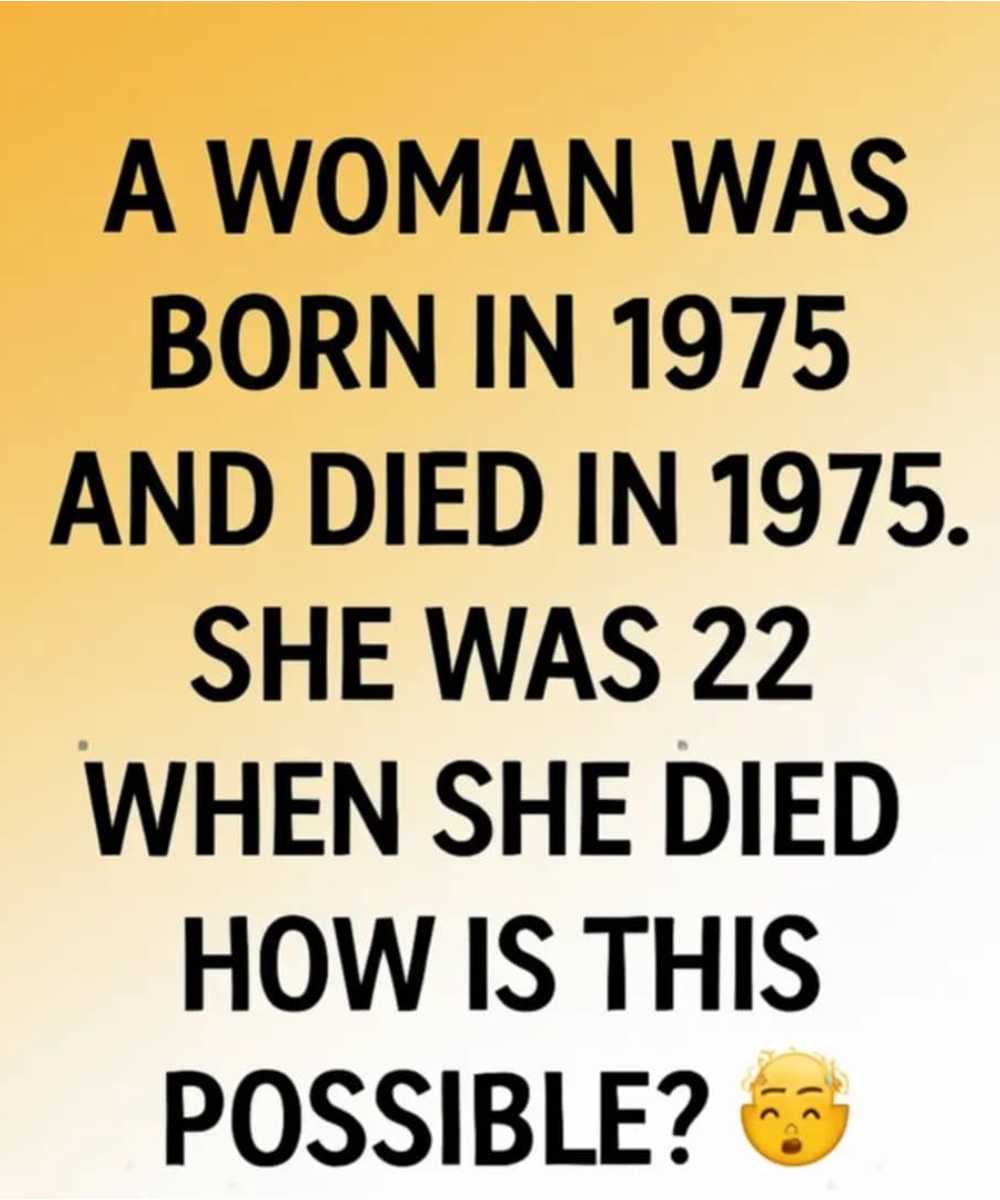
A woman was born in 1975 and died in 1975. She was 22 years old when she died. How can this be true?
At first glance, the statement feels impossible. Most readers immediately assume that “1975” refers to a calendar year. If that were the case, the woman could not have lived long enough to reach adulthood, let alone the age of 22. This apparent contradiction quickly caught the attention of puzzle lovers and casual readers alike, sparking debates and countless guesses across social media platforms.
The Guesses
Before the answer made the rounds, the theories were wonderfully creative. Some speculated about time zones, as if crossing the international date line could somehow add 22 years. Others wondered if it involved different calendars, perhaps a lunar calendar or some historical dating system where the numbers worked out differently. A few even suggested it was a trick question with no real answer, a paradox designed to have no solution.
Comment sections filled with increasingly elaborate explanations. People did math. People cited relativistic time dilation. People argued passionately about whether the riddle was fair. The more impossible it seemed, the more people needed to solve it.
The Answer
But the solution turns out to be much simpler, and much more clever.
The key lies in understanding that the number 1975 is not being used as a year at all. Instead, it refers to a hospital room number. The woman was born in Room 1975 and, years later, passed away in the same room at the age of 22. Once this detail is revealed, the riddle suddenly makes perfect sense.
There is a quiet poignancy in the answer that most solvers miss in their rush to feel clever. A woman begins and ends her life in the same hospital room, 22 years apart. The riddle is a trick, but the image it leaves behind is unexpectedly moving.
Why It Works So Well
What makes this puzzle so effective is how naturally our minds jump to conclusions. We are conditioned to associate four-digit numbers with years, especially when they appear alongside words like “born” and “died.” The riddle takes advantage of that habit, using simple wording to guide readers toward an incorrect assumption.
This is a textbook example of a cognitive shortcut at work. Our brains are prediction machines, constantly filling in gaps with the most likely interpretation. When we see “born in 1975,” the year interpretation is so overwhelmingly likely that we never even consider alternatives. The riddle does not lie to us. It simply lets us lie to ourselves.
Other classic riddles use the same technique:
- The surgeon riddle: A father and son are in a crash. The surgeon says “I can’t operate, he’s my son!” The surgeon is his mother. It exposes gender assumptions.
- The light bulb riddle: How do you get a giraffe into a refrigerator? You open the door. It exposes overcomplication.
- The rooster riddle: A rooster lays an egg on a roof peak. Which way does it roll? Roosters don’t lay eggs. It exposes inattentive reading.
Each one works by letting the solver’s own assumptions do the heavy lifting.
The Deeper Lesson
Beyond being entertaining, puzzles like this serve as a reminder of how important careful reading can be. A small shift in perspective, or a closer look at the details, can completely change the meaning of a statement. What initially feels confusing or impossible often becomes clear once we question our first interpretation.
This skill matters far beyond riddles. In everyday life, we misread contracts, skim important emails, and jump to conclusions in arguments, all because our brains prefer the fast, familiar interpretation over the careful one. The riddle is a low stakes workout for the mental muscle of slowing down.
How to Get Better at Riddles
If this one stumped you, here are strategies that help with the whole genre:
- Question every assumption. Ask yourself what you are taking for granted. In this riddle, the assumption was “1975 = year.”
- Read literally. Riddles are precise. Every word is chosen deliberately, and the trick usually hides in the most innocent looking word.
- Consider alternate meanings. Numbers can be room numbers, addresses, or quantities. Words like “born” and “died” describe events, not dates.
- Resist the elaborate. The simplest explanation that fits all the facts is usually the answer. Time zones and relativity are red herrings your brain invents.
- Sleep on it. Stepping away lets your brain drop its first interpretation and try fresh ones.
Sharing the Fun
Part of what made this riddle go viral is how shareable it is. It takes five seconds to read, it seems impossible, and the answer produces a genuine “oh!” moment. That combination is social media gold. The best riddles are not just puzzles. They are tiny stories, and this one, with its hospital room bookending a 22 year life, is more storylike than most.
So the next time someone sends you a riddle that seems impossible, remember Room 1975. The answer is probably simpler than you think, hiding in an assumption you did not know you made.
Frequently Asked Questions
What is the answer to the 1975 riddle?
The number 1975 refers to a hospital room number, not a year. The woman was born in Room 1975 and died in the same room at age 22.
Why do most people get it wrong?
Because our brains automatically interpret four-digit numbers next to “born” and “died” as calendar years. The riddle exploits this deeply ingrained assumption.
Is this riddle fair?
Yes. It contains no false statements. Every word is true under the correct interpretation. The trick is entirely in the solver’s assumptions, which is what makes it clever rather than cheap.
What is the lesson behind the riddle?
That careful reading and questioning assumptions can resolve apparent impossibilities. Small shifts in perspective often reveal answers hiding in plain sight.
Are there similar riddles?
Yes. Classics like the surgeon riddle (“the surgeon is the boy’s mother”) and the rooster riddle (“roosters don’t lay eggs”) use the same technique of exploiting unexamined assumptions.