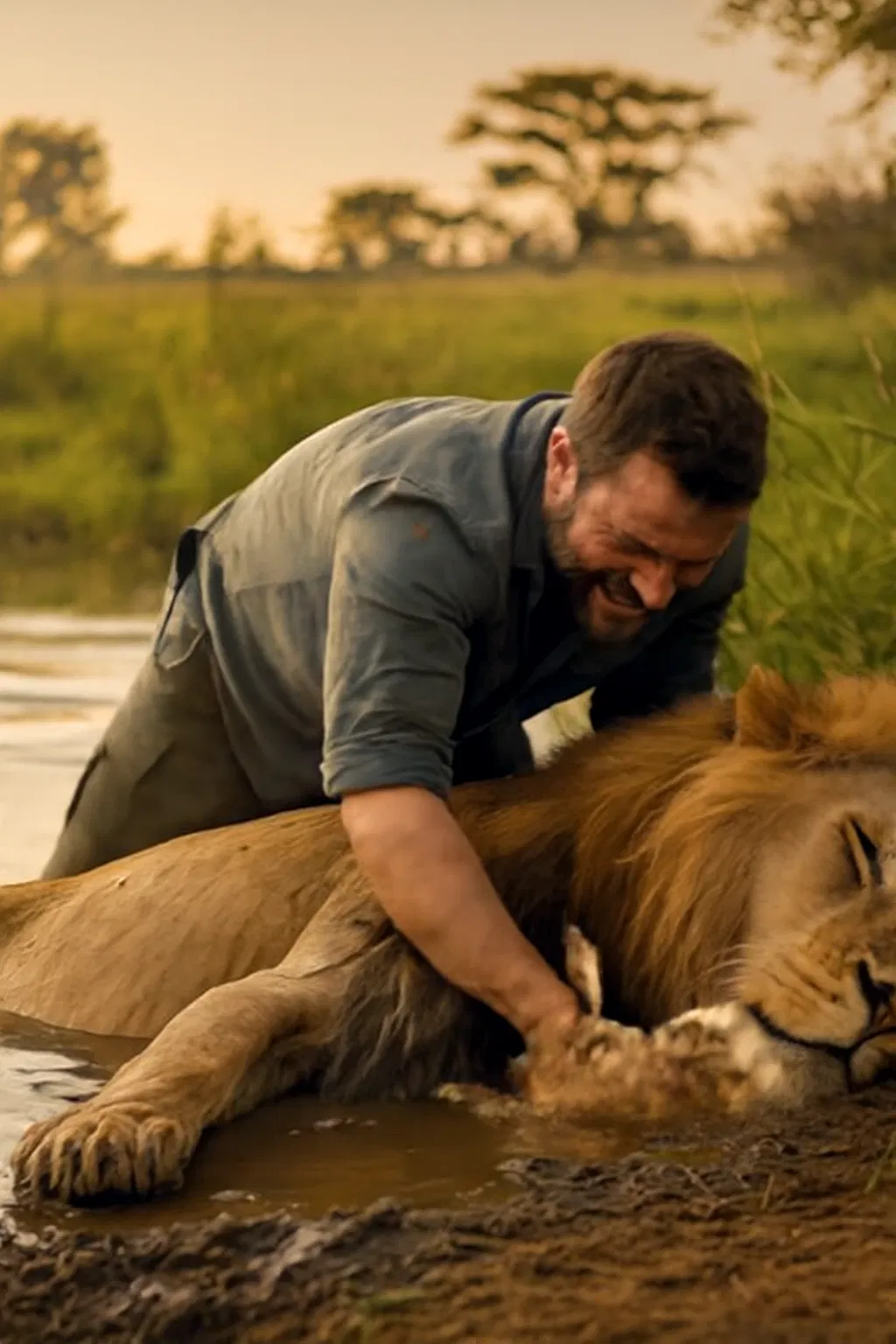
A Man Saved a Drowning Lion: But What Happened Next Left Everyone Speechless
The African savannah glowed under the golden sunset as safari tourists made their way back to camp. Laughter and camera clicks filled the air, until a sudden movement near the river caught their attention. At first, it looked like a shifting shadow. But as they focused, gasps filled the silence. A lion, the majestic king of beasts, was struggling in the muddy waters, fighting to stay afloat.
A Desperate Struggle in the River
Lions are powerful swimmers, yet something was clearly wrong. This one appeared injured, weak, and moments away from drowning. While most froze in shock, one man acted without hesitation. Dropping his backpack and camera, he dove into the cold, rushing river.
The current was merciless, and the lion's soaked body was incredibly heavy. Still, the man refused to give up. Every muscle strained as he pulled the massive predator toward the riverbank. Finally, with a final burst of strength, he dragged the lion to shore. But the animal lay motionless, its chest still.
Fighting for the Lion's Life
Instead of stepping back, fearlessly, the man began cardiac massage. His hands pressed rhythmically against the lion's broad chest. Sweat dripped down his forehead, his muscles trembled from exhaustion, but he refused to stop. Minutes passed that felt like hours.
Then, miraculously, the lion drew a faint breath. Its massive body twitched. Slowly, the golden eyes of the predator opened.
An Unexpected Moment of Truth
The man's heart pounded. The lion, now on its feet, was standing just meters away. Every instinct screamed at him to run. A fully grown lion, revived and alert, is one of the most dangerous animals on earth. The tourists held their breath.
But the lion did not attack. It stood there, regarding the man who had pulled it from the water, and then it turned and walked slowly back toward the savannah. Some witnesses would later describe the moment as recognition, as if the great cat understood what had happened. Whether that interpretation is accurate or simply the story humans needed to tell, the outcome was the same: both man and lion walked away alive.
Why a Lion Would Be Drowning
Lions are capable swimmers, so a drowning lion signals that something was seriously wrong. Wildlife experts note several possibilities:
- Injury. A wounded lion, perhaps from a territorial fight with another male, would struggle to swim effectively.
- Exhaustion. A lion that fell into a fast-moving river far from a safe crossing point could tire quickly.
- Illness. Disease weakens even the strongest animals, impairing coordination and stamina.
- Age. An older lion past its prime is far more vulnerable to exactly this kind of crisis.
A soaked lion is also far heavier than it looks. A large male can weigh over 400 pounds, and waterlogged fur adds enormously to that burden. Pulling such an animal from a current is a feat of extraordinary strength and determination.
What Wildlife Experts Want You to Know
Stories like this are thrilling, but conservationists are quick to add an important caveat: do not try this yourself. Approaching a distressed wild predator is extraordinarily dangerous, and in most African countries, interfering with wildlife can also violate park regulations designed to protect both animals and visitors.
If you encounter a wild animal in distress on safari:
- Alert your guide immediately. Trained guides know how to assess the situation and who to contact.
- Do not enter the water. Rivers in lion territory also host crocodiles and hippos, both of which kill more people each year than lions do.
- Keep your distance. A suffering animal is unpredictable, and even normally calm wildlife can lash out.
- Contact park authorities. Rangers and wildlife veterinarians are equipped to intervene safely.
The man in this story acted on pure instinct, and it worked out. But instinct is not a safety protocol, and experts stress that the right move is almost always to get professionals involved.
The Science of Animal Gratitude
The most debated part of the story is the ending: the lion's calm departure instead of an attack. Can a wild animal recognize a rescuer? The honest answer is that we do not fully know.
What researchers can say:
- Lions are highly intelligent with excellent memories for individuals and experiences.
- Animals in shock behave unpredictably. The lion's calm may have reflected exhaustion and disorientation rather than gratitude.
- There are documented cases of wild animals showing remarkable tolerance toward humans who helped them, from elephants to dolphins to big cats.
- Anthropomorphism is a risk. Humans naturally interpret animal behavior through human emotions, which does not always reflect what the animal experienced.
Whatever the lion understood in that moment, the image of predator and rescuer regarding each other in the golden light is one that stays with people. Sometimes a story endures not because every detail is explainable, but because it touches something deeper about courage and compassion.
Why Stories Like This Captivate Us
The drowning lion story contains everything the human mind finds irresistible: mortal danger, selfless courage, a brush with the wild, and an ending that feels almost scripted. It reverses the usual safari narrative, in which humans observe and animals perform. Here, the human entered the animal's world on the animal's terms, and both survived.
It also satisfies a deep human longing: the idea that kindness is recognized across the boundary of species. Whether or not the lion "understood," the man acted as if it might, and that choice is what makes the story worth telling.
Frequently Asked Questions
Can lions swim?
Yes, lions are capable swimmers, though they generally avoid water. A drowning lion is a sign that something is wrong, such as injury, illness, exhaustion, or old age.
Is it safe to rescue a wild lion?
No. Approaching a distressed wild predator is extremely dangerous. Experts advise alerting guides and park authorities rather than intervening directly.
Do animals recognize people who help them?
There are documented cases of wild animals showing tolerance toward human rescuers, but scientists caution against assuming human-like gratitude. The behavior may reflect shock, exhaustion, or habituation rather than recognition.
What should you do if you see a wild animal in distress on safari?
Stay back, alert your guide immediately, and let rangers or wildlife veterinarians handle the situation. Never enter the water or approach the animal yourself.