Most families describe their holiday traditions with laughter and noise—crowded tables, familiar recipes, songs sung year after year. Ours was different. It was quiet. Consistent. And for a long time, I didn’t understand its purpose.
Every Christmas Eve, my mother prepared a full holiday meal in our small apartment. She spent hours moving through the narrow kitchen, humming softly as she worked from stove to counter. There was always a glazed ham, mashed potatoes rich with butter, green beans cooked with bits of bacon, and warm cornbread wrapped carefully in foil to keep in the heat.
She set the table the same way every year. But one plate never stayed with us.
When I was young, I finally asked her about it. I watched from a chair as she filled the extra plate with care.
“That one isn’t for us,” she said gently. “It’s for someone who needs it.”
She spoke as if this were the most natural thing in the world.
A Quiet Walk on Christmas Eve
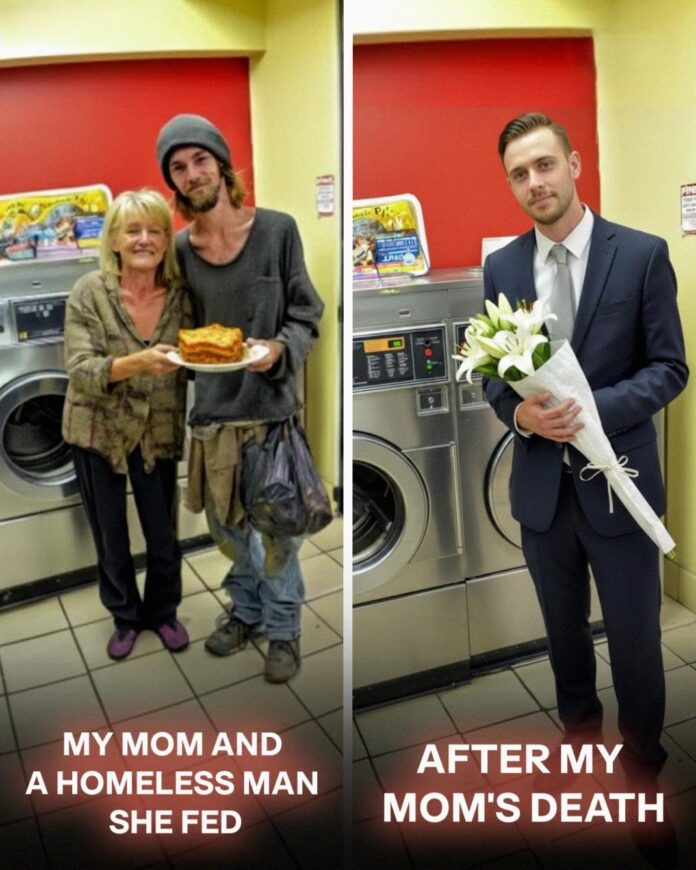
At the end of our street was a small laundromat that stayed open through the night. Its windows glowed against the dark, and the steady hum of machines carried into the cold air. That was where a young man named Eli spent his nights.
He kept to himself. He carried a worn backpack and a small plastic bag. He never asked for help and tried hard not to draw attention to himself.
Every Christmas Eve, my mother and I walked there together. She carried the plate carefully, holding it as if it were fragile. When we reached Eli, she always knelt beside him before offering the meal.
“I brought you dinner,” she said.
And every year, his response was the same.
“Thank you, ma’am. You didn’t have to.”
Her reply never changed.
“I know. I wanted to.”
Once, I asked if she was ever afraid. She shook her head and told me that real danger wasn’t a polite person accepting a warm meal. Real danger, she said, was hunger mixed with the feeling of being invisible.
Lessons I Didn’t Know I Was Learning
Over time, Eli shared parts of his life. He talked about growing up in foster care, losing his sister, and how stability sometimes felt unfamiliar to him. My mother listened without judgment and without pressure.
She offered help when it felt appropriate, but she never pushed. If he said no, she respected it. And she kept showing up.
There were no lectures about kindness. No rules. Just repetition. The same walk. The same plate. The same quiet act of care.
For my mother, generosity wasn’t a special gesture—it was a way of living.
The First Christmas Without Her
Years later, my mother became ill, and our world grew quieter. When she was gone, the idea of Christmas Eve felt heavy. I considered skipping it altogether.
But her voice stayed with me.
“It’s for someone who needs it.”
So I cooked.
I followed her recipes as closely as I could. The kitchen felt empty without her humming. I wrapped the cornbread in foil the way she always had and made the walk down the street alone.
When I reached the laundromat, I hesitated. I didn’t know what I would find.
Eli was there—but not as I remembered him.
A Moment I’ll Never Forget
He stood near the doorway wearing a neatly pressed suit. In his hands was a small bundle of white lilies. For a moment, neither of us spoke.
Then he said my name.
He told me he had come to honor my mother. He explained that she had changed his life in ways I had never known.
As we talked, he shared something my mother had never mentioned.
Years earlier, at a crowded county fair, I had wandered away and unknowingly stepped into danger. Eli had seen it happen and pulled me back to safety.
My mother never told me.
Instead, she quietly stayed part of his life—encouraging him, supporting him, and helping him believe he deserved stability.
The suit he wore was his. So was the confidence.
Understanding the Full Meaning
We ate together that evening, mostly in silence. And for the first time, I truly understood what my mother had been doing all those years.
It wasn’t just about providing a meal. It was about dignity. About showing up. About returning care with care—without expecting recognition.
Through her quiet kindness, she helped someone rebuild their life. And along the way, she protected me too.
Family, I realized, isn’t defined only by blood. Sometimes it grows from presence, from compassion, from choosing to care again and again.
A Tradition That Lives On
That Christmas Eve changed the way I see generosity. It doesn’t always look dramatic. It doesn’t need attention. Often, it looks like a warm meal carried down a quiet street.
My mother’s tradition continues in how I move through the world now—in noticing people who are easy to overlook and choosing kindness even when it takes effort.
Every holiday season, I remember her words. And I remember Eli standing there with lilies, proof that small acts of compassion can travel farther than we ever expect.
Some traditions don’t need photographs.
They live on in the lives they touch.