
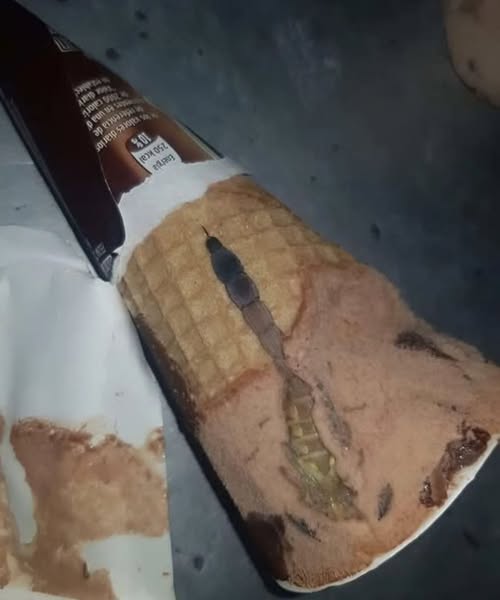
An Unexpected Discovery Inside a Familiar Ice Cream Treat
Yesterday afternoon unfolded like any other ordinary school day in our home. My daughter arrived back from class, set her backpack down near the door, and reached for a familiar after-school favorite: a chocolate ice cream cone she enjoys regularly. She unwrapped it with excitement, taking a moment to admire the crisp cone and smooth chocolate topping. Everything appeared completely normal.
After a few bites, she suddenly paused and called out to me. Her tone had changed, and I could tell something felt off.
Something Doesn't Belong
When I took a closer look, I noticed a dark spot deeper inside the ice cream. At first, it seemed like it could simply be a thicker section of chocolate or another ingredient. I suggested removing it so she could continue enjoying her snack.
However, once the item was pulled out, it became clear that it didn't belong there. The object was unfamiliar and clearly not part of the dessert. My daughter stepped away, feeling uneasy, and handed me the cone.
I felt surprised more than alarmed. It was unexpected to find something like that in a sealed, store-bought product, one we'd purchased without a second thought dozens of times before. The trust we place in familiar brands is so automatic that any crack in it feels disproportionately unsettling.
Handling It the Right Way
To handle the situation responsibly, I set the ice cream aside, took photos, and saved the packaging with its batch information. I then contacted the company's customer service team to explain what had happened.
The representative responded professionally, requested the images, and assured me the matter would be investigated. This is exactly the sequence food safety experts recommend, and it's worth spelling out because most people's first instinct is either to throw everything away in disgust or to post an angry photo online before documenting properly.
If you find a foreign object in food, do this:
- Stop eating immediately and keep everyone from consuming more of the product.
- Preserve the evidence: Save the product, the foreign object, and all packaging, including batch codes, expiration dates, and manufacturing information.
- Photograph everything before anything is moved or discarded: the object in place, the packaging, the labels.
- Contact the manufacturer through their official customer service channels. Provide the batch information and photos.
- Report to authorities if warranted: In the U.S., the FDA handles most packaged foods; local health departments handle restaurant issues. Serious cases, especially involving injury, should always be reported.
- See a doctor if anyone feels unwell or if there was any risk of injury, such as biting down on something hard or sharp.
- Keep records of all communications, reference numbers, and responses.
How Do Foreign Objects End Up in Sealed Food?
It's natural to wonder how something like this happens in an era of automated production and quality control. The reality of food manufacturing explains it:
- High-speed production: Modern food plants run at extraordinary speeds. Even with multiple inspection points, the sheer volume means rare misses occur.
- Ingredient supply chains: Contaminants sometimes enter with raw ingredients before they reach the main production line.
- Equipment wear: Gaskets, seals, screens, and machine parts degrade over time. A fragment of equipment can occasionally break off into product.
- Packaging materials: Bits of packaging, labels, or seals sometimes end up where they shouldn't.
- Human factors: Despite automation, people are involved at many stages, and people make mistakes.
This isn't a reason to distrust the food supply. It's a reason to understand that "rare" doesn't mean "never," and that proper reporting helps manufacturers find and fix the gaps.
What Companies Are Supposed to Do
Reputable food companies take foreign-object reports seriously, because the stakes, regulatory, legal, and reputational, are enormous. A proper response typically includes:
- Logging the complaint with batch traceability to identify the production run.
- Reviewing quality control records for that batch.
- Inspecting retained samples from the same production lot.
- Investigating the production line for equipment issues or process failures.
- Following up with the consumer about findings and corrective actions.
- Issuing a recall if investigation suggests the problem could affect other units.
When companies respond professionally, as in this case, it's a sign the system is working. The reports consumers file are a critical early-warning network that catches issues before they spread.
Talking to Kids About It
My daughter was uneasy, and understandably so. Finding something wrong in a favorite treat can shake a child's sense of safety around food. We talked it through honestly but calmly: this was unusual, we handled it the right way, the company is investigating, and most of the time food is perfectly fine.
It's tempting to either catastrophize ("we're never buying that again!") or dismiss ("it's nothing, forget about it"). The middle path, acknowledging the weirdness while modeling a calm, responsible response, teaches kids something valuable: when something goes wrong, you document, you report, you follow up. You don't panic, and you don't ignore it either.
The Bigger Picture
Every year, consumers discover foreign objects in food products, and the vast majority of cases are resolved quietly through exactly the process described here. The food safety system isn't perfect, but it has layers: manufacturer quality control, regulatory oversight, and the most distributed sensor network of all, millions of observant consumers.
Our ice cream incident ended undramatically, which is how these stories should end. The product was set aside, the photos were taken, the company was notified, and an investigation was promised. My daughter got a replacement treat (a different one, her choice), and life went on.
But I'll be checking the inside of the cone from now on. Some habits you pick up whether you want them or not.
Frequently Asked Questions
What should I do first if I find something strange in my food?
Stop eating, preserve the product and packaging with batch information, photograph everything, and contact the manufacturer's customer service. Seek medical attention if anyone may have been harmed.
Should I report it to the government or just the company?
Start with the company, but for serious cases, also report to the relevant authority (such as the FDA for packaged foods in the U.S.). Reports help regulators spot patterns across multiple complaints.
How common are foreign objects in food?
They're uncommon relative to the billions of units produced, but they do occur. Manufacturing at scale means rare failures happen, which is why quality systems and consumer reporting both matter.
Will the company compensate me?
Policies vary. Many companies offer coupons, replacements, or refunds as goodwill. If there was injury or illness, consult a professional about your options rather than accepting a quick settlement.
How can I reduce the risk for my family?
You can't eliminate it entirely, but checking food as you serve it, especially for children, keeping packaging until food is consumed, and buying from reputable manufacturers with strong safety records all help.



