I immediately became defensive.
“If this has anything to do with Noah having Down syndrome—”
“It doesn’t.”
“Then what is this about?”
My mother sat on the edge of my bed.
For several seconds, she couldn’t find the words.
Then she asked:
“Do you remember when your father left?”
“Of course.”
“You were twelve.”
“I know.”
She looked down at her hands.
“You stopped eating lunch.”
I froze.
“How do you know that?”
She looked at me.
“Noah told me.”
The Secret My Mother Had Kept for Years
I didn’t understand.
My mother explained that during the worst period of the divorce, she had once been sitting alone in her car in the school parking lot.
She had been crying.
She thought nobody could see her.
But Noah had seen her.
“He came over to me,” Mom said.
“What did he say?”
She swallowed.
“He asked me if you were broken.”
My throat tightened.
“Why would he ask that?”
“Because you weren’t eating. You weren’t laughing much. He said you were sitting alone more often.”
Suddenly, memories came rushing back.
The cafeteria.
The untouched food.
The quiet table.
Noah sitting beside me.
Sometimes talking.
Sometimes staying silent.
Never demanding an explanation.
My mother continued.
“I told him you weren’t broken.”
Then she reached for my hand.
“And he said something I’ve never forgotten.”
“What?”
Her eyes filled with tears.
“He said, ‘Good. Because I don’t know how to fix people. I only know how to stay.’”
I couldn’t speak.
For years, I had remembered those lunches.
But I had never known what Noah had noticed.
I had never known that my mother had seen it too.
The Promise I Never Knew About
Mom continued.
“That day, I asked Noah to promise me something.”
“What?”
“I asked him to look after you.”
I stared at her.
“You did what?”
“I was desperate, Christina.”
Her voice cracked.
“Your father was gone. You barely spoke to me. I felt like I was losing you too. Noah was one of the few people who could still make you smile.”
“What did he say?”
She gave a small laugh through her tears.
“He said, ‘Okay.’”
Of course he had.
Then my mother’s expression changed.
“There is something else I need to admit.”
I waited.
“For years, I made a mistake.”
“What mistake?”
“Whenever you defended Noah, whenever you changed plans because someone excluded him, whenever you chose to spend time with him, part of me worried.”
“Worried about what?”
“That you were giving up too much.”
I stared at her.
She continued.
“I kept thinking about everything Noah might need from you someday. I convinced myself I was protecting you.”
She looked down.
“But I wasn’t seeing your friendship clearly.”
The room became quiet.
“I was so focused on what Noah might need from you,” she said, “that I never stopped to notice everything he gives you.”
And suddenly, I saw our friendship differently too.
The ice cream after my driving test.
The ridiculous dinosaur drawing.
The quiet lunches.
The conversations about baseball.
The night he sat beside me after my first serious heartbreak.
The hundreds of ordinary moments nobody else knew about.
Noah had never been a responsibility I carried.
We had carried each other.
The Question I Asked My Mother
“So what’s your condition?” I finally asked.
Mom looked confused.
“You said I could go if I made you a promise.”
She smiled.
Then she took both my hands.
“Don’t go to prom because six-year-old Chrissy made a promise.”
I waited.
“Go because eighteen-year-old Christina chooses him.”
I smiled.
“Mom, that’s already why I’m going.”
Her expression softened.
“I know that now.”
Going Downstairs
When Mom and I finally returned downstairs, Noah was waiting exactly where we had left him.
He looked from me to Mom.
“You took a long time.”
I laughed.
Then Mom walked toward him.
“Noah, can I have the first dance?”
His eyebrows rose.
“Mrs. Jane, this isn’t prom.”
I burst out laughing.
Mom ignored him and turned on some music.
For the next few moments, Noah attempted to teach her how to dance around the living room.
She repeatedly stepped in the wrong direction.
Finally, Noah stopped.
“Mrs. Jane.”
“Yes?”
“Chrissy dances better.”
Mom laughed.
“That’s why she’s your date.”
Then her expression became serious.
She looked directly at him.
“Thank you for staying.”
Noah seemed confused by the seriousness of the statement.
To him, staying wasn’t extraordinary.
It was simply what friends did.
He shrugged.
“She stays too.”
My mother closed her eyes for a moment.
Those three words seemed to answer something she had been carrying for years.
The Prom Was Surprisingly Ordinary
Prom itself wasn’t dramatic.
Nobody made a speech about us.
Nobody stopped the music.
Nobody treated Noah like a symbol.
Nobody treated me like I had done something heroic.
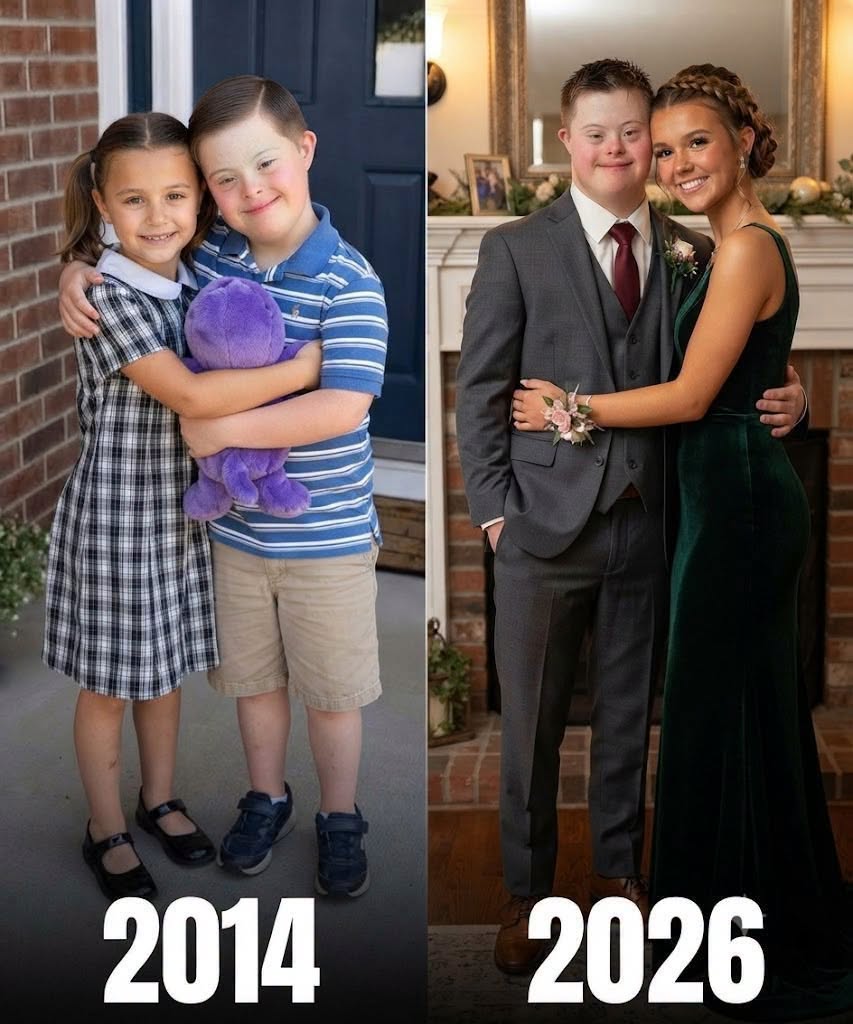
We were simply two eighteen-year-olds at prom.
And that was exactly how it should have been.
When the first slow song started, Noah turned toward me.
“Chrissy.”
“Yes?”
He held out his hand.
“You owe me.”
“Twelve years?”
“Twelve years.”
I took his hand.
Five seconds later, he stepped directly on my shoe.
“Ow!”
“That was your fault.”
“How?”
“Your dress is badly designed.”
“You’re terrible at dancing.”
“You knew that when you agreed.”
We both started laughing.
People nearby looked at us.
We didn’t care.
Standing there under the lights, surrounded by music and decorations, I realized something.
When we were six, Noah had asked whether somebody could love him.
I had never thought of him as a diagnosis.
I had never thought of myself as making a sacrifice.
He was simply Noah.
My best friend.
The boy who hated raisins.
The boy who remembered promises.
The person who stayed.
And now we were almost adults.
The world had become more complicated.
But our friendship didn’t have to be.
Nobody Was Rescuing Anybody
Mom picked us up after prom.
My feet hurt, so Noah carried my heels.
He was uncomfortable in his suit, so I carried his jacket.
When we reached the car, he opened the door for me.
I climbed inside.
Then I leaned across the back seat and opened his door.
He got in beside me.
From the driver’s seat, Mom watched us through the rearview mirror.
For years, she had looked at our friendship through a question many people instinctively ask:
Who is taking care of whom?
That night, she finally understood that it was the wrong question.
Nobody was rescuing anybody.
Nobody was staying because of guilt.
Nobody was fulfilling an obligation.
There was no hero.
There was no person waiting to be saved.
There were simply two friends who had grown up together.
Sometimes I carried Noah.
Sometimes Noah carried me.
Most of the time, we simply walked beside each other.
Maybe that was why our friendship had lasted.
Neither of us had been expected to become the other’s entire world.
We simply made room for each other in our own.
What Noah Had Understood All Along
On the drive home, Noah eventually fell asleep against the window.
His bow tie was crooked.
Mom glanced at him through the rearview mirror.
Then she looked at me.
I smiled.
No words were necessary.
For years, Mom had worried that I might confuse loyalty with obligation.
She had wondered whether I was sacrificing too much.
But she finally understood what Noah and I had known for a long time.
Real friendship isn’t measured by who needs more help.
It isn’t a balance sheet.
Kindness doesn’t always have to be immediately repaid.
There are seasons when one person gives more.
There are seasons when the other person does.
Sometimes friendship means showing up with two ice creams after a failed driving test.
Sometimes it means keeping an ugly dinosaur drawing in your locker.
Sometimes it means sitting beside someone who doesn’t know how to explain why she’s hurting.
And sometimes it means remembering a promise made over a box of raisins twelve years earlier.
Noah had said something when we were twelve that my mother never forgot:
“I don’t know how to fix people. I only know how to stay.”
Maybe that was the real lesson.
We spend so much of our lives trying to fix the people we love.
We search for perfect advice.
We look for the right words.
We want to find a solution that will make someone stop hurting.
But sometimes people don’t need us to fix them.
Sometimes they simply need to know they won’t have to face a difficult moment alone.
Noah understood that long before I did.
He couldn’t fix my parents’ divorce.
He couldn’t make my failed driving test disappear.
He couldn’t erase my heartbreak.
He couldn’t stop every cruel comment.
But he could stay long enough for those moments to stop feeling impossible.
And I stayed for him too.
The Promise Was Only the Beginning
My mother had once asked Noah to look after me.
But our friendship had never truly depended on that request.
The promise we made at six was real.
But the years that followed were made up of thousands of smaller choices.
We chose to remain friends.
We chose to forgive each other.
We chose to show up.
We chose to laugh.
We chose to make room for each other’s lives.
The prom promise mattered.
But the choices we made after that promise mattered even more.
Somewhere between raisins and dinosaurs, school lunches and baseball statistics, paintings and heartbreaks, we had chosen each other as friends.
And that choice kept happening.
Again and again.
Final Thoughts
Love and friendship don’t always look the way people expect.
Sometimes they aren’t dramatic.
Sometimes they aren’t about grand gestures or heroic sacrifices.
Sometimes they look like sitting quietly beside someone who is having a difficult day.
Sometimes they look like bringing two ice creams.
Sometimes they look like carrying someone’s shoes after a long night.
Sometimes they look like laughing after stepping on each other’s feet during a slow dance.
And sometimes, they look like keeping a promise made when you were six years old.
Noah taught me something I didn’t understand as a child:
You don’t always have to fix someone to help them. Sometimes, simply staying is enough.
And perhaps the greatest part of our story wasn’t that we kept the promise we made at six.
It was that twelve years later, we were still choosing to keep it.