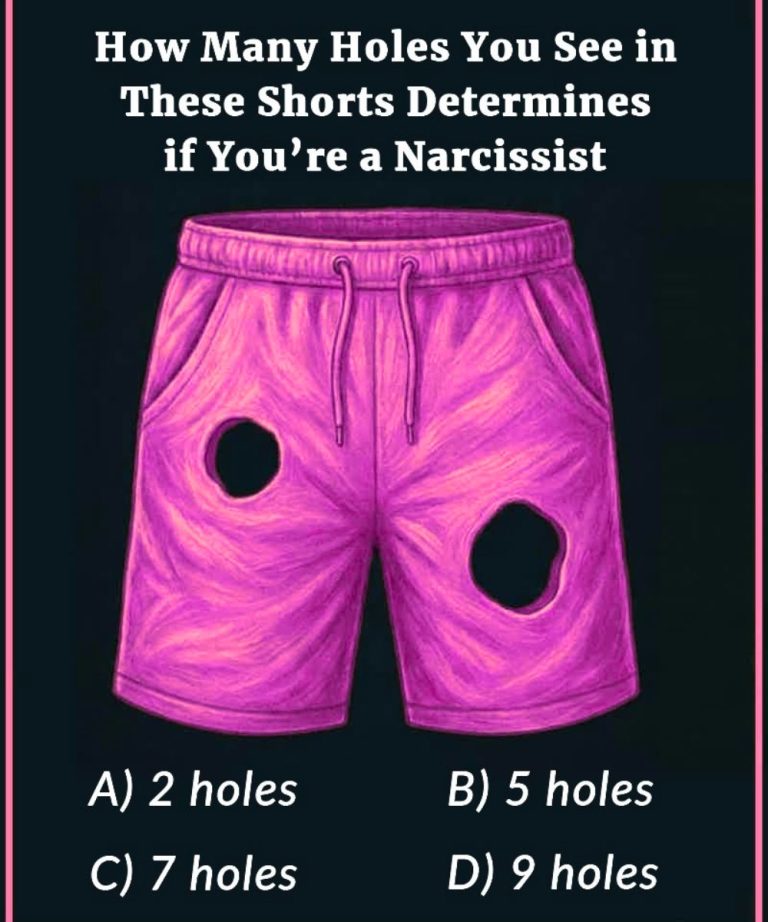
How Many Holes Do You See in These Shorts? This Viral Puzzle Says Something Interesting About You
At first glance, the viral image looks like nothing more than a pair of worn-out shorts. But the moment you are asked, "How many holes do you see?" everything shifts. This simple question has taken over social media because it challenges your perception and sparks instant debate. Although some eye-catching titles connect the answer to personality traits, the real purpose of this puzzle is much lighter: it shows how differently our brains interpret the same picture.
The Puzzle: How Many Holes Are Actually There?
Most people quickly answer 2, noticing only the obvious tears on each leg. That is the fast, first-impression response, the one your brain delivers almost automatically. But then someone mentions the waist opening, and the leg openings, and suddenly the number changes.
Let us break it down clearly:
- 2 torn holes in the fabric
- 2 leg openings at the bottom
- 1 waist opening at the top
That brings the count to 5.
Some people go even further. If each tear goes through both the front and back of the fabric, they count the front tear and the back tear separately, which can raise the total to 7 or even 9, depending on interpretation. This is where the fun begins, because everyone sees the image differently.
There is no single officially correct answer, which is precisely why the puzzle works. It exposes the assumptions hidden inside a simple question.
Why Your Brain Answers Too Fast
The reason most people say "2" is a well-documented feature of human cognition. Psychologists describe two modes of thinking:
- Fast thinking is automatic, intuitive, and effortless. It spots the two obvious rips and declares the job done.
- Slow thinking is deliberate, analytical, and effortful. It asks what counts as a "hole" and systematically examines the garment.
The puzzle is a trap for fast thinking. The question feels simple, so the brain answers quickly and confidently, and confidence is the enemy of reconsideration. Only when someone challenges the answer does slow thinking engage, and suddenly the waistband becomes relevant.
This is the same mechanism behind classic puzzles like the bat-and-ball problem and the Linda problem. Our brains are prediction machines optimized for speed, not precision. Most of the time, that tradeoff serves us well. In puzzles, it makes us confidently wrong.
What Your Answer May Say About Your Thinking Style
This puzzle is not meant to diagnose anything. Instead, it highlights how your mind naturally processes visual information. Think of it as a playful window into your cognitive habits:
- If you answered 2: You tend to trust first impressions and process visuals quickly. You are decisive and efficient, though you may occasionally miss details that slower examination would catch.
- If you answered 5: You naturally consider function and structure. You looked past the obvious damage and accounted for how the garment is actually constructed. You tend to think systematically.
- If you answered 7 or more: You think in three dimensions and question definitions. You considered that a tear through two layers of fabric might count twice. You are the person who asks what "hole" means before answering, which is either admirable rigor or delightful pedantry, depending on who you ask.
- If you refused to answer: You may have recognized the ambiguity immediately and declined to play a rigged game. Philosophers and lawyers tend to land here.
None of these is better than the others. They are simply different default settings, and the puzzle's value is in making those settings visible.
Why These Puzzles Go Viral
The shorts puzzle is one installment in a long lineage of viral perception challenges, from the dress that was blue and black (or white and gold) to the Yanny versus Laurel audio clip. They share a formula:
- A simple question with no obvious trick, which invites everyone to participate.
- Genuine disagreement, which drives comments, shares, and debates.
- Low barrier to entry. No expertise required. Anyone with eyes can play.
- Identity involvement. Your answer feels like it says something about you, which makes you want to share it and defend it.
- The reveal. Learning the fuller answer delivers a satisfying "aha" moment worth passing on.
Social media algorithms amplify all of this. Disagreement generates comments, comments generate reach, and reach generates more disagreement. The puzzle does not go viral despite the arguments. It goes viral because of them.
The Deeper Lesson: Ambiguity Is Everywhere
The shorts puzzle is trivial, but the skill it exercises is not. Much of real life consists of questions that seem simple but contain hidden ambiguities: What counts as a hole? What counts as success? What counts as fair?
People who do well with complex problems tend to share the habits the puzzle rewards:
- Questioning definitions before rushing to answers.
- Considering multiple perspectives, including the literal-minded 7-hole counter and the big-picture 5-hole thinker.
- Holding answers lightly, updating when new information (like the waist opening) arrives.
- Recognizing that confidence and correctness are different things.
The puzzle is a gym for the mind disguised as a meme. Every share, every argument in the comments, is someone practicing the art of thinking carefully about something small, which is the same art required for thinking carefully about something large.
Other Great Perception Puzzles to Try
If the shorts got you, these classics exercise the same mental muscles:
- The dress: Is it blue and black or white and gold? (A lesson in color perception and lighting assumptions.)
- Rubin's vase: Do you see a vase or two faces? (Figure-ground perception.)
- The Necker cube: A wireframe cube that flips orientation as you stare. (The brain imposing 3D structure on 2D images.)
- "How many triangles?" images: Counting puzzles that punish fast answers.
- The Stroop test: Say the color of the ink, not the word. (Fast thinking sabotaging slow thinking in real time.)
Frequently Asked Questions
How many holes are in the shorts?
The most reasoned answer is 5: two torn holes, two leg openings, and one waist opening. Some argue for 7 or 9 by counting front and back layers of the tears separately. Most people's first answer is 2.
What does my answer say about me?
Nothing diagnostic, but it hints at your thinking style. Quick "2" answers suggest fast, intuitive processing. "5" suggests systematic thinking. Higher counts suggest three-dimensional, definition-questioning thought.
Why do puzzles like this go viral?
They combine a simple question, genuine disagreement, low barriers to participation, and the satisfying reveal, all of which drive the comments and shares that algorithms reward.
Is there a trick to solving perception puzzles?
Slow down, question your definitions, and consider what you might be assuming. The trick is almost always in the assumptions, not in the image.