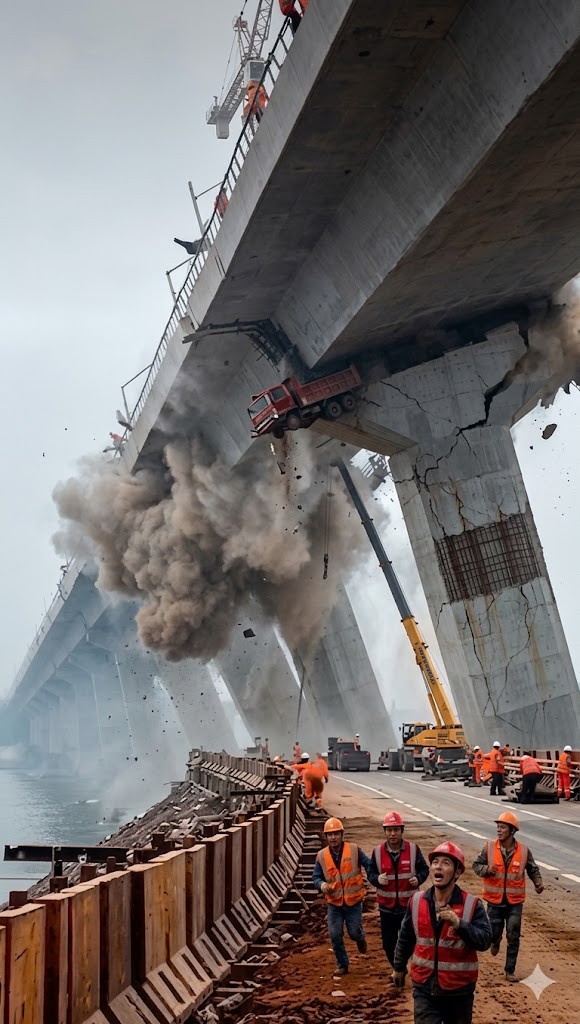
Powerful Earthquake Shakes Several Asian Regions
A strong 7.7-magnitude earthquake struck parts of Asia early Monday morning, causing concern across areas of Myanmar, northern Thailand, and southern China. The earthquake occurred during the early hours when many residents were asleep, leading to sudden evacuations and emergency alerts in several communities.
What Happened
According to early seismic reports, the epicenter was located near the China-Myanmar border in a mountainous area. Experts say the relatively shallow depth of the quake may have increased the intensity of the shaking in nearby regions.
A 7.7-magnitude earthquake is classified as a major earthquake. To put that in perspective:
- The energy released is roughly equivalent to hundreds of atomic bombs.
- Shaking from an earthquake this size can be felt hundreds of miles from the epicenter.
- Damage can be severe near the epicenter, especially where buildings are not designed to withstand strong shaking.
- Aftershocks, some potentially strong enough to cause additional damage, typically follow for days or weeks.
The shallow depth is a critical factor. Deeper earthquakes lose energy as seismic waves travel upward through the earth. Shallow earthquakes deliver more of their energy directly to the surface, producing more violent shaking in nearby communities.
Immediate Impact
Authorities and emergency response teams quickly began assessing the situation. Initial reports indicate damage to homes, roads, and public infrastructure, although full evaluations are still underway. Hospitals and local officials are assisting injured residents and supporting families affected by the disaster.
The timing, in the early morning hours when most people were asleep, complicated the initial response. Nighttime earthquakes are particularly dangerous because:
- People are disoriented when awakened by violent shaking.
- Darkness hampers evacuation and rescue efforts.
- Families may be separated in different rooms when the shaking starts.
- Communication networks are often disrupted, delaying warnings and coordination.
Rescue crews continue working in challenging conditions as they reach remote areas and inspect damaged structures. The mountainous terrain near the epicenter makes access difficult, with damaged roads and the risk of landslides, themselves often triggered by strong earthquakes, slowing the response.
Why This Region Is Seismically Active
The China-Myanmar border region sits in one of the world's most seismically active zones. The collision between the Indian Plate and the Eurasian Plate, the same tectonic forces that built the Himalayas, generates enormous stress along fault systems throughout Myanmar, southwestern China, and northern Thailand.
This region has a long history of destructive earthquakes. The Sagaing Fault, which runs north-south through Myanmar, is particularly notorious. Communities in this zone live with seismic risk as a permanent fact of life, which makes building standards, preparedness, and early warning systems matters of life and death.
Earthquakes of this strength can affect large regions, especially in places where buildings may not be fully designed for major seismic activity. In rural and mountainous areas, traditional construction, unreinforced masonry, adobe, and timber frames, can collapse catastrophically under strong shaking.
The Response Effort
Relief organizations, community volunteers, and emergency teams are coordinating efforts to provide assistance and restore essential services. Disaster response in this region typically involves multiple layers:
- Local first responders who begin search and rescue immediately, often with limited equipment.
- National emergency agencies deploying specialized teams, medical support, and supplies.
- International aid organizations providing expertise, funding, and coordination support.
- Community volunteers who often do the bulk of early relief work: distributing food and water, sheltering the displaced, and checking on vulnerable neighbors.
Officials are encouraging residents to remain cautious, avoid damaged buildings, and follow local safety instructions. This guidance is critical in the aftermath period, when aftershocks can collapse already-weakened structures and when damaged infrastructure poses ongoing hazards.
Authorities are expected to release additional updates as inspections and rescue operations continue.
Earthquake Safety: What Everyone Should Know
Whether you live in a seismic zone or are traveling in one, these fundamentals save lives:
During shaking:
- Drop to the ground, take cover under sturdy furniture, and hold on.
- Stay indoors if you are inside; most injuries come from falling objects and collapsing facades, not building collapse.
- If outdoors, move away from buildings, trees, and power lines.
- If driving, pull over in a clear area and stay in the vehicle.
After the shaking stops:
- Expect aftershocks. Some may be strong.
- Check yourself and others for injuries. Provide first aid where needed.
- Avoid damaged buildings. Do not re-enter until inspected.
- Check for gas leaks, electrical damage, and water line breaks.
- Use text messages rather than calls to avoid overwhelming networks.
- Follow official instructions from local authorities.
Preparedness before the next one:
- Secure heavy furniture, water heaters, and appliances to walls.
- Keep an emergency kit: water, food, flashlight, first aid, medications, important documents.
- Know how to shut off gas, water, and electricity.
- Identify safe spots in each room of your home.
- Practice drills with your family, especially children.
Frequently Asked Questions
What does a 7.7 magnitude mean?
The moment magnitude scale measures the energy released by an earthquake. A 7.7 is classified as a major earthquake, capable of causing serious damage over large areas. Each whole number increase represents roughly 32 times more energy released.
Why was this earthquake felt across multiple countries?
Large, shallow earthquakes generate seismic waves that travel great distances. A 7.7-magnitude event can produce noticeable shaking hundreds of miles from its epicenter, which is why Myanmar, northern Thailand, and southern China all felt its effects.
What are aftershocks and how long do they last?
Aftershocks are smaller earthquakes that follow the main event as the earth's crust adjusts. They can continue for days, weeks, or even months, gradually decreasing in frequency and strength. Large aftershocks can cause additional damage to weakened structures.
Why do shallow earthquakes cause more damage?
Seismic energy dissipates as it travels through rock. In a shallow earthquake, the energy has less distance to travel before reaching the surface, so more of it arrives intact, producing stronger shaking.
How can I help earthquake victims?
Donate to reputable relief organizations active in the region, avoid spreading unverified information on social media, and if traveling in affected areas, follow local authorities' guidance and avoid hindering rescue operations.
Is this region prone to future earthquakes?
Yes. The tectonic forces driving this earthquake are ongoing and permanent. Communities in this region should treat earthquake preparedness as a continuous priority, not a one-time response.