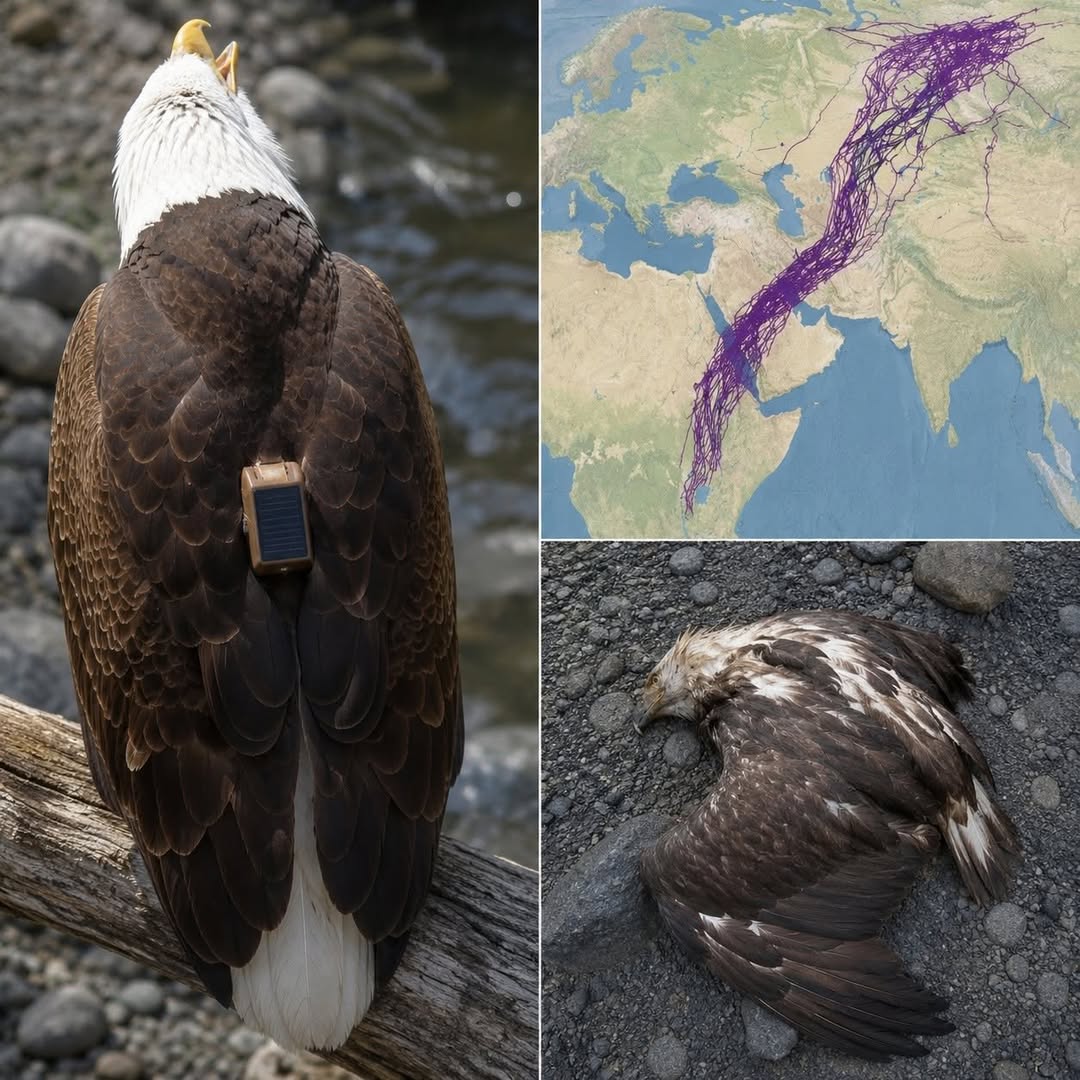
Scientists Tracked an Eagle for 20 Years: What They Discovered Changed Their Understanding of Migration
For more than two decades, a team of researchers followed the remarkable journey of an eagle equipped with a GPS tracking device. What they expected to be a routine study of migration patterns soon evolved into a fascinating scientific mystery that challenged long-held assumptions about how birds navigate the world.
A Study That Refused to Be Routine
At first, the eagle's movements seemed difficult to explain. Rather than following the well-documented migration routes typically observed in its species, the bird traveled across deserts, mountain ranges, coastlines, and vast stretches of open terrain in ways that appeared unusual and unpredictable.
Most migration studies run for a few years. Researchers tag birds, collect a few seasons of data, publish, and move on. Twenty years of continuous tracking of a single individual is extraordinarily rare. It requires the tag to keep working, the bird to keep surviving, and the research team to keep funding alive across decades. The payoff, as this study showed, is access to patterns invisible on shorter timescales.
The Puzzle in the Data
The tracking data revealed a complex network of routes spanning multiple regions. At times, the eagle revisited areas it had previously crossed, paused in locations that did not seem significant, and then continued its journey in unexpected directions. These behaviors left researchers searching for answers.
On a map, the first years of data looked almost random. The eagle ignored the “correct” flyways. It crossed terrain its species supposedly avoided. It lingered in places with no obvious resources and skipped places that should have been ideal. If migration were a simple matter of following an inherited route, this bird was doing it wrong.
Scientists explored several possible explanations. They examined whether changing weather conditions, shifting food sources, habitat changes, or unique behavioral traits could be influencing the eagle's decisions. Every piece of data was carefully analyzed in an effort to understand the bird's extraordinary travels.
The Pattern Emerges
As the years passed, the growing collection of GPS information painted an increasingly detailed picture. What initially looked like random movement began to reveal subtle patterns. Researchers noticed connections between the eagle's routes and environmental factors such as seasonal winds, temperature changes, geographic landscapes, and ecological conditions.
The findings suggested that the eagle was making highly adaptive decisions based on information available in its surroundings. Rather than following a fixed path, the bird appeared to adjust its travel strategy in response to changing conditions, allowing it to maximize efficiency and improve its chances of survival.
This is the key insight, and it's worth stating plainly: the eagle wasn't lost or confused. It was optimizing. What looked like wandering was actually sophisticated decision-making, responding to variables the researchers hadn't thought to measure in the early years.
How Eagles Actually Navigate
Modern ornithology has revealed that large raptors navigate using a remarkable toolkit:
- Thermal soaring. Eagles ride columns of rising warm air to gain altitude without flapping, saving enormous energy. Route choices often follow thermal availability, not geography.
- Wind patterns. Seasonal winds can make or break a journey. A smart bird adjusts its timing and path to catch favorable winds.
- Landmarks. Raptors use visual landmarks: coastlines, mountain ridges, rivers, which is why their routes often trace terrain features.
- Magnetic sensing. Many birds can detect Earth's magnetic field, providing a compass sense independent of visual cues.
- Experience. Older birds migrate more efficiently than younger ones, strongly suggesting that learning, not just instinct, shapes routes.
The tracked eagle was likely integrating all of these inputs continuously, producing a path that looked chaotic to humans watching a map but made perfect sense to a bird reading the sky.
Migration Is Not a Railroad Track
This discovery provided valuable insight into the complexity of wildlife behavior. It demonstrated that migration is not always a rigid process but can be far more flexible than previously believed. Animals may respond to environmental signals in sophisticated ways that are not immediately obvious to human observers.
The old model treated migration like a railroad track: inherited, fixed, repeated. The new model, supported by studies like this one, treats it more like sailing: the destination is known, but the route is negotiated continuously with wind, weather, and circumstance. Individual birds develop personal strategies. They learn. They adapt. They sometimes innovate.
This flexibility has profound implications for conservation. If birds depend on fixed corridors, protecting those corridors is enough. If they adapt dynamically to conditions, conservation must protect the underlying ecological flexibility: diverse habitats, intact wind patterns, and the freedom to adjust.
Why Long-Term Research Matters
The study also highlighted the importance of long-term research. Without decades of tracking data, these patterns might never have been detected. Short studies capture snapshots. Long studies capture lives.
Consider what the researchers would have concluded after three years: that this eagle was an outlier, possibly disoriented. After ten years, they might have suspected a pattern but lacked proof. Only at twenty years did the adaptive logic become undeniable. The eagle's journey offered scientists a rare opportunity to observe how an individual animal interacts with an ever-changing environment over an extended period.
This is an argument for patient science in an impatient funding world. Some questions can't be answered quickly. The eagle didn't reveal its secrets on anyone's schedule.
What This Means for How We See Nature
Today, the research serves as a reminder that nature often contains hidden layers of complexity. What may appear confusing or chaotic at first can reveal remarkable order when examined closely. The eagle's twenty-year journey continues to inspire scientists and wildlife enthusiasts alike, showing that there is still much to learn about the natural world and the creatures that inhabit it.
The next time you see a bird of prey circling high overhead, consider what it might know that you don't: the location of the next thermal, the shift in the wind, the memory of a route refined over decades. We share the sky with navigators of extraordinary sophistication. We're only beginning to read their maps.
Frequently Asked Questions
What did the 20-year eagle tracking study find?
That the eagle's seemingly random movements actually reflected sophisticated adaptive decision-making, adjusting routes based on winds, weather, terrain, and ecological conditions rather than following a fixed path.
How do eagles navigate during migration?
Using thermal soaring, wind patterns, visual landmarks, magnetic sensing, and accumulated experience. Older birds migrate more efficiently, indicating learning plays a major role.
Why was long-term tracking important?
Short-term data made the eagle look like an outlier. Only decades of data revealed the underlying adaptive logic, demonstrating that some natural patterns require patient, extended observation.
Is migration flexible or fixed?
Both. Many species have general migratory tendencies, but individual birds show remarkable flexibility, adjusting routes and timing to conditions. The rigid railroad-track model is outdated.
What are the conservation implications?
If birds adapt dynamically rather than following fixed corridors, conservation must protect ecological flexibility: diverse habitats and intact natural systems, not just narrow migration routes.