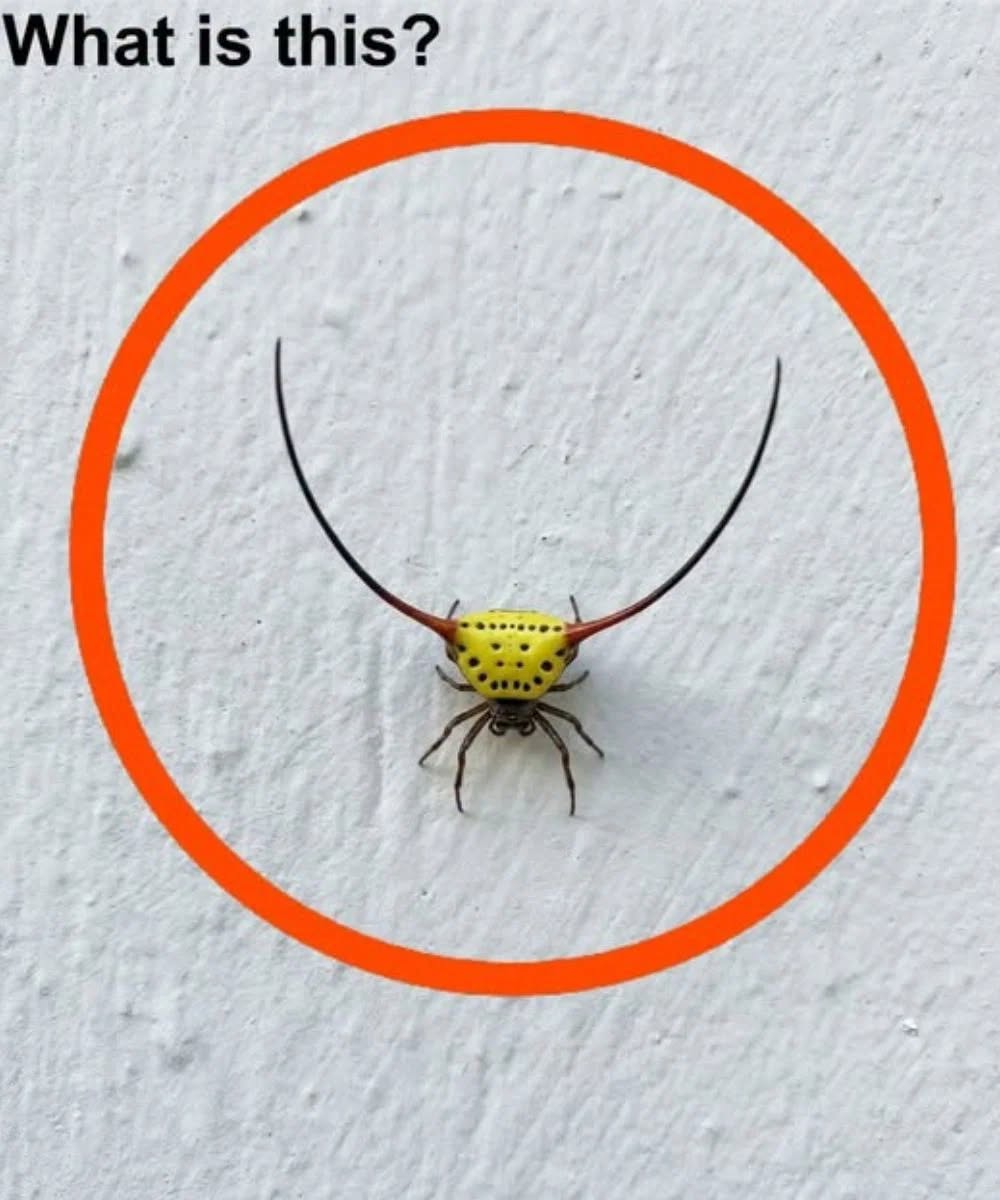
One quiet evening, I stepped into the garage and noticed something unusual attached to the wall. At first glance, it looked almost artificial, as though someone had placed a decorative object there.
The creature was bright yellow with black markings and several dark spines extending outward from its body. It remained completely still, making it difficult to determine exactly what it was.
Its unusual appearance immediately caught my attention. While it looked intimidating, the spider showed no signs of aggression or movement. Curious about the unexpected visitor, I decided to observe it from a safe distance.
After taking a photograph and researching the animal, I discovered that it was a spiny orb-weaver spider, a member of the Gasteracantha group. These spiders are known for their striking colors and distinctive spines, which help protect them from predators.
Spiny orb-weavers can display a variety of colors, including yellow, orange, red, and white, often combined with dark markings. Their unusual appearance serves as a natural defense mechanism, making them less appealing to birds and other animals.
Despite their dramatic look, these spiders are generally harmless to people. They spend most of their time building webs and capturing small flying insects. Like many spiders, they prefer to avoid human interaction and rarely cause problems when left undisturbed.
These spiders play an important role in local ecosystems by helping control insect populations. Their webs capture flies, mosquitoes, and other small insects, contributing to the natural balance of the environment.
When encountering an unfamiliar animal, it is always wise to observe from a safe distance and avoid handling it. Taking photographs and consulting reliable educational resources can help identify species accurately.
Unexpected encounters with wildlife often become valuable learning experiences. What initially appeared mysterious turned out to be a fascinating example of nature’s diversity and adaptation.
The appearance of the spiny orb-weaver served as a reminder that many creatures found around our homes play important ecological roles. Understanding these animals can replace uncertainty with appreciation and encourage greater awareness of the natural world.
This experience demonstrated how curiosity and careful observation can lead to new knowledge. Even ordinary surroundings can reveal remarkable examples of wildlife when we take the time to look closely.
The colorful spider eventually moved on, but the encounter left behind a greater appreciation for local species and the important roles they play in maintaining healthy ecosystems.