
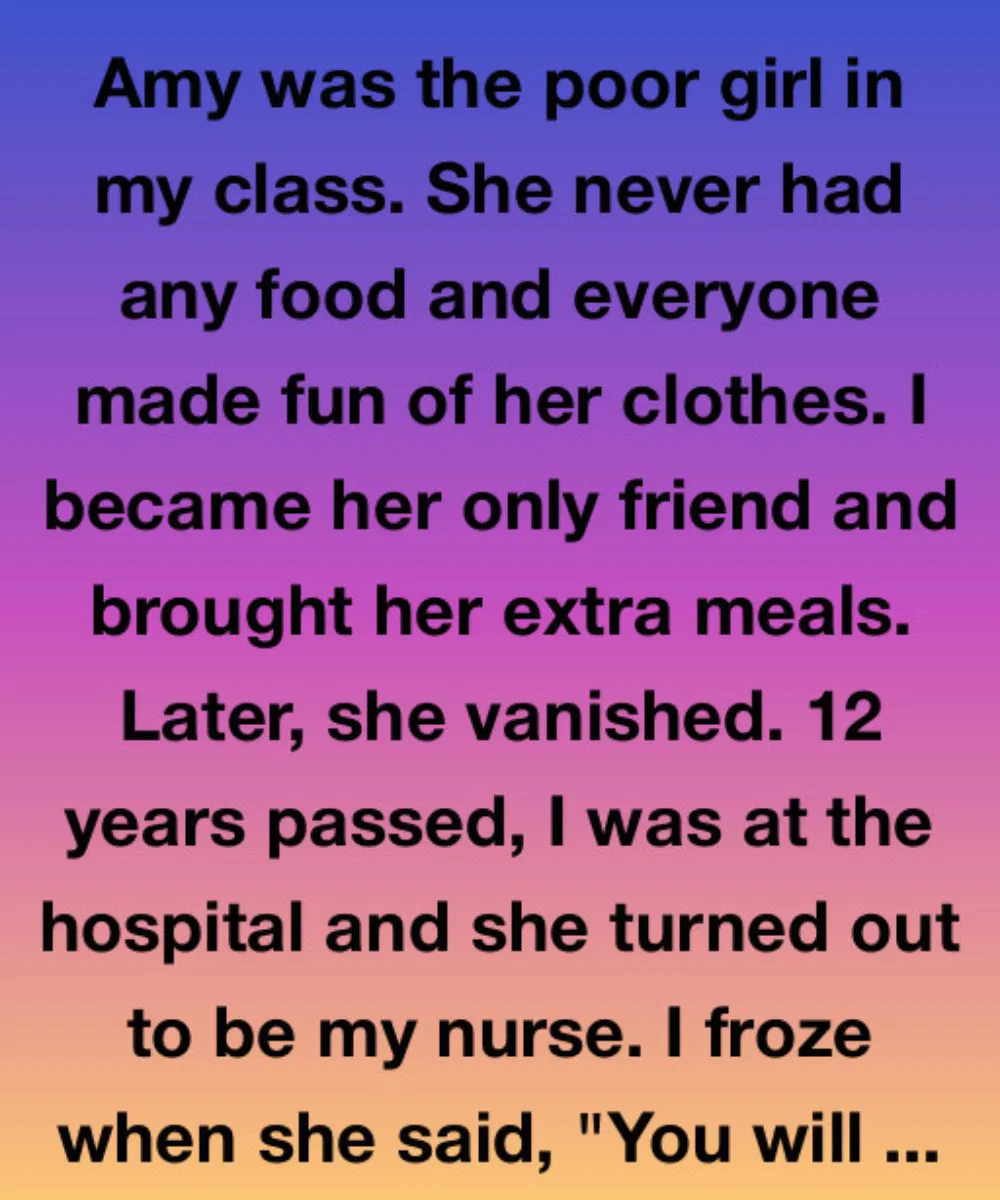
The Girl I Helped as a Child: And Who Saved Me Years Later
In fifth grade, there was a girl named Amy who was often overlooked. Her shoes were patched together with tape, her sleeves barely reached her wrists, and many days her lunchbox was empty. While other children whispered or laughed, I couldn't ignore the quiet ache in her eyes.
One afternoon, I noticed her pretending to chew, as though she had food. Without thinking twice, I slid half of my sandwich across the table. At first, she refused, but I insisted. Soon, it became a habit: I packed extra food just for her.
That small act of sharing turned into the start of a friendship that shaped both of our lives.
A Friendship Built on Small Kindnesses
Amy slowly opened up. Beneath her silence, she was witty, thoughtful, and incredibly talented. She loved to draw and once sketched a picture of the two of us swinging on the playground. I kept that drawing tucked inside my notebook for years, a small treasure from an unlikely friendship.
We never talked about why her lunchbox was empty or why her clothes were worn. Children understand more than adults credit them for, and Amy and I had an unspoken agreement: the sandwiches were just sandwiches, and we were just friends. That simplicity was its own kind of grace.
Looking back, I realize those lunchroom moments were teaching me something I wouldn't fully understand for decades. Kindness doesn't require a grand gesture or a perfect understanding of someone's circumstances. Sometimes it just requires noticing, and then doing the small, obvious thing.
The Empty Desk
Then one Monday, her desk was suddenly empty. She had moved away without a goodbye, leaving me to wonder what had become of her.
Anyone who has lost a childhood friend to a sudden move knows the particular ache of it. There is no closure, no farewell, just an absence where a person used to be. I kept the drawing. I kept packing, for a while, an extra half sandwich out of habit before remembering there was no one to give it to. Eventually, fifth grade ended, life moved on, and Amy became a warm memory I revisited less and less often.
I never forgot her, though. Some people leave a mark precisely because the time was short. Amy was one of those people for me.
Years Later: A Hospital Bed
Many years later, after surgery, I woke up in a hospital bed. Everything was foggy: the beeping monitors, the antiseptic smell, the disorienting float between sleep and waking. A nurse was gently adjusting my IV line and reassuring me that everything would be alright.
Something about her voice felt familiar. I couldn't place it through the haze of anesthesia, but it tugged at something deep. When she smiled and said, "I will never forget the time you helped me," recognition washed over me.
It was Amy.
The Reunion
She shared her journey: how her family's sudden move had forced her into new schools, how she had struggled, and how she had eventually found her calling in nursing. She told me she had never forgotten the kid who shared sandwiches without making her feel small about needing them. That memory, she said, had stayed with her through hard times, a proof that kindness existed in the world even when her own circumstances felt bleak.
And now, here she was, repaying that childhood kindness in the most literal way possible: caring for me when I was at my most vulnerable, adjusting my IV, monitoring my recovery, offering the calm reassurance that only a good nurse can give.
The symmetry of it left me speechless. The girl I had helped as a child had grown up to save me, or at least to shepherd me through one of the frightening passages of adult life, with skill and tenderness I will never forget.
What Goes Around: The Science of Kindness Ripples
Stories like this feel almost too perfect to be true, which is why they resonate so deeply. But researchers who study prosocial behavior say the underlying pattern is real and well documented.
- Kindness is remembered far longer than we expect. Studies on gratitude show that recipients of even small kindnesses remember them for years or decades, while givers consistently underestimate how much their actions mattered.
- Witnessed kindness spreads. Observing or recalling an act of generosity makes people more likely to act generously themselves, a phenomenon psychologists call moral elevation.
- Childhood experiences shape career callings. Many nurses, teachers, and social workers trace their vocation to a moment when someone showed them care during a vulnerable time. Amy's path from lunchroom recipient to hospital caregiver follows a pattern researchers see repeatedly.
- Giving benefits the giver too. Longitudinal studies link regular prosocial behavior to better mental health, stronger social connections, and even improved physical health outcomes for the giver.
My half sandwiches didn't just feed Amy. They planted something that grew, quietly, for decades, and eventually came back to me in a hospital room when I needed it most.
The Lesson I Keep Relearning
I think about Amy whenever I'm tempted to dismiss a small kindness as insignificant. We have no idea what our smallest actions set in motion. A shared sandwich in fifth grade became, twenty years later, a nurse's steady hands and a familiar voice saying everything would be alright.
We tend to think of our lives as linear: we help, we move on, the story ends. But lives are braided together in ways we rarely see. The people we help go on to help others, and sometimes, in the fullness of time, they come back to help us.
Pack the extra sandwich. You never know where it ends up.
Frequently Asked Questions
Do small acts of kindness really have long-term effects?
Yes. Research on gratitude and prosocial behavior consistently shows that even minor kindnesses are remembered by recipients for years and can influence their own behavior toward others, creating ripple effects the original giver never sees.
Why do givers underestimate their impact?
Psychologists call this the "underestimation effect." Givers focus on the awkwardness or smallness of the act, while recipients focus on the warmth and relief it provided. The two perspectives rarely match, with recipients valuing the act far more.
What is moral elevation?
It is the warm, uplifting feeling people experience when witnessing acts of kindness or courage. Studies show it motivates observers to perform kind acts themselves, which is how single good deeds spread through communities.
Can childhood experiences really shape career choices?
Absolutely. Many helping professionals cite formative experiences of receiving care as motivation for their careers. Positive early encounters with kindness can become a template for how a person wants to move through the world.
How can I teach my children the value of small kindnesses?
Model it consistently, narrate your own kind acts simply ("she looked hungry, so I shared"), and avoid making generosity performative. Children learn most from what they see adults do when no one is watching.



